Scientists found that aging muscle stops sending a molecular signal that suppresses tumor growth, and exercise can switch it back on

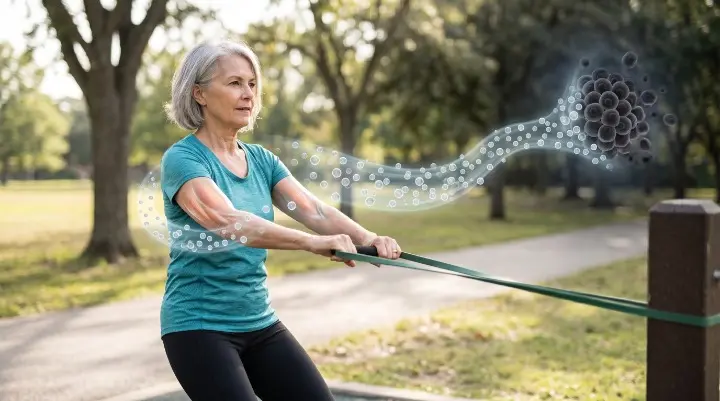
As people age, their muscles don’t just get weaker, they may also stop doing something that’s been quietly protecting them from cancer the whole time. A study published in Nature Communications by researchers at Duke-NUS Medical School in Singapore found that healthy muscle releases tiny molecular messages into the bloodstream that actively suppress tumor growth elsewhere in the body, and that aging muscle releases far fewer of them. The encouraging part: exercise turns the system back on.
The messages muscle sends
Every cell type releases extracellular vesicles, tiny membrane-bound parcels about 100 nanometers across that carry proteins, lipids, and genetic material to other cells. They’re one of the ways tissues talk to each other without direct contact. The Duke-NUS team, led by Assistant Professor Tang Hong-Wen, set out to understand what muscle specifically is saying through these parcels, and what happens to that message as muscle ages.
Using fruit flies and mice, they found that vesicles from young, healthy muscle traveled to gut tissue and reduced the overgrowth of stem cells that drives age-related tissue dysfunction, a step that matters because uncontrolled stem cell proliferation is one of the early conditions that can set the stage for cancer. Vesicles from old muscle largely failed to do this. The protective signal wasn’t completely absent, it was fading.
The effect held up directly against cancer cells too. When the researchers exposed colorectal, lung, and bile duct cancer cells in a dish to extracellular vesicles from healthy mouse muscle, the vesicles sharply reduced cancer cell numbers.
What’s actually inside the message
The team sequenced the cargo inside these vesicles to find out what was doing the protective work, and one molecule stood out. A microRNA called miR-7a-5p, a small piece of genetic material that helps control which proteins a cell produces, was abundant in vesicles from young muscle and scarce in vesicles from old muscle. miR-7a-5p has a known role in restraining the pathways that drive tumor growth. As muscle ages, the vesicles it releases don’t just become fewer in number, the protective cargo they carry thins out as well.
The researchers traced the control system behind this back to a signaling pathway called NOTCH-SDC2, which governs how muscle builds and releases these vesicles in the first place. As muscle ages, NOTCH-SDC2 activity declines, vesicle production and packaging become disrupted, and the tumor-suppressive signal that used to reach the rest of the body weakens.
Why exercise matters here specifically
This is where the finding becomes something more than a description of decline. The researchers found that the NOTCH-SDC2 pathway, and the vesicle output it controls, can be reactivated through exercise. Physical activity didn’t just preserve muscle mass in the traditional sense, it restored the muscle’s capacity to produce and release the protective vesicles that had dropped off with age.
“Muscle cells use extracellular vesicles to send messages and influence how other cells behave, but exactly how these messages are delivered and received is not fully understood,” Tang said. “Our research uncovers this hidden process, showing that as muscles weaken with age, these signals can change in ways that can promote tumor growth.”
Why this matters beyond the lab
The clinical relevance here connects to something oncologists have already noticed without fully understanding why: low muscle mass is associated with worse outcomes in cancer patients. Sarcopenia, the age-related loss of muscle mass and strength, affects roughly one in three adults over 60 in Singapore and is similarly common in aging populations worldwide. It’s typically discussed in terms of mobility, falls, and independence. This research adds a more direct mechanistic link to cancer risk specifically, not just a correlation between frailty and worse outcomes, but an active biological pathway connecting muscle health to tumor suppression.
The researchers are now planning to validate the findings in human tissue samples and investigate whether miR-7a-5p levels in these vesicles could serve as a measurable biomarker, a blood-based signal that could help identify which older adults face elevated cancer risk specifically due to muscle loss, well before a tumor develops.
What this doesn’t establish yet
This is animal and cell-culture research. The pathway and the cargo molecule are well characterized in mice and flies, but confirming the same mechanism operates the same way in humans, and confirming that exercise-driven changes in this specific pathway meaningfully reduce cancer risk in people, will require the human validation studies the team has planned next. What the study does establish clearly is a specific, traceable biological reason why physical activity in older adults might matter for cancer prevention beyond the general metabolic and inflammatory benefits exercise is already known for.
Sources:
Goh, K.Y., Lee, W.X., Gou, Q., Choy, S.M., Ong, S.C., Gopal Krishnan, P.D., Wang, H., Turqueza, L.R.R., Tan, Q.H., Chua, K., Li, S., Nishiyama, J., Harmston, N., Tang, H.W.
Sarcopenia promotes tumorigenesis by disrupting NOTCH-SDC2-regulated biogenesis of muscle-derived extracellular vesicles.
Nature Communications, 2026.
DOI: 10.1038/s41467-026-72410-y