For the first time, neuroscientists have mapped which individual brain cells encode word meaning, which handle grammar, and which track how sentences build, and an AI can read all three

Scientists listened to individual brain cells fire during natural conversation and found, for the first time, exactly which neurons produce language and what each one is responsible for
Every word you speak begins somewhere in the brain before it reaches your mouth. Neuroscientists have known for more than a century which broad regions of the brain are involved in language production, mapping them through strokes, lesions, and brain imaging studies that illuminate which areas go dark when speech is lost. What those tools cannot show is what individual cells within those regions are doing at the moment a word forms. Whether a single neuron encodes the meaning of a specific word, or the grammatical role it plays in a sentence, or the way that word connects to everything that came before it in the conversation, has remained beyond reach. Until now.
A team of researchers at Massachusetts General Hospital has done something that has never been done before in neuroscience. They recorded the activity of hundreds of individual neurons in the brains of eight people while those people had natural, free-flowing conversations, then used artificial intelligence models to decode what each neuron was actually encoding. What they found, published in Nature, is that language in the brain is organized as a precise division of labor at the cellular level, with different neurons assigned to different levels of linguistic structure simultaneously, and that the activity of those cells is specific enough that an AI trained on it can predict not just what words are being spoken but what they mean in context.
How they got inside the conversation
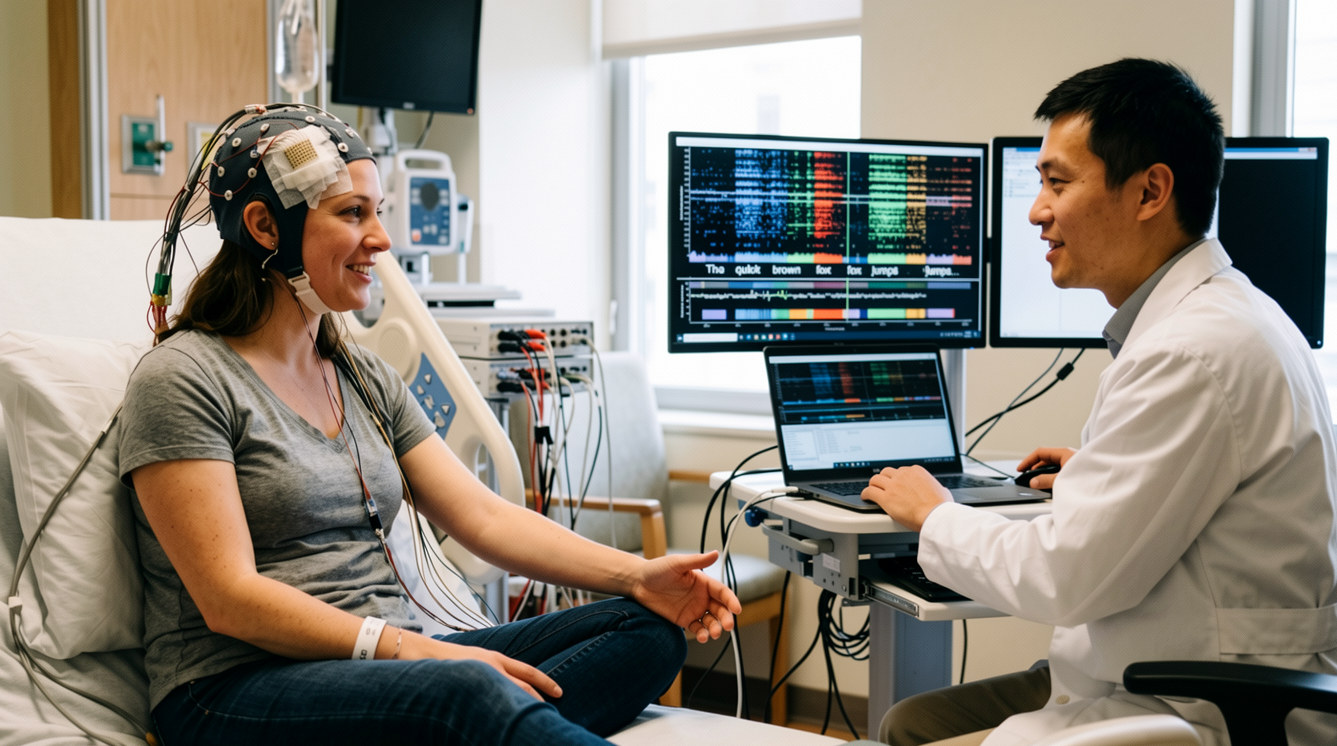
The technical barrier to this kind of research has always been access. Recording from individual neurons requires electrodes placed directly on or into brain tissue, a procedure that carries risks and is only justifiable when it serves a medical purpose. The opportunity that made this study possible came from epilepsy treatment. Eight patients at Massachusetts General Hospital had microelectrode arrays implanted in their brains for the clinical purpose of identifying where their seizures originated, a standard procedure in epilepsy care that requires continuous neural monitoring over a period of days.
The research team, led by Jing Cai, recognized this as a rare window. With patients’ consent, they conducted natural conversations with each participant during the monitoring period, spanning a wide range of topics across multiple sessions. They recorded these conversations with precision transcription, aligning every word and phrase to the millisecond-level activity of hundreds of neurons in the frontotemporal cortex, a region the team had previously linked to speech production.
From this aligned dataset, they asked a question that has never been answerable before: when a person is actively speaking, what is each of those neurons actually doing?
The division of labor
The answer that emerged from the data was not a uniform system but a structured hierarchy. The neurons the researchers recorded did not all respond to language in the same way. They fell into distinct functional categories based on what linguistic information they encoded.
Some neurons were tuned to the basic level of language: the meaning of individual words and the grammatical roles those words play in a sentence. These cells fired differently depending on whether a word was a noun or a verb, or whether it carried a particular semantic category. They were the foundational layer, encoding the raw linguistic material from which sentences are built.
Other neurons operated at a higher level, responding not to individual words but to how words were being assembled into phrases and sentences. These cells tracked the structural relationships between words, encoding information about clause boundaries, phrase groupings, and the way meaning accumulates across a sentence as it unfolds in time.
“For the first time we’re describing processes not only at the regional but cellular scale that produce speech,” said first author Jing Cai. “Having identified these fundamental building blocks, we’ve set the table for us to begin answering some really interesting questions.”
The existence of this division of labor at the single-neuron level is significant because it matches theoretical models of language that linguists have proposed on purely behavioral grounds. Generative linguistics, the field associated with Chomsky, has argued for decades that language involves hierarchically structured operations: words carry meanings and grammatical features, and a separate combinatory mechanism assembles those features into sentences according to syntactic rules. The neuronal data from Mass General shows that these two levels of operation are not just functionally distinct in linguistic theory. They are physically distinct in the brain, implemented by different cells.
What the AI confirmed
To test how much information the neuronal recordings actually contained about the content of speech, the researchers trained natural language processing models on the data. These are the same class of AI systems that underlie modern language tools, trained to predict linguistic structure from neural signals rather than from text.
The results were precise enough to be striking. The AI models trained on the neuronal data could predict the grammatical structure and meaning of what was being spoken with enough accuracy to distinguish between similar phrases with different meanings. They could capture what the researchers describe as the unique context of sentences, the specific meaning a word carries in a particular conversational moment rather than its general dictionary definition.
This is more than a technical demonstration. It reveals that the neuronal activity the team recorded carries rich, structured, context-sensitive linguistic information, not just a noisy signal correlated with speech but the actual computational content of language as the brain produces it. The cells are not merely active during speech. They are encoding specific aspects of what is being said, at a resolution that AI models can read.
Why this matters for people who cannot speak
The study’s authors frame the practical significance of their findings in terms of what they make possible for people who have lost the ability to speak. Brain-computer interfaces that translate neural activity into synthesized speech already exist, and some have produced remarkable results for patients with paralysis or ALS. But the current generation of these devices operates at a relatively crude level, translating broad patterns of neural activity rather than the fine-grained linguistic content that the Mass General team has now mapped.
“This level of granularity is necessary for us to more completely understand how the brain generates speech and, ultimately, how we can develop technologies to restore it for individuals with communication disorders,” said Debara Tucci, director of the NIH’s National Institute on Deafness and Other Communication Disorders, which funded the research.
What the new findings offer is a cellular-level map of where specific types of linguistic information live in the brain. A brain-computer interface built on this map would not need to infer what a person is trying to say from coarse signals. It could read directly from the neurons that encode word meaning, grammatical structure, and sentence context separately, potentially enabling a system that captures not just that a person is speaking but what they actually mean, including the nuances of context and sentence structure that make natural language what it is.
The eight patients in this study provided an irreplaceable dataset because of the medical circumstances that granted access to their neurons. That access is rare, and the scale of future studies will be limited by the same ethical constraints that made this one possible in the first place. But what the data from those eight conversations has established is a foundational architecture: language in the human brain is built from cellular components, each responsible for a specific piece of linguistic structure, organized into a hierarchy that maps precisely onto how linguists have long understood language to work.
The question of what the brain is doing when it produces a word is now answerable at the level of individual cells. What researchers do with that answer over the coming years is likely to change both the neuroscience of language and the technologies that will one day restore it.
Source
Jing Cai et al. Mapping the neuronal building blocks of human language with language models. Nature, 2026.
DOI: 10.1038/s41586-026-10691-5