Scientists discovered that drugs designed for weight loss may reduce breast cancer risk by nearly one-third

Most people think of Ozempic, Wegovy, Mounjaro, and Zepbound as weight-loss drugs. Some see them as diabetes medications. Others see them as appetite suppressants that accidentally became one of the biggest pharmaceutical success stories in history. Almost nobody thinks of them as breast cancer drugs.
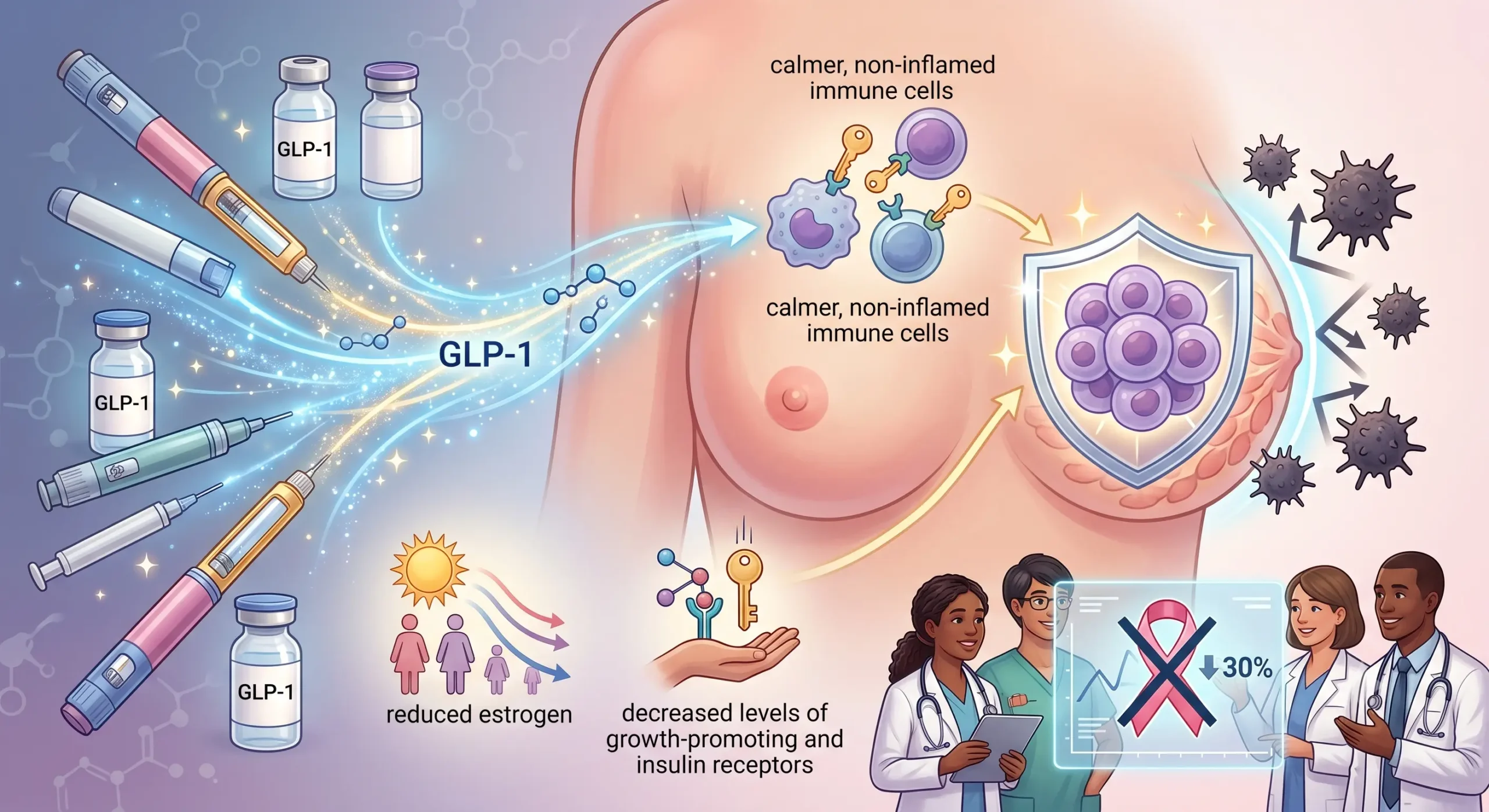
A large study presented in June 2026 just made that assumption much harder to defend. Researchers analyzing health records from hundreds of thousands of women found that patients taking GLP-1 receptor agonists were about 30% less likely to develop breast cancer compared to women not taking the medications. The effect appeared across multiple drugs in the class, including Ozempic, Wegovy, Mounjaro, and Zepbound.
The finding is surprising because these drugs were never designed to prevent cancer. They were created to control blood sugar, reduce appetite, and help people lose weight. Yet one of the largest real-world analyses ever conducted on GLP-1 medications suggests they may be doing something much bigger.
A treatment millions of people started taking to lose weight may also be changing one of the most important cancer risks facing women.
The Discovery Nobody Was Looking For
The modern GLP-1 story began with diabetes. Scientists discovered that a naturally occurring hormone called glucagon-like peptide-1 helps regulate blood sugar levels after meals. Drug developers eventually learned how to mimic this hormone with medications that improve insulin response, reduce appetite, and slow stomach emptying. The results were dramatic. People lost substantial amounts of weight. Blood sugar improved. Cardiovascular risk fell. Studies began reporting reductions in heart attacks, strokes, kidney disease, and overall mortality.
Then researchers started noticing something unexpected. Cancer rates appeared lower among patients taking these medications. Initially, many scientists assumed the explanation was simple. Obesity is one of the strongest risk factors for breast cancer, particularly after menopause. If GLP-1 drugs help people lose significant amounts of weight, cancer risk should naturally decrease as a consequence. But newer data increasingly suggests the story may not be that straightforward.
Why Obesity Matters So Much
Breast cancer is often thought of as a disease driven primarily by genetics. While genes can play an important role, most breast cancers occur in women with no strong family history. One of the biggest risk factors is excess body fat.
Fat tissue is not simply stored energy. It functions as a highly active endocrine organ that produces hormones, inflammatory molecules, and growth signals that influence tissues throughout the body.
After menopause, fat tissue becomes a major source of estrogen production. Higher estrogen exposure can stimulate the growth of hormone-sensitive breast cancer cells. At the same time, obesity increases chronic inflammation and insulin resistance. Both processes create an environment that encourages abnormal cells to survive, multiply, and eventually become tumors.
For years, researchers have known that reducing excess body weight should theoretically reduce breast cancer risk.
The question was whether GLP-1 drugs were simply achieving that goal through weight loss or whether they were influencing cancer biology more directly.
The Insulin Connection
One explanation centers on insulin itself. Many people think of insulin solely as a blood sugar hormone.
It is also one of the body’s most powerful growth signals. When insulin levels remain chronically elevated, cells receive repeated instructions to grow, divide, and resist programmed cell death. Cancer cells can exploit these same signals.
GLP-1 medications dramatically improve insulin sensitivity and often lower circulating insulin levels. By reducing this growth-promoting environment, they may remove one of the biological conditions that allows early cancer cells to thrive. Researchers have long suspected that hyperinsulinemia plays an important role in multiple cancers, including breast cancer. The new findings add substantial weight to that hypothesis.
The Inflammation Explanation
Another possible mechanism involves inflammation. Cancer does not emerge in isolation. Tumors develop inside tissues that are constantly interacting with immune cells, hormones, and inflammatory signals. Obesity creates a state of low-grade chronic inflammation that can persist for decades. Immune cells become activated. Inflammatory molecules circulate through the bloodstream. Cellular damage accumulates.
Many researchers now view chronic inflammation as one of the fundamental drivers of aging and cancer development. GLP-1 drugs consistently reduce inflammatory markers throughout the body. Several studies have shown improvements in systemic inflammation independent of weight loss alone. If the inflammatory environment becomes less favorable for cancer development, breast cancer risk could decline even before significant weight reduction occurs.
The Direct Cancer Effect Scientists Are Investigating
The most intriguing possibility is that GLP-1 medications may have direct effects on cancer biology.
Laboratory studies have identified GLP-1 receptors in various tissues throughout the body. Researchers are now investigating whether activating these receptors influences cell growth, cellular metabolism, DNA repair, or immune surveillance. The evidence remains preliminary.
Scientists are careful not to claim that GLP-1 drugs directly prevent cancer. But the consistency of emerging observational findings has become difficult to ignore. As larger datasets accumulate, the same signal continues appearing: people taking GLP-1 medications often develop fewer obesity-related cancers than expected. The new breast cancer findings are among the strongest examples yet.
Why This Matters Beyond Breast Cancer
Breast cancer is the most commonly diagnosed cancer in women worldwide. Millions of new cases occur every year.
Even a modest reduction in risk would translate into an enormous public health impact. A 30% decrease is not a small effect. For comparison, many established preventive interventions in medicine produce benefits substantially smaller than that.
Researchers caution that observational studies cannot prove causation. Women taking GLP-1 drugs may differ from non-users in important ways that influence cancer risk. Randomized trials specifically designed to evaluate cancer outcomes will ultimately be needed. Still, the pattern is becoming increasingly difficult to dismiss.
The same medications that transformed obesity treatment are now being linked to reductions in cardiovascular disease, kidney disease, dementia risk, and multiple forms of cancer. What began as a diabetes therapy is steadily expanding into something that looks much larger.
The Drugs That Keep Doing More Than Expected
When Ozempic first entered the public conversation, most attention focused on weight loss.
Then studies showed reductions in heart attacks and strokes. Then kidney protection emerged. Now cancer prevention is entering the discussion.
Medicine occasionally encounters treatments that affect a single biological pathway connected to many diseases at once.
GLP-1 drugs may be turning into one of those rare examples. Researchers set out to create better diabetes medications. They may have accidentally uncovered a tool that influences some of the most important drivers of aging, chronic disease, and cancer risk simultaneously.
The women in this study were not taking these medications to prevent breast cancer. Yet the data suggest that may be one of the benefits they were receiving all along.
Sources:
McDonald, E.S., et al. GLP-1 Agonists Are Associated With a Significant Reduction in Breast Cancer Incidence in Women With Overweight and Obesity. JCO Oncology Practice, 2026. DOI: 10.1200/OP-26-00485