Scientists gave people psilocybin in two different rooms and scanned their brains a week later. The rooms produced measurably different brains

The field of psychedelic-assisted therapy has spent the last decade trying to determine how psilocybin works. The question has focused almost entirely on the drug: what dose, what frequency, what biological mechanisms, what brain targets. The assumption embedded in that focus is that the drug is the treatment, and everything else, the room, the music, the presence of a guide, the quality of the couch, the artwork on the wall, is either irrelevant or at most a matter of patient comfort.
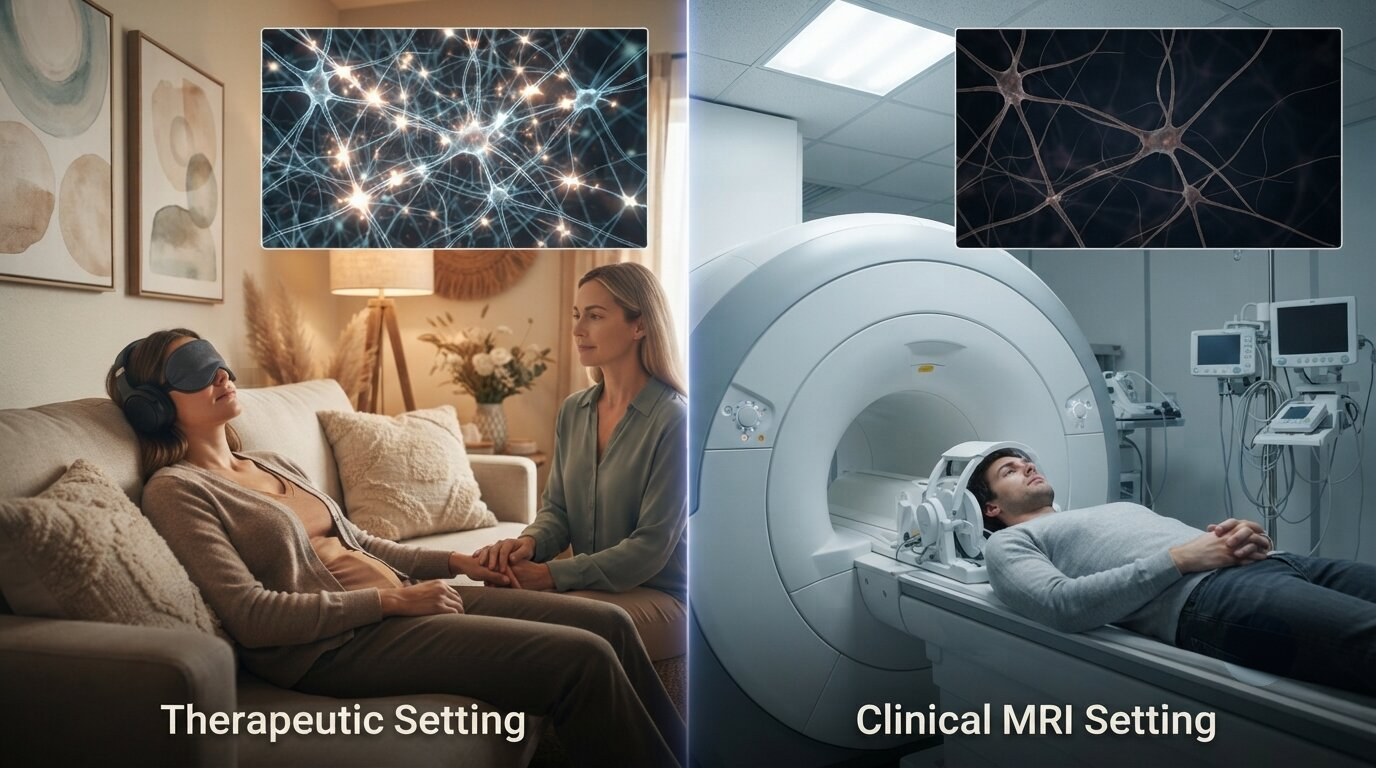
A study published today in Translational Psychiatry has produced the most direct evidence yet that this assumption is wrong. Fifteen healthy people received the same dose of psilocybin. Half of them took it inside an MRI scanner, in a clinical environment that was loud, confined, and medically sterile. The other half took it in a room designed to resemble a therapeutic setting: comfortable furniture, carefully chosen artwork, music, and the presence of a supportive guide. One week later, the researchers scanned everyone’s brains using PET imaging sensitive enough to measure changes in synaptic density at the molecular level.
The two groups had measurably different brains. The people who took psilocybin in the therapeutic room showed greater increases in synaptic density than those who took the same drug in the scanner. They also reported more intense mystical experiences during the session and more lasting psychological benefits three months later. Same drug. Same dose. Different room. Different brain.
Why synaptic density matters
The leading hypothesis for why psilocybin works as a therapy is neuroplasticity. Depression, PTSD, and addiction are all associated with a brain that has become rigid: neurons that have lost connections, synaptic networks that have contracted, circuits that are locked into repetitive patterns that no longer serve the person running them. What psilocybin might do, on the neuroplasticity hypothesis, is physically reverse some of that contraction, stimulating the growth of new synaptic connections and restoring the brain’s capacity for flexible response.
Animal studies have supported this picture convincingly. Rodents given psilocybin show rapid and lasting increases in dendritic spine density, the physical structures that form synapses between neurons, in regions linked to mood and cognition. The effects appear within hours and persist for weeks. Extrapolated to humans, the neuroplasticity hypothesis predicts that people who take psilocybin should show measurable increases in synaptic density in the days following the experience.
The Copenhagen team tested this prediction directly using one of the most specific tools available: PET scanning with a radiotracer called [¹¹C]UCB-J that binds to a protein called SV2A, which is present on synaptic vesicles inside nerve terminals and serves as a reliable marker of synaptic density. By comparing SV2A binding in the frontal cortex and hippocampus before and one week after the psilocybin session, they could measure whether new synapses had formed in the regions most implicated in depression and emotional regulation.
The null result that revealed something more important
The main finding is, on the surface, a disappointment for the neuroplasticity hypothesis: across all 15 participants, the researchers found no statistically significant overall increase in SV2A density one week after the psilocybin session. The average change across the whole group was not large enough to rule out chance.
But when the researchers separated the two groups, the picture changed. The participants who had taken psilocybin in the therapeutic setting showed greater increases in frontal cortex and hippocampal SV2A density than those who had taken it in the scanner. The difference was not simply a matter of one group feeling better subjectively. It was visible in the PET data, in the molecular density of synaptic connections in the brain one week after the experience.
The therapeutic setting group also showed more intense mystical-type experiences during the session itself, assessed using validated measures of psychedelic phenomenology. And when participants were followed up at three months, the group that had taken psilocybin in the therapeutic room reported significantly more lasting psychological benefits than those who had taken it in the scanner.
The chain connecting these findings is direct. The setting shaped the quality of the experience. The quality of the experience shaped the brain changes. The brain changes were associated with lasting psychological outcomes. Each link in the chain was independently measurable, and the measurements all pointed in the same direction.
What set and setting means in the brain
The idea that set and setting shape the psychedelic experience has been central to the culture and practice of psychedelic use since at least the 1960s, when Timothy Leary and Richard Alpert used the phrase to describe how the mindset of the user and the environment of the experience jointly determine the quality and character of what happens during a session. In the subsequent decades of therapeutic research, the concept was incorporated into virtually every psychedelic-assisted therapy protocol: prepare the patient, create a comfortable environment, provide a supportive guide, use carefully chosen music.
What the Copenhagen study provides is something the field has not had before: a direct neural measurement of what set and setting actually does to the brain. The mystical experience, the dissolution of ordinary self-boundaries, the sense of profound interconnection and meaning that characterizes high-quality psychedelic sessions, is not merely a subjective report. It is associated with measurable changes in synaptic density that persist for at least a week and predict psychological outcomes that last for at least three months. And both the experience and the brain changes are modulated by the environment in which the drug is taken.
This finding has immediate and significant implications for how psychedelic therapy trials are designed. Most clinical trials of psilocybin use relatively standardized therapeutic settings because this is the protocol that produced early positive results in depression, addiction, and end-of-life anxiety. But the trials vary considerably in the quality and nature of that setting, in how the room is decorated, how music is selected, how therapists are trained to be present, how much preparation is done with patients beforehand. If these variations translate into differences in the quality of the mystical experience, and those differences translate into differences in synaptic density and lasting outcomes, then the variability in trial results across sites and protocols may be partly a function of environmental variability rather than drug variability.
The small sample and what it means
The study’s most obvious limitation is its size. Fifteen participants is an extremely small sample for a clinical neuroscience study, and the comparison between the two groups of roughly seven or eight participants each is underpowered for definitive conclusions. The researchers themselves note this explicitly, framing the results as preliminary evidence that warrants investigation in larger and better-powered trials.
The sample size is not a reflection of poor design. PET scanning with radioactive tracers involves exposure to ionizing radiation, requires specialized equipment available at only a small number of centers worldwide, and costs substantially more per participant than behavioral or fMRI studies. The maximum number of participants a responsible ethics committee will approve for a PET study involving a novel radiotracer in combination with a psychedelic drug is limited. The Copenhagen group conducted as large a study as the regulatory and ethical constraints of their setting permitted.
The conflict of interest disclosures also deserve attention. Senior author Gitte Knudsen, one of the most prominent figures in European psychedelic neuroscience, has disclosed relationships with multiple companies working in the psychedelic therapy space, including Cybin, Lundbeck, Sanos, Onsero, Pangea, Gilgamesh, Seaport, and AbbVie. Drummond McCulloch’s salary was funded by COMPASS Pathways, a publicly traded company developing psilocybin-based therapies. The authors state that funding sources had no role in the study’s design or analysis, and the finding that psilocybin overall did not significantly increase synaptic density is not the result a company invested in psilocybin therapy would prefer to see published. The conflict disclosures are present and appropriate, and the null main finding suggests the analysis was not shaped to produce commercially favorable results.
Where this leaves the neuroplasticity hypothesis
The study does not resolve whether psilocybin increases synaptic density in humans. It found that the overall effect across all participants did not reach statistical significance, but it also found that the effect was larger in participants who had a more therapeutically supported experience. A larger trial with more participants, all in a therapeutic setting optimized for mystical experience, might find a significant effect. A trial conducted entirely in scanner conditions might not.
This ambiguity is scientifically productive rather than merely frustrating. It suggests that the neuroplasticity hypothesis may be correct but conditional: psilocybin may have the capacity to increase synaptic density, but whether that capacity is realized depends on what the brain is doing during the experience, which depends on the environment in which the experience occurs. The drug opens a window. The setting determines what comes through it.
For the clinical trials currently underway, for the regulatory agencies reviewing their results, and for the therapists and patients who will eventually use these treatments if they are approved, that distinction matters enormously. A drug that only works in a specific kind of room is not the same as a drug that works reliably anywhere. It is a drug-and-environment combination, and getting either element wrong may mean that the treatment fails in a patient who might have benefited from it.
Source
Annette Johansen, Pontus Plavén-Sigray, Martin K. Madsen, Anna Søndergaard, Catharina Messel, Maria Geisler, Arafat Nasser, Drummond E-W. McCulloch, Vincent Beliveau, Alexandra Vassilieva, Anton Lund, Szabolcs Lehel, Brice Ozenne, Dea S. Stenbæk, Patrick M. Fisher, Claus Svarer, Gitte M. Knudsen. “Psilocybin’s effect on human brain synaptic plasticity.” Translational Psychiatry, July 15, 2026.
DOI: 10.1038/s41398-026-04285-y