Scientists found that THC does not just blur memories but actively creates false ones that feel completely real and there is no internal way to tell the difference

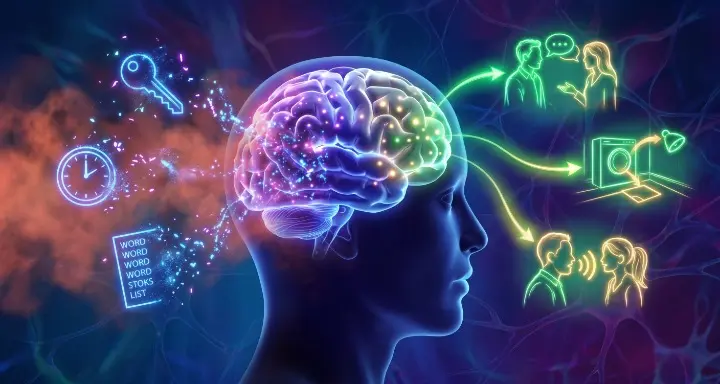
Most people who use cannabis expect it to make their memory worse. Forgetting where you put your keys. Losing the thread of a conversation. Missing an appointment that was in the back of your mind. These are the memory failures that fit the cultural picture of what cannabis does to the brain, and they are real effects that the research literature has documented for decades.
What a study published in the Journal of Psychopharmacology by researchers at Washington State University found is something the cultural picture does not include. Cannabis does not just erase or blur memories. Under conditions of acute intoxication, it manufactures them. People who had consumed THC remembered words they had never heard, recalled events that had not occurred, and identified information as coming from sources it never came from. The memories felt real. They were not.
This is a different problem from forgetting. Forgetting leaves a gap that the person can recognize as a gap. A false memory fills the gap with something that feels like genuine recall, which means the person has no internal signal that the memory is wrong.
The Experiment
The WSU study, led by associate professor of psychology Carrie Cuttler, used a randomized double-blind placebo-controlled design. 120 cannabis users were randomly assigned to vaporize either a placebo or doses of THC at 20 milligrams or 40 milligrams. They were then given 21 separate memory tests covering a wider range of memory systems than any previous cannabis study had examined in a single protocol.
Most previous research on cannabis and memory focused on one or two types, typically simple word list recall. Cuttler’s team tested false memory, source memory, prospective memory, temporal order memory, working memory, semantic memory, and several others, mapping the breadth of cognitive impact across the full architecture of the human memory system.
Cannabis affected 15 of the 21 tests significantly. About 70 percent of participants who consumed THC showed measurable impairment across multiple memory types. The two systems showing the largest effects were false memory and source memory, the two most consequential for how reliably a person’s recollection of experience corresponds to what actually happened.
What False Memory Means in Practice
The false memory finding is the one that changes what cannabis intoxication means at a fundamental level. In one key test, participants listened to lists of related words that were connected by a common theme, but the central word tying the list together was never spoken. It was implied by everything around it but never actually presented.
Later, participants who had consumed THC were significantly more likely to say they remembered hearing the central word that was never in the list. “I found it was really common for people to come up with words that were never on the list,” Cuttler said. “Sometimes they were related to the theme of the list, and sometimes they were completely unrelated.”
This is not a failure of recall. It is an active construction of a memory that has no factual basis. The brain, working with THC-disrupted encoding, fills gaps in its record by generating content that fits the pattern of what it thinks it encoded. The result is a memory that feels experientially identical to a real one because it is produced by the same reconstructive process the brain uses for genuine recall. The person who remembers the word that was never spoken is not lying. They are reporting what their brain has constructed as a memory.
The endocannabinoid system helps explain the mechanism. THC binds to CB1 receptors distributed throughout the hippocampus and prefrontal cortex, the brain regions most centrally involved in encoding new information and retrieving stored memories. When THC disrupts the signaling that normally coordinates encoding, fewer details are accurately stored during the experience. Later, during retrieval, the brain reconstructs rather than replays, and with less accurate raw material to work with, it confabulates. The false memory is not a hallucination. It is reconstruction filling in what encoding failed to capture.
Source Memory and the Attribution Problem
Source memory is the second system most severely affected by THC, and its disruption has consequences that extend beyond remembering words on a list. Source memory is how the brain tracks where information came from. It is what allows you to distinguish between something you read, something someone told you, something you imagined, and something you actually experienced.
When source memory is compromised, information becomes detached from its origin. A person might accurately remember a fact while being completely wrong about where they learned it. They might attribute something they read to a conversation they had. They might experience something they imagined as something they witnessed. The content of the memory survives. The metadata about its origin does not.
The practical implications of this are wider than most discussions of cannabis and memory acknowledge. Source memory failures under THC are not confined to controlled laboratory word list experiments. They would apply to any situation in which a person under acute intoxication is encoding information that will later need to be accurately attributed: a conversation, an agreement, a sequence of events, a person’s statement, a detail that becomes important later.
Researchers from earlier work published in PNAS specifically examined the implications for eyewitness testimony, finding that cannabis consistently increased susceptibility to false memories across different paradigms including eyewitness and perpetrator scenarios presented in virtual reality environments. Cannabis-intoxicated witnesses were more susceptible to suggestion-based false memories as well as spontaneous ones, meaning that information provided to them after an event was more likely to be incorporated into their memory of the event itself.
The Dose Finding That Challenges Assumptions
One finding from the WSU study that received less attention than it deserves involves dose. The researchers found no meaningful differences between participants who consumed 20 milligrams of THC and those who consumed 40 milligrams. Both doses produced comparable levels of memory disruption across the 21 tests.
This matters for how people think about managing their cannabis use. The implicit assumption in many harm reduction frameworks is that lower doses mean proportionally lower cognitive risk. For the memory systems most affected in this study, that assumption appears not to hold. The threshold at which THC begins disrupting encoding and reconstruction is apparently reached at 20 milligrams, and going to double that dose does not meaningfully worsen the effect.
Cuttler noted that this suggests even moderate amounts of THC may significantly interfere with memory, which is a different framing than the dose-dependent model most users apply when deciding how much they are comfortable consuming.
What This Adds to the Lancet Findings
The timing of the WSU false memory study, published in March 2026 in the same month as the Lancet Psychiatry systematic review finding no evidence of therapeutic benefit for anxiety, depression, or PTSD, creates a compounding picture that the cannabis research community will be processing for years.
The Lancet review established that the conditions most commonly cited as reasons for medicinal use lack clinical evidence of benefit. The WSU study adds a finding about what cannabis is actively doing to cognitive function that users managing mental health conditions would arguably need to know. A person using cannabis to manage PTSD symptoms is using a substance that the largest clinical review shows has no evidence of treating PTSD, while simultaneously exposing themselves to acute disruptions of the memory systems most centrally implicated in PTSD processing: source memory, temporal order memory, and the accurate attribution of experience to its correct origin.
Trauma processing, in every evidence-based therapeutic framework that has been developed for PTSD, requires accurate access to episodic memories and the ability to correctly contextualize them. A substance that disrupts the brain systems involved in exactly those functions is not a neutral coping tool for trauma, regardless of the subjective sense of relief it may provide in the short term.
The Memory That Feels Real
The detail from the WSU study that should sit with people longest is not the percentage of participants impaired or the number of tests affected. It is the phenomenological reality of what a false memory is to the person experiencing it.
There is no internal flag that distinguishes a false memory from a real one at the level of conscious experience. Both feel like memories. Both are reported with the same confidence. The brain that encoded something accurately and the brain that constructed something that never happened are producing experientially identical outputs when they retrieve. The person who remembers the word that was never spoken does not feel like they are remembering something false. They feel like they are remembering.
That is the finding that goes beyond blurry recollection and fuzzy mornings. Cannabis under acute intoxication is not just failing to record experience accurately. It is actively building a record that corresponds to things that did not happen, in memory systems that the person will rely on the next day, the next week, and for as long as those memories persist.
Sources:
Cuttler, C., Spradlin, A. Cannabis intoxication impairs multiple types of memory: results from a randomized, double-blind, placebo-controlled study. Journal of Psychopharmacology, March 2026. DOI: https://doi.org/10.1177/02698811261416079