A decade of research claimed psychedelics increase brain entropy. A new study tested every major version of that claim and found most of them don’t hold up

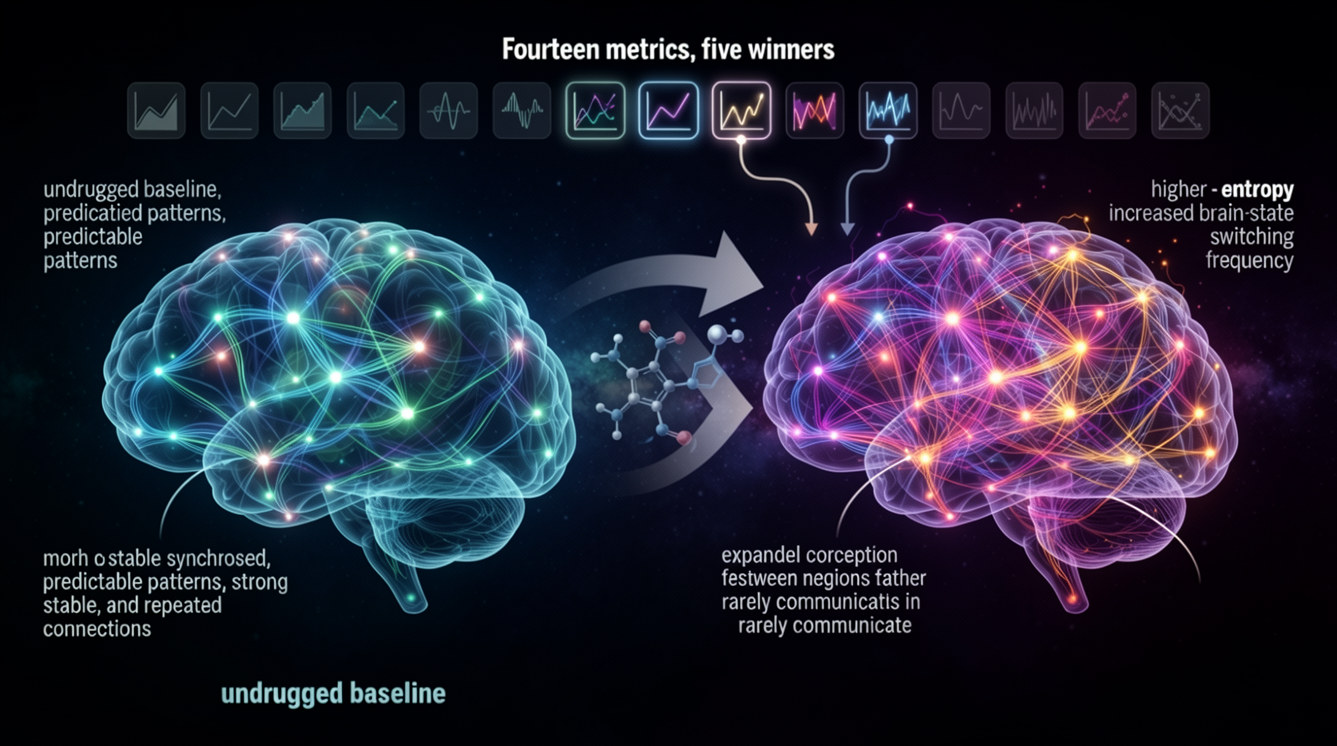
The most widely cited explanation for what psychedelics do to the brain goes by the name of the entropic brain hypothesis. Proposed more than a decade ago, it holds that substances like psilocybin and LSD shift the brain toward a higher-entropy state: a more disordered, more flexible, more unpredictable pattern of neural activity. In this high-entropy state, the brain’s rigid default patterns dissolve, allowing more unusual connections to form between regions that rarely communicate, producing the characteristic expansion of perception, the loosening of the ego, and potentially the therapeutic breakthroughs that have made psychedelic-assisted therapy one of the most discussed developments in psychiatry in a generation.
The hypothesis is elegant, scientifically plausible, and extremely difficult to test cleanly. The reason is that entropy is not one thing. It is a mathematical concept that can be measured in dozens of different ways, each sensitive to different features of a signal. Thirteen previous studies have each measured the effect of psychedelics on brain entropy, and each has used a different metric. When the results agree, the field cites the consensus. When they do not, the disagreement is attributed to methodological variation and largely set aside.
A team at the University of Copenhagen has now done something the field has been avoiding: they took all 14 of the most commonly used brain entropy metrics, applied them to the same dataset of 121 brain scans from 28 people before and after taking psilocybin, and asked which of these metrics actually track the drug’s effects reliably. The results, published in Nature Communications, are more specific and more uncomfortable than the hypothesis’s proponents might prefer.
Fourteen metrics, five winners
The study design was straightforward in principle and demanding in execution. Twenty-eight healthy participants underwent fMRI brain scanning before and after receiving psilocybin, producing 121 total scan sessions. Each session was analyzed using all 14 entropy metrics the team had identified as prominent in the literature. To make the findings as robust as possible, they ran every metric through two different brain parcellation strategies and seven different data denoising pipelines, testing whether the results held across different analytical choices rather than depending on one specific processing decision.
Of the 14 metrics tested, five showed consistent and significant positive associations with psilocybin in the data: brain-state switching frequency, path-length, instantaneous correlations, short-timescale sample entropy, and Shannon entropy of the spatial eigendistribution. These five metrics all moved in the same direction under psilocybin, their values increasing consistently with the drug’s effects, and they did so robustly across the different analytical approaches the team employed.
Eight of the 14 metrics showed no significant effect at all. One metric, Lempel-Ziv complexity of the BOLD signal, showed inconsistent results that varied depending on how the data were processed.
The field has been citing the entropic brain hypothesis as supported by a growing body of evidence. What that body of evidence actually contains, as this study makes clear, is a collection of studies each measuring a different version of entropy, with results that depend substantially on which version was chosen.
The metrics do not agree with each other
The more disquieting finding emerged when the researchers examined how the 14 metrics related to one another. If they were all measuring the same underlying property of brain activity, they should correlate strongly. High entropy on one measure should predict high entropy on another. The pattern the data showed was the opposite: the metrics showed only limited correlation with each other.
This means that when different research groups have measured “brain entropy” under psychedelics and reported increases, they have not necessarily been measuring the same thing. The word entropy has served as a common label for a heterogeneous set of mathematical quantities that may reflect genuinely different aspects of neural dynamics. The apparent convergence of evidence for the entropic brain hypothesis has been partly an artifact of using the same word to describe different measurements.
“These metrics do not reflect a singular construct,” the authors write. The implication is direct: future research on what psychedelics do to the brain will need to be considerably more precise about which aspect of entropy it is measuring, and why.
What the five reliable metrics have in common
The five metrics that survived the rigorous multi-pipeline testing share a feature worth examining. They are all sensitive to dynamics at relatively short timescales: the rapid switching of the brain between different activity states, the moment-to-moment variability in how brain regions correlate with each other, the local complexity of the signal over brief windows. The metrics that failed were more often sensitive to the longer-timescale or more spatially averaged properties of the brain signal.
This suggests a more specific account of what psilocybin actually does to neural dynamics. The drug appears to increase the frequency and variety of the brain’s rapid state transitions, the speed with which it moves between different configurations of correlated activity. It makes the brain a more restless switching system, jumping between states more often and more unpredictably than it does in the undrugged baseline condition.
This is consistent with the subjective experience of psychedelics as described by research participants: rapid shifts in the quality and content of awareness, unusual associations appearing and dissolving, the sense that the brain is doing many different things in quick succession rather than settling into any single mode. What the five reliable entropy metrics are capturing may be precisely this quality of rapid, diverse neural movement.
Why clinical research needs these distinctions
The practical significance of the study extends into the clinic. Psilocybin and LSD are currently in Phase 3 clinical trials for major depressive disorder and generalized anxiety disorder, the most advanced stage of testing before regulatory approval is considered. If these trials succeed and psychedelics become approved therapies, clinicians will need ways to measure what the drugs are doing in individual patients’ brains, to identify who is responding, who is not, and what aspects of the acute drug experience predict longer-term therapeutic outcomes.
Brain entropy metrics have been proposed as candidate biomarkers for exactly this purpose. But a biomarker that works in some analytical pipelines and not others, or that turns out to be measuring something different from what another lab’s version of the same biomarker measures, is not clinically useful. The five metrics the Copenhagen study identified as robust across pipelines and parcellations are the ones that can be pursued seriously as clinical tools. The eight that failed the replication test are the ones that should be used with extreme caution, if at all, until better evidence emerges.
“This research highlights candidate clinical biomarkers and informs psychedelic brain entropy models,” the authors write, framing the study as a tool for building better foundations rather than as a demolition of the field’s prior conclusions.
The sample size and its limits
The study’s most significant limitation is its 28 participants, a number that is large for psychedelic fMRI research, where the logistical and regulatory demands of scanning people during an active drug experience are substantial, but small relative to the standards of clinical biomarker research. Effects that appear robust across analytical pipelines in 28 participants may look different in 280. The authors are explicit about this limitation, and the finding that only five of fourteen metrics passed the robustness test in a sample this size suggests that the other eight might be genuinely unreliable rather than simply underpowered.
One author’s salary was supported by an unrestricted grant from COMPASS Pathways, a company conducting psychedelic drug trials. The authors state the funder had no involvement in the study’s design, analysis, or conclusions, and the conflict is disclosed. Given that a finding which narrows the field of viable biomarkers to five specific metrics does not obviously favor any commercial interest, the disclosed conflict does not appear to compromise the study’s conclusions.
The entropic brain hypothesis survives this study. Psychedelics do increase brain entropy, in the specific sense captured by five particular mathematical measures of neural dynamics. What does not survive intact is the casual assumption that entropy is a single unified thing, that studies measuring different versions of it are studying the same phenomenon, and that the accumulating literature on psychedelics and brain entropy reflects a coherent and convergent body of evidence. It reflects something more complicated: a productive but imprecise conversation that this study has now made considerably more rigorous.
Source
Drummond E-Wen McCulloch, Anders Stevnhoved Olsen, Brice Ozenne, Kristian Larsen, Dea Siggaard Stenbæk, Sophia Armand, Martin Korsbak Madsen, Gitte Moos Knudsen, Patrick MacDonald Fisher. “Multi-metric evaluations of acute psychedelic effects on fMRI brain entropy.” Nature Communications, 2026.
DOI: 10.1038/s41467-026-74215-5