Researchers scanned 110 women before and after pregnancy and found that a second pregnancy completely rewires different brain networks than the first one did

Every mother of two children knows that the second child felt different from the first. The pregnancy felt different. The postpartum period felt different. The way attention split between a newborn and a toddler felt nothing like the absorption of new motherhood the first time around. Most people chalk this up to experience, to knowing what to expect, to being simply more practiced. New research from Amsterdam UMC suggests the difference goes considerably deeper than that.
A team led by neuroscientist Elseline Hoekzema has spent years building one of the most detailed pictures of what pregnancy does to the human brain. Their earlier work, published in Nature Neuroscience in 2017, was the first to establish that pregnancy physically changes the structure of a woman’s brain and that those changes persist for years. A follow-up study mapped those changes across multiple brain systems simultaneously. Now, in a new paper in Nature Communications, the team has done something that had never been done before: they followed women through a second pregnancy and scanned their brains at each stage, comparing what happened to what occurred during a first pregnancy in the same longitudinal study.
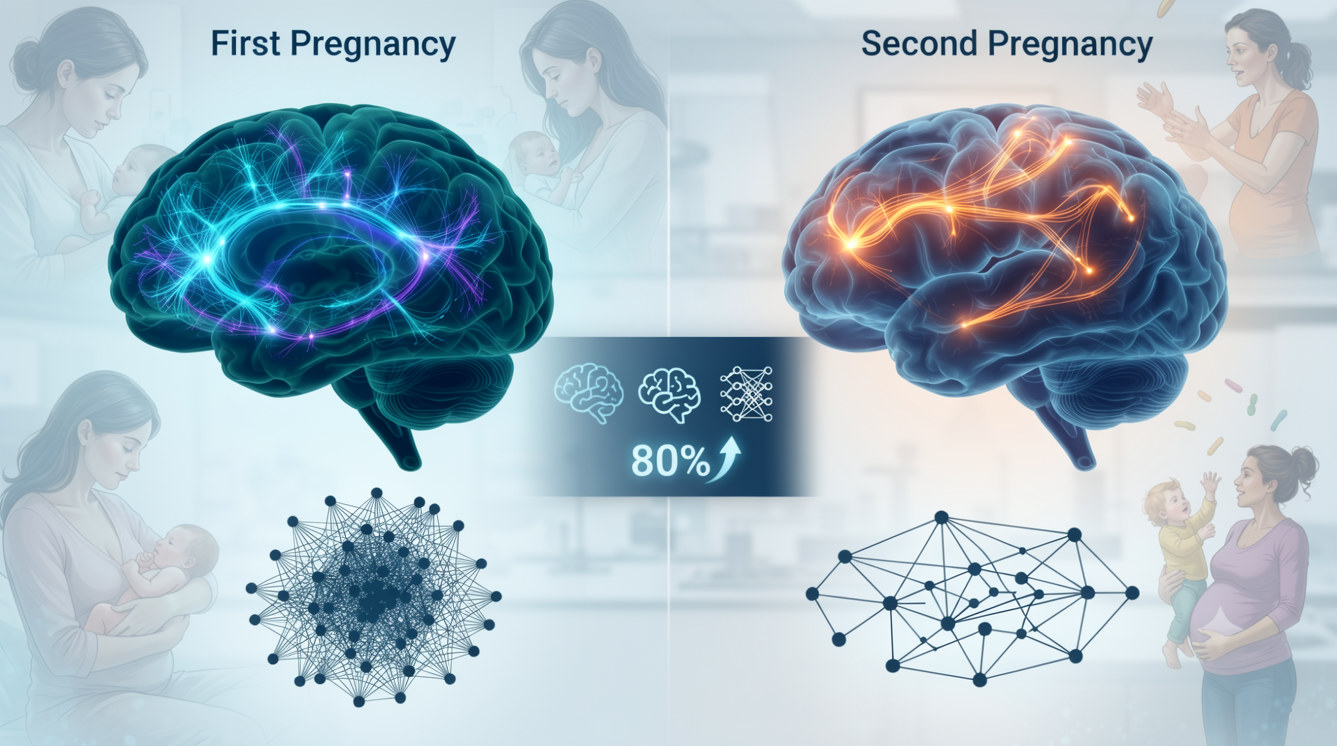
The core finding is specific and counterintuitive. Pregnancy changes the brain both times. But the brain regions that change are not the same. A first pregnancy reshapes the networks involved in introspection, self-perception, and social cognition. A second pregnancy targets an entirely different set of networks: the ones involved in attention to the external world, physical coordination, and responding rapidly to multiple simultaneous demands. An artificial intelligence classifier trained on the brain scan data could correctly identify which pregnancy a woman had undergone with 80 percent accuracy based solely on the pattern of brain changes, without any other information about her.
What a first pregnancy does to the brain
The brain changes that accompany a first pregnancy have now been replicated by multiple independent research groups worldwide. They are real and they are substantial. Across the study’s 40 first-time mothers, cortical volume decreased by a median of 3.1 percent across the regions most strongly affected. The brain was losing tissue in a patterned, organized way, not degenerating randomly.
The regions showing the largest reductions clustered in the default mode network, a set of brain areas that activate together during rest, self-reflection, autobiographical memory, and the kind of social imagination that allows one person to model the inner life of another. Alongside the default mode network, the frontoparietal network showed prominent changes, along with one of its major white matter tracts, the superior longitudinal fasciculus. This tract connects frontal and parietal regions and plays an important role in language processing and working memory.
The researchers interpret these changes in the context of what they are preparing for. Becoming a mother for the first time requires a fundamental reorganization of the self. The identity of someone with a newborn is different from the identity of the person who existed before. The capacity to rapidly and intuitively model the needs, discomforts, and communications of a being who cannot speak requires a highly tuned social-cognitive system. The brain appears to build that capacity through structural reorganization, eliminating unnecessary connections and refining the circuits that will matter most for new motherhood.
Functional connectivity in the default mode network increased across a first pregnancy as well. The cuneus, a structure at the core of the brain’s self-representation system, showed heightened functional coherence with the rest of the network. This functional change ran in the opposite direction to what normal aging does to the default mode network, where connectivity typically declines over time.
What a second pregnancy does instead
Across the 30 second-time mothers in the study, cortical volume also decreased, by a median of 2.8 percent across the affected regions. The change was real and statistically robust. But the location of the change was strikingly different.
The default mode network, which showed such dramatic structural reorganization in first-time mothers, was less strongly affected in second-time mothers. The additional areas that were specifically affected only during a first pregnancy clustered in those same introspective, social-cognitive networks. The brain appeared to have already done that work during the first pregnancy. The primary adaptation had occurred. What a second pregnancy did was fine-tune the same networks more subtly while simultaneously opening up an entirely different zone of plasticity.
The areas specifically affected in second-time mothers concentrated in the dorsal attention network and the somatomotor network. These are externally oriented systems. The dorsal attention network drives goal-directed attention, the capacity to focus on what is environmentally relevant and override distractions. The somatomotor network coordinates physical movement and sensory feedback from the body. The corticospinal tract, the major white matter pathway connecting the motor cortex to the spinal cord, showed significant changes specifically in second-time mothers that were not present in first-time mothers.
The researchers suggest a direct functional interpretation. A second pregnancy occurs while a toddler or young child already exists and requires care. The mother’s attentional system cannot afford the inward reorientation that characterized first-time motherhood. It needs to become more externally alert, faster at switching between competing demands, better at the physical coordination of simultaneously managing multiple children. The brain, it appears, prepares for exactly that.
“The areas affected specifically across a second pregnancy were not localized in the introspection-related default mode network but instead were mainly located in networks involved with the responsiveness to external stimuli, goal-oriented attention and task demands,” the researchers write. “These changes can be speculated to prepare a woman for the increased demands associated with caring for multiple children at the same time.”
The AI test that settled the question
To confirm that the differences between first and second pregnancy brain changes were genuinely distinct rather than simply smaller versions of the same pattern, the team ran a machine learning classification analysis. They fed the brain scan data into a support vector machine classifier and asked it to distinguish, based solely on the pattern of brain changes observed, which women had undergone a first pregnancy and which had undergone a second.
The classifier achieved 80 percent accuracy. Using an independent cross-validation method to reduce the risk of overfitting, accuracy dropped slightly to 70 percent but remained highly statistically significant. The brain changes produced by a first and second pregnancy are different enough, in their distribution across neural networks, that an algorithm can reliably tell them apart.
The classifier could also distinguish pregnant women from non-pregnant controls with even higher accuracy: 87 percent for second-time mothers versus controls, and 94 percent for first-time mothers versus controls. Pregnancy changes the brain in a way that is legible to a machine learning system that has learned what those changes look like.
The mental health dimension
The brain changes associated with each pregnancy did not only differ in their regional distribution. They also differed in their relationship to maternal mental health in a way that carries clinical implications.
In first-time mothers, the degree of volumetric brain change during pregnancy correlated with the risk of postpartum depression and psychological distress in the months following birth. Women whose brains changed more strongly were at higher risk for mental health difficulties in the postpartum period.
In second-time mothers, the same correlations appeared in a different time window. The brain changes that occurred across a second pregnancy were more prominently associated with depression and psychological distress during the pregnancy itself, rather than after the birth. The risk window shifted earlier.
The researchers do not yet have a definitive explanation for this temporal shift. One possibility is that the demands of managing an existing child while pregnant with a second one create a different stress profile during the pregnancy period itself, and that the brain changes that accompany second pregnancy reflect this heightened in-pregnancy stress load more directly than they do the postpartum adjustment.
The study also found that brain changes correlated with mother-infant attachment in both groups, but these correlations were more widespread in first-time mothers, where the brain changes in the default mode network appeared to lay the neural foundation for the bond that forms with a first child. In second-time mothers, whose attachment systems were already established from the first pregnancy, the brain changes played a smaller role in determining bonding behavior.
What this means for understanding the maternal brain across a lifetime
The study’s implications extend beyond the immediate postpartum period. Prior research from the same group and others has shown that the brain changes induced by pregnancy do not fully reverse. Structural differences are still measurable two years after delivery, and in some studies up to six years later. More intriguingly, population-level data from thousands of women shows that those who have had multiple children tend to have younger-looking brains in midlife compared to women who had one or no children.
If a first pregnancy reconfigures the social-cognitive brain and a second pregnancy sharpens the attentional and motor systems, the cumulative effect of multiple pregnancies on the brain’s long-term architecture may be distinctly beneficial. Each pregnancy appears to induce its own unique form of neural plasticity, adding a different set of structural modifications that may collectively contribute to the cognitive resilience that the epidemiological data hints at.
The study’s sample size, while substantial for this kind of intensive longitudinal imaging research, is limited enough that replication in larger cohorts is needed. The researchers were not permitted by their ethics committee to scan women during pregnancy itself, only before and after, which means the precise timing of when the changes occur remains unknown. And the classification result, while statistically significant, reflects group-level patterns that cannot predict any individual woman’s experience.
What it does establish, with a precision that self-report and behavioral observation alone could never provide, is that the experience of having a second child leaves a structural mark on the brain that is categorically different from the mark left by having the first. The brain does not repeat itself. Each pregnancy writes something new.
Source
M. Straathof, S. Halmans, P.J.W. Pouwels, E.A. Crone, E. Hoekzema. “The effects of a second pregnancy on women’s brain structure and function.” Nature Communications, 17, 1495, February 19, 2026.
DOI: 10.1038/s41467-026-69370-8