Scientists found that chronic pain persists not because the body fails to heal but because a specific brain circuit keeps instructing the spinal cord to transmit pain signals after healing is complete

Most people who live with chronic pain believe their pain is coming from the place that hurts. A back injury means the back is sending pain signals. A nerve damaged years ago is still firing. The tissue is the source, and the brain is just receiving the message. University of Colorado Boulder researchers have now shown that this understanding, which shapes how chronic pain is treated across virtually every medical system in the world, is missing a critical piece of the picture.
The brain is not just receiving pain signals. In many cases of chronic pain, a specific brain circuit is actively deciding to keep sending them, long after the original injury has stopped providing any biological reason to do so. And in animal studies, when researchers silenced that circuit, chronic pain that had already taken hold simply disappeared.
The Decision Maker Nobody Knew Existed
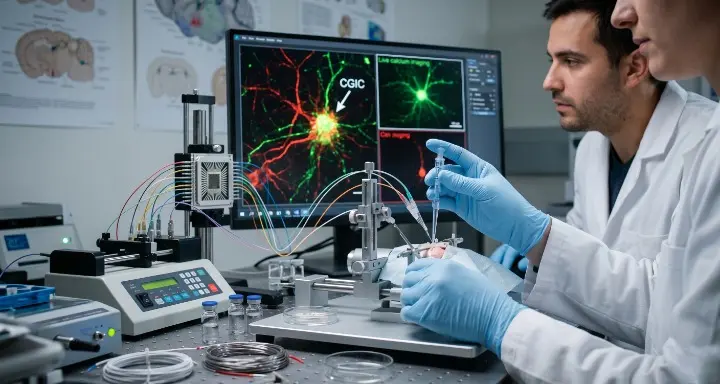
The research, published in the Journal of Neuroscience in February 2026, focused on a small and largely unstudied region deep in the brain called the caudal granular insular cortex, or CGIC. The insular cortex is a broad structure involved in interoception, the brain’s awareness of the body’s internal state, and it has long been known to play some role in pain processing. But the caudal granular subdivision had received almost no dedicated attention before the CU Boulder team, led by Linda Watkins and first author Jayson Ball, decided to map its specific connections and functions in detail.
What they found was a circuit that acts as a gatekeeper between short-term and long-term pain. The CGIC sends signals to the somatosensory cortex, the part of the brain that processes touch and pain. This area then communicates with the spinal cord, effectively instructing it to continue transmitting pain signals. The spinal cord, rather than generating chronic pain independently based on ongoing tissue damage, is in many cases receiving top-down instructions from the brain to keep the pain transmission active. The injury may be healed. The peripheral damage may be resolved. But if the CGIC is still sending its signal down through the somatosensory cortex to the spinal cord, the pain continues regardless.
Watkins described the CGIC as a decision maker. “If this crucial decision maker is silenced, chronic pain does not occur. If it is already ongoing, chronic pain melts away.”
What Happens When the Switch Is Turned Off
The experimental design tested the CGIC pathway in two distinct ways. In the first set of experiments, researchers activated or inhibited the CGIC before chronic pain had developed following sciatic nerve injury. When the pathway was silenced before the transition from acute to chronic pain would normally occur, the transition did not happen. The animals recovered from the acute pain without developing the lasting sensitization that characterizes chronic pain conditions.
The second set of experiments was more significant for the hundreds of millions of people who already live with established chronic pain. Researchers waited until chronic pain had fully developed in the animals, then silenced the CGIC pathway after the fact. The pain disappeared. Not reduced, not managed at a lower level, but gone, in animals that had been experiencing persistent pain that had already taken hold.
Ball described the current moment as a gold rush of neuroscience, with advances in technology now allowing scientists to precisely alter specific groups of brain cells in ways that were not possible even five years ago. The tools used in this study, including chemogenetic DREADD technology that allows specific neural populations to be activated or inhibited with chemical precision, and circuit-specific viral tracers that map exactly which neurons are talking to which, are part of a new generation of neuroscience methods that are making this level of specificity possible for the first time.
Why Touch Becomes Pain
One of the more disorienting findings from the research involves a phenomenon called allodynia, where sensations that would normally register as touch begin to be perceived as pain. People with chronic pain conditions know this experience intimately. A light brush against the skin becomes unbearable. A gentle pressure that should be neutral registers as agony. This is not a psychological response to anticipating pain. It is a neurological reorganization of how the brain’s sensory processing system interprets incoming signals.
“We found that activating this pathway excites the part of the spinal cord that relays touch and pain to the brain, causing touch to now be perceived as pain as well,” said Ball. The CGIC, by sending ongoing signals through the somatosensory cortex to the spinal cord, is effectively recalibrating the spinal cord’s interpretation of sensory input. Signals that previously traveled up a touch pathway begin traveling up a pain pathway instead. The body has not changed. The brain has changed how it categorizes what the body is reporting.
This mechanism helps explain one of the most frustrating features of chronic pain conditions for both patients and clinicians: the complete disconnect between measurable tissue damage and the severity of pain being experienced. Imaging and physical examination often show no ongoing injury. The patient is told there is nothing structurally wrong. But the pain is real, because the brain’s top-down signaling system is maintaining it independent of any peripheral source.
Why Current Treatments Keep Missing the Target
Most pharmacological treatments for chronic pain work peripherally, targeting inflammation, nerve conduction, or receptor sensitivity at the site of injury or along the pain transmission pathway from body to brain. Opioids work centrally but broadly, suppressing pain perception across multiple systems rather than addressing the specific circuit maintaining chronic pain, which is why they produce tolerance, dependence, and diminishing returns over time without resolving the underlying maintenance mechanism.
The CGIC discovery points toward a fundamentally different therapeutic target. Rather than suppressing pain perception after the brain has already decided to maintain it, an intervention targeting the CGIC pathway could potentially interrupt the decision itself. The researchers suggest that brain-machine interfaces and new medications aimed at modulating the CGIC and its downstream projections could offer a path to chronic pain relief that does not rely on opioids and addresses the actual source of maintenance rather than its downstream expression.
This is not a near-term clinical prospect. The current research was conducted in animals, and translating a circuit-level finding into a safe human intervention requires years of additional research, safety testing, and clinical trials. But the identification of a specific, anatomically defined circuit that is necessary and sufficient for the transition from acute to chronic pain, and whose silencing can reverse established chronic pain, gives the field a therapeutic target with a level of precision that has been largely absent from chronic pain research until now.
What This Changes About the Conversation Around Chronic Pain
Chronic pain affects an estimated 1.5 billion people worldwide and is consistently undertreated, partly because of the persistent cultural assumption that pain without visible ongoing tissue damage is either exaggerated or psychological. That assumption has caused enormous harm to patients whose pain is entirely real but whose underlying mechanism was invisible to the diagnostic tools and conceptual frameworks available to their clinicians.
The CGIC research adds to a growing body of evidence that chronic pain is in many cases a brain state as much as a body state, maintained by neural circuits that have taken on a life independent of the original injury. Understanding where the decision to maintain pain is being made, and demonstrating that reversing that decision reverses the pain, changes what chronic pain actually is at a fundamental level. It is not the body refusing to heal. In many cases, it is the brain refusing to stop instructing the spinal cord to transmit a signal that the body no longer needs to send.
Source:
Ball, J.B., Finch, M.R., Taylor, J.A., et al. Caudal Granular Insular Cortex to Somatosensory Cortex I: A Critical Pathway for the Transition of Acute to Chronic Pain. Journal of Neuroscience, February 3, 2026; 46(5): e1306252025. DOI: 10.1523/JNEUROSCI.1306-25.2025 https://www.jneurosci.org/content/46/5/e1306252025