A study of 18 fossils from a South African cave found that Homo erectus, likely our direct ancestor, lived there 2 million years ago. At that site, it was outnumbered 10 to 1 by another human species.

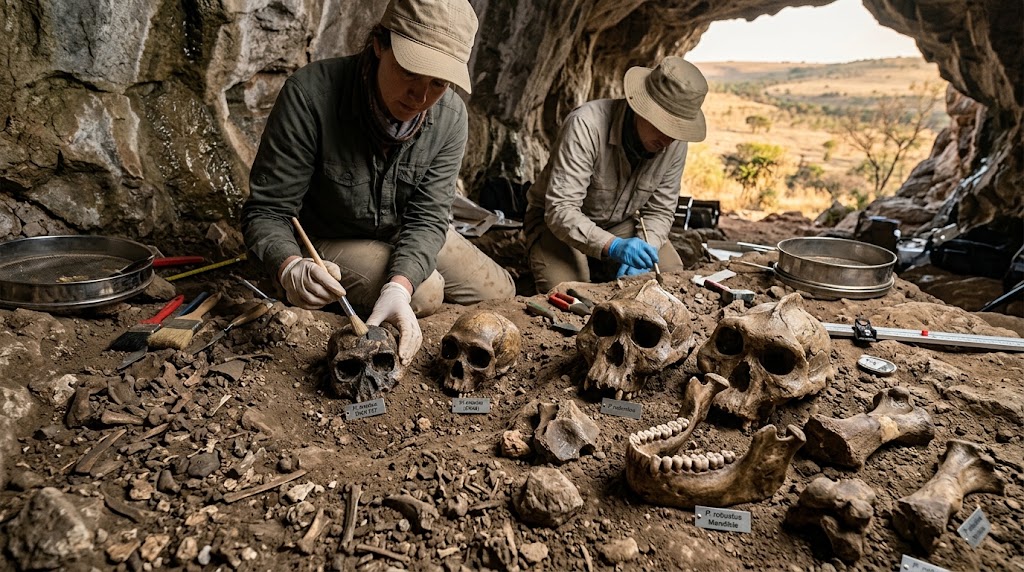
About 2 million years ago, a cave in what is now South Africa’s Cradle of Humankind collected the bones of two very different kinds of early human. One had a big brain and small teeth. The other had massive jaws built for grinding tough plants. Many of the fossils dug out of that cave between 1992 and 2019 were never fully described. Researchers have now gone back to 18 of them, and the count tells a story nobody would have bet on.
The big-brained species was Homo erectus, the first early human that researchers broadly agree belongs in our own genus and is likely our direct ancestor. Among the 18 fossils, the team identified a fragment of an adult Homo erectus skull dated to about 2 million years ago. That is about 200,000 years older than the adult Homo erectus fossils from Dmanisi in Georgia, until now among the oldest known.
But Homo erectus was the rare one. Of the 18 fossils, 14 belonged to Paranthropus robustus, the species with the giant jaws. Only one was Homo erectus, and three could not be pinned down. Across the site, Paranthropus outnumbered our ancestors by more than 10 to one.
Lead researcher Jesse Martin of La Trobe University put it bluntly: our ancestors “looked like the outside long-odds chance to survive.” Paranthropus robustus eventually went extinct. Homo erectus spread across Africa and Asia, and its line most likely led to us.
This is the second Homo erectus fossil from the cave, known as Drimolen. In 2020, a team writing in Science described the partial skull of a Homo erectus child, aged about two to four, from the same site and dated it to roughly 2 million years ago. Martin has said the child’s skull resembled Homo erectus but left room for doubt without an adult specimen. That was the missing piece.
The new fragment, catalogued as DNH 127, carries two telltale features. The seam where two of the skull’s bones meet runs straight, a Homo erectus trait, and the bony bump behind the ear is too small for Paranthropus. Together, the researchers say, those features place it in Homo erectus. The earlier benchmark, the famous skulls from Dmanisi, are about 1.8 million years old.
“Homo erectus is the first species of hominin that researchers broadly agree fits within our own genus Homo and is likely directly ancestral to us,” the La Trobe team said in a statement.
The second finding is about how the two species changed. Over roughly 200,000 years, the Paranthropus at Drimolen developed bigger teeth and stronger chewing equipment, doubling down on a diet of tough plants. Homo erectus went the other way, with a larger brain and smaller molars, a shift the researchers link to eating more meat.
Two human species shared the same landscape for a long time, each betting on a different strategy. The one with the bigger jaws looked like the winner for a while, at least at this cave. The one with the bigger brain is the one whose line most likely leads to the people reading this.
There are limits to what this shows. The adult Homo erectus identification rests on a single skull fragment, and some coverage has called it tentative. The fossils also do not show that Homo erectus first evolved in southern Africa, only that it was there at about the same time it appears elsewhere, or earlier.
Ten-to-one at one cave may also say as much about which bones ended up in that cave as about how many of each species were alive. Predators, water and the cave’s shape all affect what gets preserved.
Source
Martin JM, et al. “New hominin cranial and mandibular remains from Drimolen Main Quarry, South Africa.” Annals of Human Biology, 2026.
DOI: 10.1080/03014460.2026.2725046
Also cited
Herries AIR, Martin JM, Leece AB, et al. “Contemporaneity of Australopithecus, Paranthropus, and early Homo erectus in South Africa.” Science, 2020.
DOI: 10.1126/science.aaw7293
Lordkipanidze D, Ponce de León MS, Margvelashvili A, et al. “A complete skull from Dmanisi, Georgia, and the evolutionary biology of early Homo.” Science, 2013.
DOI: 10.1126/science.1238484