A study of 899 gun homicides in the Chicago area found that deaths on greener streets were less likely to be shootings. But in the poorest neighborhoods, being near a park pointed the other way.

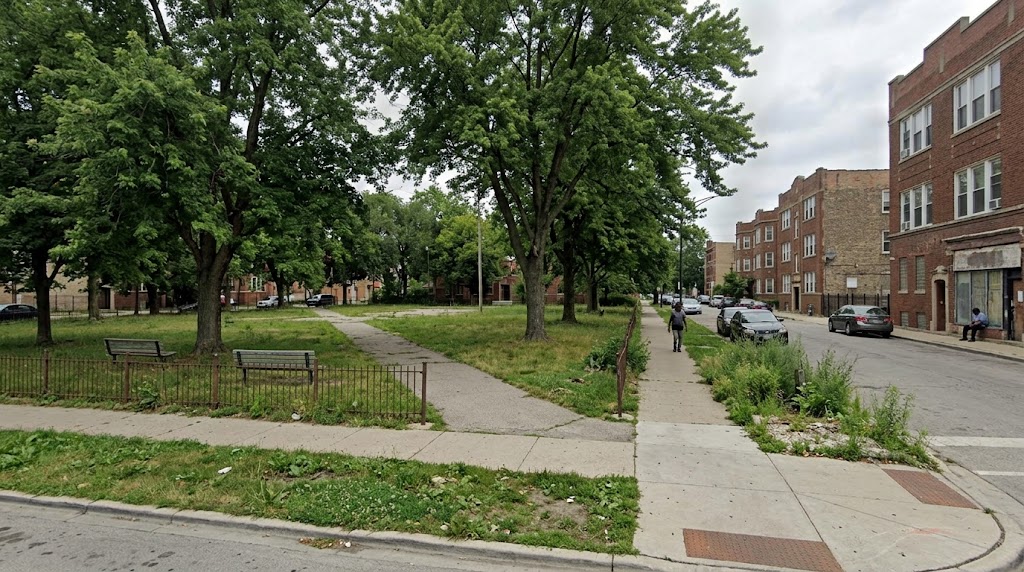
Plant more trees, build more parks, and violence goes down. It is one of the more hopeful ideas in public health. Researchers at Ohio State University wanted to know whether it works the same everywhere. They took 899 fatal shootings in Cook County, Illinois, from 2023 and used Google Street View and machine learning to measure exactly how much greenery a person would have seen from the street where each death happened. The answer depended on the neighborhood.
Across the county, more visible greenery, tree canopy and green space along walkable streets were linked to lower odds that a death at that spot was a gun homicide. Trees and greenery seemed to help most in neighborhoods that were already better off.
In the most disadvantaged neighborhoods, the pattern flipped for parks. Deaths that happened closer to a park there were more likely to be firearm homicides, not less.
“It’s not as simple as planting a tree and thinking that alone will solve it,” lead author Gia Barboza-Salerno, an associate professor of social work and public health at Ohio State, said in a statement.
The finding complicates one of the best-known experiments in the field. In a 2018 randomized trial in Philadelphia, published in PNAS, researchers cleaned up and planted hundreds of vacant lots and saw gun violence fall sharply nearby, with the biggest drop in the poorest neighborhoods. That trial changed the land itself. The new study looks at greenery that already exists, and finds that in the poorest areas it is not enough on its own.
The method is unusual. The team compared 899 firearm homicides with 2,256 natural deaths of people of similar age, sex and race who died nearby. For each location, they pulled Google Street View images and used machine learning to measure trees, grass and other plants as a pedestrian would see them, rather than relying on satellite maps or park boundaries.
Cook County, which includes Chicago, recorded the most homicides of any US county in 2022, according to the study.
The researchers think the park finding is about what surrounds the park, not the park itself. In neighborhoods with deep poverty, poor housing and long economic disinvestment, those forces weigh more than any green space. A neglected, rarely used park can become an eyesore rather than a place where neighbors gather and keep an eye on the street.
“In these very disadvantaged areas, there’s a lot of economic disinvestment, and that is the association with violence, not the park per se,” Barboza-Salerno said.
She calls the result a double inequity. Disadvantaged areas tend to get less quality green space to begin with, and the green space they do get does less to protect them without other support.
For cities, the takeaway is that parks work best as part of a wider investment, alongside upkeep, programs, housing and jobs, rather than as a standalone fix. Barboza-Salerno has seen that approach work in Boston, where young people were employed to restore local parks. How public systems serve, or fail, the people who need them most is a theme in other research we have covered, from hospital staffing to access to care.
There are limits to what this shows. The study is observational and covers one county and one year, so it cannot prove that greenery prevents shootings or that parks cause them. It looked only at the place where each person died, not at where they lived or spent their lives, a point co-author Taylor Harrington stressed. Street View images also may not match the exact conditions on the day of each death.
Source
Barboza-Salerno G, Harrington T, Ramesh B, Wing J. “Street-view measures of urban greenness, area-level deprivation, and the risk of firearm-related homicide: A matched case-control study.” Urban Forestry & Urban Greening, 2026.
DOI: 10.1016/j.ufug.2026.129597
Also cited
Branas CC, South E, Kondo MC, et al. “Citywide cluster randomized trial to restore blighted vacant land and its effects on violence, crime, and fear.” Proceedings of the National Academy of Sciences, 2018.
DOI: 10.1073/pnas.1718503115