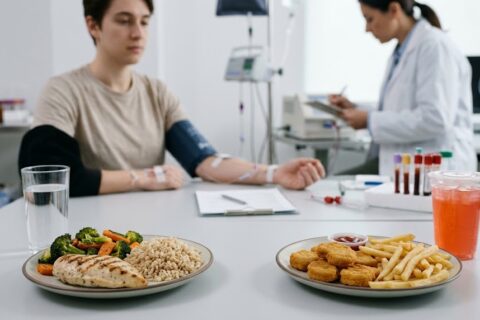
Teens who ate the most crisps, corn chips and popcorn had a 32% higher risk of bowel disease in a study of 111,999 kids. Fruit and fish cut Crohn’s risk


Inflammatory bowel disease, the umbrella term for Crohn’s disease and ulcerative colitis, has been rising worldwide, and what children eat is one of the leading suspects. Researchers pooled three birth cohorts from Norway, Denmark and Sweden covering 111,999 children whose eating habits were recorded twice between the ages of 7 and 15, then checked national patient registries up to 2024 for IBD diagnoses.
Teenagers who ate the most salty snacks, such as crisps, corn chips and popcorn, had a 32% higher risk of developing any form of IBD than those who ate the least. For ulcerative colitis specifically, the risk was 51% higher. Fruit and fish pointed the other way for Crohn’s disease: a high fruit intake in the teen years was linked to a 64% lower risk, a high fruit intake in childhood to a 34% lower risk, and a high fish intake in childhood to a 35% lower risk.
Fruit also produced the study’s most puzzling result. Children who ate a lot of fruit at around age 7 or 8 had a 54% higher risk of ulcerative colitis, even as the same habit was linked to less Crohn’s disease. Fruit eaten in the teen years showed no significant link with ulcerative colitis. The researchers did not find statistically significant associations for vegetables, dairy, meat or sugar-sweetened drinks.
The children came from the Norwegian Mother, Father and Child Cohort Study, the Danish National Birth Cohort and All Babies in Southeast Sweden, all of which enrolled families around the turn of the millennium. Parents or the children themselves filled in food frequency questionnaires at two points: ages 7 and 13 to 15 in Norway, 7 and 14 in Denmark, and 8 and 11 in Sweden. Over an average of 12 to 17 years of follow-up, 653 participants were diagnosed with IBD. Salty snacks were only asked about in the teen questionnaires.
The analysis adjusted for sociodemographic factors, conditions around birth, early-life exposures, whether a parent had IBD, and whether the mother smoked. Results held up largely unchanged when the team also accounted for antibiotic use in the first year of life and how long the children were breastfed.
The authors offer possible explanations rather than proof. “Fruits are thought to exert favourable effects on the gut microbiome,” they wrote, and fruit can increase the production of short-chain fatty acids that may calm inflammation. They suggested fibre may partly explain the Crohn’s link but noted that not all fibre behaves the same way. For fish, they pointed to long-chain omega-3 fats, writing that “polyunsaturated fatty acids play a central role in regulating inflammatory pathways.”
The work builds on a 2024 study in the same journal that used two of the same cohorts and found that a higher-quality diet and more fish at age 1 were linked to a lower risk of IBD later in childhood and adolescence. The new analysis extends the window into the school years and the early teens.
For parents, the practical message is modest and familiar. The findings fit with advice to keep salty packaged snacks as an occasional food and to make fruit and fish regular parts of children’s diets. If the results are confirmed elsewhere, the authors wrote, “promoting healthy dietary habits could be a potential strategy for IBD prevention.” Readers interested in how specific foods and drinks track with disease risk in large cohorts can also see the coffee and atrial fibrillation study and the beer, spirits and kidney injury study.
There are important caveats. This is an observational study, so it cannot show that crisps cause IBD or that fruit prevents Crohn’s disease. The team could not adjust for physical activity or for antibiotic use later in childhood, and it looked at single food groups rather than whole dietary patterns, so a heavy snack intake may simply mark a broader way of eating. The reports did not define in numbers what counted as high or low intake. IBD remains rare in children, so even a 32% higher relative risk translates into a small number of extra cases, and the cohorts were all Scandinavian.
Source
Guo A, et al. “Food group intake during childhood and adolescence and risk of IBD: a pooled study of three Scandinavian birth cohorts.” Gut, 2026.
DOI: 10.1136/gutjnl-2026-339600
Also cited
Guo A, et al. “Early-life diet and risk of inflammatory bowel disease: a pooled study in two Scandinavian birth cohorts.” Gut, 2024; 73(4): 590-600.
DOI: 10.1136/gutjnl-2023-330971