New research shows depression is a physical immune disorder rather than just a mood

Depression is a physical glitch in your grey matter. For decades, we have treated the condition as a phantom—a vague cloud of “chemical imbalances” or a lack of willpower that could be talked away in a therapist’s chair. But new data has finally pinned the ghost to the wall. Scientists at McGill University just identified the exact cellular coordinates of human despair.
Dr. Gustavo Turecki and his team didn’t just look at the brain; they looked into the individual lives of cells. By analyzing rare tissue from the Douglas-Bell Canada Brain Bank, they compared the brains of people who died with depression against those who did not. The results, recently published in Nature Genetics, show that your brain isn’t just “sad.” It is suffering from a specific biological failure in two very different types of cells.
The Exhaustion of the Excitatory Guard
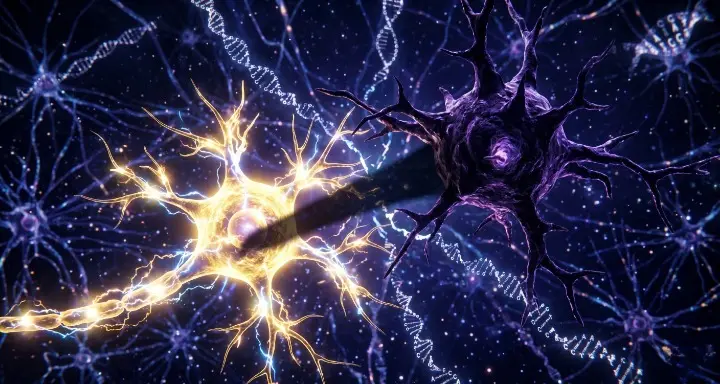
The first culprit is a group of excitatory neurons. These are the messengers responsible for regulating your mood and dictates how you respond to stress. In a healthy brain, these neurons fire with precision, helping you navigate the highs and lows of daily life. In a depressed brain, the gene activity within these cells is fundamentally altered.
These neurons are the engines of your emotional resilience. When their genetic code begins to misfire, the engine stalls. You don’t just feel “down”; your brain loses the physical capacity to regulate your response to the world around you. It is a disruption in the underlying machinery of the DNA itself. This discovery validates what many patients have felt for years: the struggle isn’t a failure of character, but a failure of circuitry.
The Guardians Turned Traitors
The second discovery is perhaps even more startling. The researchers found that a specific subtype of microglia—the brain’s dedicated immune cells—behave differently in people with depression. These cells are supposed to be your protectors. They are the cleanup crew that manages inflammation and keeps the neural environment pristine.
In the depressed brain, these microglia appear to be stuck in a state of malfunction. Instead of protecting the brain, they may be contributing to a cycle of inflammation that keeps the mind trapped in a dark loop. This suggests that depression might be as much an immune disorder as it is a psychiatric one. Your internal defense system, designed to keep you safe, may actually be the thing holding you under.
The Power of the Post-Mortem
This breakthrough was only possible because of a rare and somber resource: donated human brains. The study used samples from 59 individuals diagnosed with depression and 41 without, utilizing advanced single-cell genomic tools to map the RNA and DNA of thousands of individual cells.
This level of detail is unprecedented. We are no longer looking at the brain as a single, homogenous organ. We are looking at it as a vast, complex city where specific neighborhoods—and specific residents—are starting to crumble. By mapping gene activity alongside the mechanisms that regulate the DNA code, Turecki’s team has provided a high-definition map of a territory that was previously invisible.
The So-What Factor
This matters to you because it changes the goalposts for treatment. Current antidepressants are often a blunt instrument, splashing the entire brain with chemicals in the hope that something sticks. But now that we know exactly which cells are misbehaving, we can start talking about “precision psychiatry”.
Imagine a treatment that doesn’t just dull your emotions or tweak your serotonin levels globally, but instead goes directly to the malfunctioning excitatory neurons or the haywire microglia and resets them. This research provides the biological evidence needed to stop viewing depression as a purely “emotional” struggle. It is a measurable, physical change in the brain.
The End of the “All in Your Head” Myth
There is a profound sense of relief in this data. It moves the conversation away from the abstract and into the concrete. If you are struggling, it isn’t because you aren’t trying hard enough. It is because your excitatory neurons are struggling to manage stress at a genetic level. It is because your immune-related microglia are failing to maintain the balance of your neural environment.
The team at McGill is now moving toward investigating whether therapies targeting these specific cells could lead to more effective treatments. We are moving away from a world of trial-and-error prescriptions and toward a future where we fix the biological foundations of the disorder. The ghost has been caught, and for the 264 million people worldwide living with this condition, the path toward a real, physical cure has never been clearer.