
Scientists estimated that about 1 in 5 colorectal cancers worldwide is linked to a common stomach germ that more than four in ten people carry

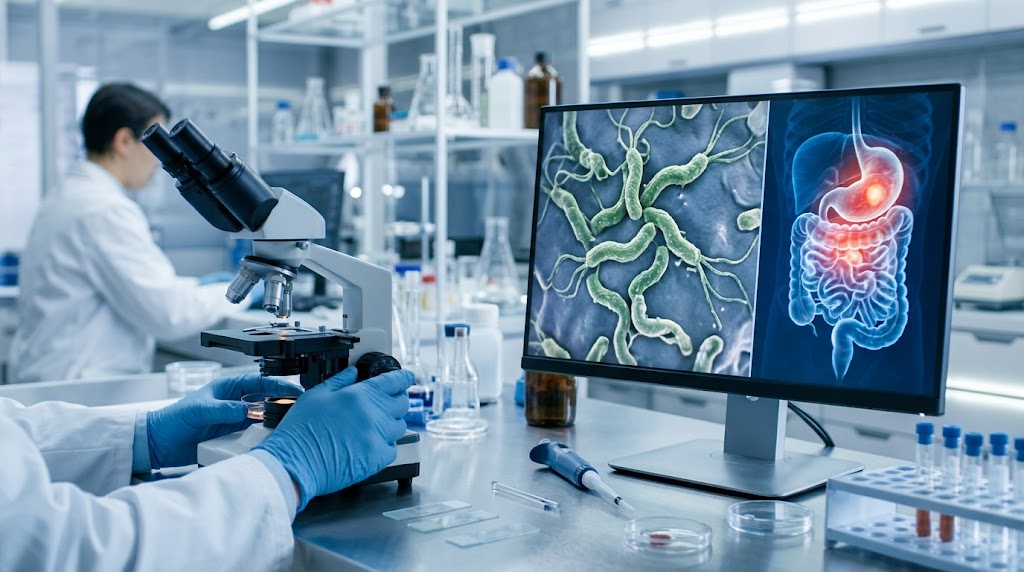
Helicobacter pylori is a stomach bacterium that more than four in ten people worldwide carry. It is a known cause of stomach ulcers and stomach cancer, and some studies have also tied it to cancer further down the gut. Researchers at the University of Hong Kong and UC San Diego pooled 43 earlier studies covering about 48.7 million people and combined them with global cancer data. They estimated how many colorectal cancers worldwide might be connected to the infection.
Their estimate: about 22% of colorectal cancer cases worldwide, or roughly one in five, may be linked to H. pylori exposure. Across the 43 studies, people who had been exposed to the bacterium had about 1.6 times the odds of colorectal cancer compared with people who had not.
That is a large share of a big disease. Colorectal cancer is the second leading cause of cancer death, with nearly 2 million new cases and about 900,000 deaths worldwide in 2022.
The estimate comes with a big caveat, and the authors spell it out. Linked does not mean caused, and one in five linked does not mean one in five preventable. When the researchers used only the five studies that followed healthy people forward over time, the stronger kind of evidence, the share dropped to about 12%.
The idea has been building for years. A 2019 review in PLOS Pathogens counted 40 case-control studies and six forward-looking studies on H. pylori and colorectal tumors, and noted that some studies had detected the bacterium in about a fifth to a quarter of the colorectal polyps or tumors they examined. Because H. pylori is more common in poorer communities, though, some of the link could reflect other differences in diet and living conditions.
The share varied a lot by region. It was highest in the Western Pacific, including China, Mongolia and Vietnam, where the infection is most common, and China had the largest absolute number of colorectal cancers potentially tied to it. The authors also suggest that people born in more recent decades may be at greater risk, an exploratory finding they say needs confirmation.
The second finding is a reminder of what matters most. Worldwide, the researchers write, diet, alcohol, obesity and physical inactivity account for a larger share of colorectal cancer than H. pylori does, especially in Western countries.
“These findings may inform primary colorectal cancer prevention strategies, particularly in regions with high H. pylori prevalence and limited resources,” the authors write. They call for long-term trials to test whether clearing the infection with antibiotics actually lowers colorectal cancer risk.
For individuals, the practical steps have not changed. H. pylori is diagnosed with a simple breath, stool or blood test and treated with a course of antibiotics, and people with stomach symptoms or a family history of stomach cancer can ask their doctor about testing. Colorectal screening remains the most effective way to catch the cancer early, whatever its cause. Diet still matters too, as a recent 19-year study of ultra-processed food and colorectal cancer showed.
There are limits to what this shows. Thirty-eight of the 43 studies compared people with and without cancer at a single point in time, which cannot show which came first. The headline figure depends on the assumption that the link is causal, which the study cannot test, and the authors describe it as an exploratory estimate, not a settled count.
Source
Li Y, et al. “Global and regional burden of colorectal cancer potentially related to Helicobacter pylori exposure: a risk attribution modelling study.” eGastroenterology, 2026.
DOI: 10.1136/egastro-2026-100436
Also cited
Butt J, Epplein M. “Helicobacter pylori and colorectal cancer: A bacterium going abroad?” PLOS Pathogens, 2019.
DOI: 10.1371/journal.ppat.1007861