Scientists found that the Gulf Stream is moving toward a tipping point that will freeze Europe

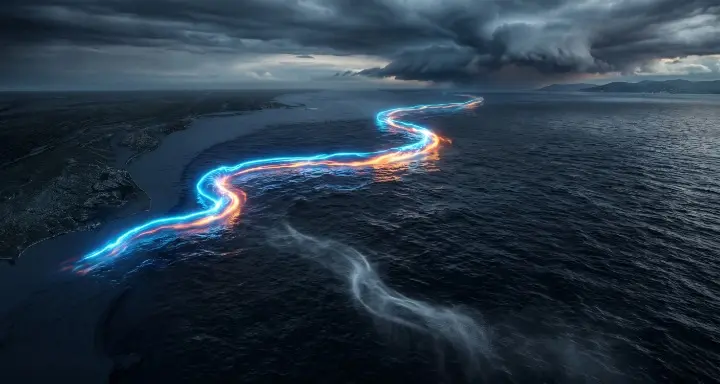
Imagine standing on the coast near Cape Hatteras, North Carolina. For generations, this has been the “Graveyard of the Atlantic,” where the warm, pulsing heart of the Gulf Stream detaches from the continental shelf and veers out into the deep blue of the open ocean. It’s an engine of staggering power, part of a global conveyor belt called the Atlantic Meridional Overturning Circulation (AMOC) that moves heat from the tropics to the freezing North. Without it, Europe would be an ice box and global weather patterns would descend into chaos.
For years, scientists have worried this conveyor belt is slowing down, but they’ve struggled to find a “smoking gun”—a clear, physical signal that the system is actually about to break. Now, they’ve found it. It isn’t a slow, quiet fade. It’s a violent, 219-kilometer jump.
In a study published in the journal Communications Earth & Environment, researchers René M. van Westen and Henk A. Dijkstra from Utrecht University have identified a terrifyingly simple early warning signal. They found that before the entire Atlantic circulation collapses, the Gulf Stream performs an abrupt northward lunge. And according to the latest satellite data, that lunge has already begun.
The 219-Kilometer Jump
To find this signal, the team used a high-resolution ocean simulation called POP (Parallel Ocean Program). Most climate models are too “blurry” to see the fine details of ocean currents, like looking at a masterpiece through a frosted window. But this simulation was sharp enough to track the Gulf Stream’s every move as the researchers slowly “poisoned” the Atlantic with freshwater—simulating the melting ice sheets that are currently diluting the ocean’s saltiness.
What they saw was a biological-style panic response from the ocean. As the AMOC weakened, the Gulf Stream didn’t just drift. At model year 392, it suddenly snapped northward by 219 kilometers in just two years. This isn’t just a change in a map; it’s a thermal explosion. In the simulation, this shift caused local sea surface temperatures to spike by a staggering 6.5°C in that same two-year window.
Why does this happen? The secret lies in the “Deep Western Boundary Current,” a massive river of cold, dense water flowing miles beneath the surface. This deep current acts like a physical barrier, a sort of underwater mountain of moving water that keeps the Gulf Stream pinned down to the south. As the global conveyor belt slows, this deep barrier vanishes. With nothing left to hold it back, the Gulf Stream surges north like a released spring.
The Twenty-Five Year Countdown
This discovery would be a fascinating academic footnote if it were only happening in a computer. But the researchers checked the simulation against thirty years of real-world satellite altimetry and sixty years of subsurface temperature records.
The reality is chilling. Since 1993, satellite data shows a significant northward trend in the Gulf Stream near Cape Hatteras. Subsurface observations going back to 1965 confirm it. The Gulf Stream is currently positioned further north than almost any time in recorded history, mirroring the exact behavior seen in the simulation just before the point of no return.
The “So What?” factor here is a ticking clock. In the models, this abrupt northward shift happens roughly 25 years before the entire AMOC system collapses. If the real-world shift we are seeing now follows that same physics-based script, we aren’t looking at a problem for the next century. We are looking at a tipping point that could arrive in the next few decades.
A Continent on the Edge
If you live in Europe, this isn’t just about warmer beaches in North Carolina. A collapsed AMOC means the end of the mild climate that has allowed European civilization to thrive for millennia. We are talking about extreme cold events, a massive drop in rainfall, and a total disruption of agriculture.
The study also found that as the Gulf Stream moves, it leaves a “warming hole” in its wake, while simultaneously allowing the Labrador Current to wither away. Without the Labrador Current acting as a cold barrier, the waters south of Newfoundland are seeing “accelerated warming” that matches exactly what the researchers predicted.
This isn’t a vague “maybe” anymore. The ocean is giving us a physical, measurable warning. We can see it from space. We can measure it with thermometers miles below the waves. The Gulf Stream is moving, and it’s telling us that the Atlantic’s life-support system is starting to fail.
The question is no longer whether the climate is changing, but how much time we have left before the conveyor belt stops entirely. If the 25-year window holds true, the clock is already at five minutes to midnight. The ocean has tripped the wire. Now, we wait to see if the rest of the system follows.