Your personality may predict how long you live, massive new study suggests

Disorganized people die earlier than their disciplined peers. It is a blunt, statistical reality drawn from a massive metadata haul covering 569,859 individuals across four continents. While we obsess over cholesterol levels and gym routines, a landmark systematic review led by Máire McGeehan at the University of Limerick suggests that the way you think, feel, and behave is one of the most critical determinants of how long you live.
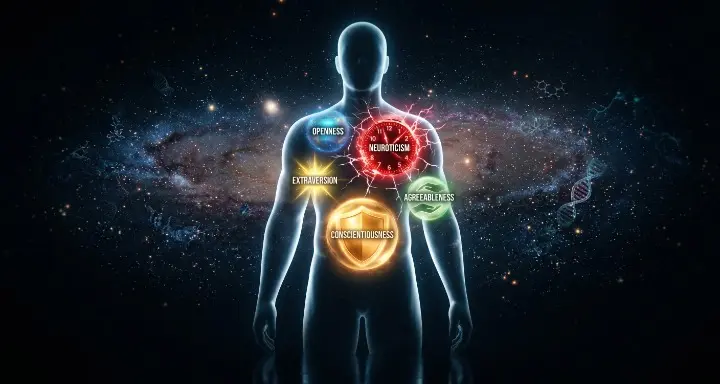
The research, recently published in the Journal of Personality and Social Psychology, analyzed nearly 6 million person-years of data to see how the Big Five personality traits dictate your final chapter. The results aren’t psychological curiosities. They are biological warnings. Your personality permeates your biology, influencing everything from the way your mitochondria produce energy to the level of inflammation running through your veins.
The Premature Ticking of the Worried Mind
If you are prone to chronic worry, anxiety, and emotional instability, a trait psychologists call neuroticism, your internal clock is likely ticking faster than it should. The study found that high neuroticism is a robust predictor of premature death. But the startling part is that the effect is significantly stronger in younger people.
For younger populations, neuroticism acts as a biological accelerant. It drives coping mechanisms like smoking and creates a state of cumulative physiological stress that wears down your organs before they’ve reached their prime. It isn’t just feeling stressed. It is a systemic failure to regulate the body’s response to the world. The trait has been linked to everything from Alzheimer’s disease to accelerated telomere shortening, effectively aging you from the inside out.
The Self-Discipline Shield
Conscientiousness, by contrast, is the closest thing the human psyche has to a suit of armor. If you are orderly, goal-directed, and self-disciplined, you are significantly more likely to see your 80th or 90th birthday. This isn’t magic. It is the result of thousands of small protective choices made over a lifetime. Conscientious people use preventative cancer screenings more often, stick to their medication schedules, and avoid the dietary traps that lead to metabolic collapse.
The researchers found something revealing when they adjusted for biological markers like BMI and blood pressure. When these physical indicators were accounted for, the protective effect of conscientiousness weakened considerably. This suggests that self-discipline buys you extra years specifically by keeping your weight and your heart in check. If you are disorganized and impulsive, you aren’t just messy. You are physically degrading your body’s ability to manage its own survival.
The Geographic Protective Shield
One of the more unexpected findings in McGeehan’s meta-analysis involves extraversion. Being social and active is generally protective, but only if you live in North America or Australia. In European and Japanese samples, the health benefit of being a people person essentially disappeared.
Why does your location change the health value of your social life? The researchers suggest it may come down to person-culture fit. In highly individualistic societies, extraversion tends to lead to better social integration and higher income, which in turn means better healthcare access. In more egalitarian or collectivistic cultures, the health benefits of being outgoing are far weaker. Your social tendencies, it turns out, are only as healthy as the economic environment you inhabit.
The Mitochondrial Ledger
We are beginning to see these traits at the molecular level. Personality isn’t just in your head. It shows up in your C-reactive protein and interleukin-6 levels, both markers of systemic inflammation. High neuroticism and low conscientiousness have been directly linked to these markers, suggesting that a turbulent inner life keeps your body in a state of constant low-grade biological stress.
Recent findings even connect personality traits to mitochondrial health. Your cells’ power plants are literally more efficient if you are disciplined and emotionally stable. This creates what researchers call a mitochondrial mediation of mortality. If your personality feels like a burden, your cells are carrying that burden too. The pathways are measurable: your emotional patterns today are the biological blueprints for your health a decade from now.
The End of the Personality as Preference Myth
For too long we have treated our traits as simple preferences. I’m just a worrier. I’m just disorganized. This meta-analysis, spanning 43,851 recorded deaths, proves that these are clinical risk factors. Your level of neuroticism and your capacity for self-discipline are not personality quirks. They are predictors with the same statistical weight as your socioeconomic status or your intelligence when it comes to when you die.
The practical takeaway is a shift in how we think about self-improvement. Working on your organizational habits or managing your anxiety isn’t about becoming a better person. It is closer to medical intervention. Stop looking only at your blood work and start looking at your behavior. Your character may be the most accurate predictor of your lifespan that has ever been assigned to you.