Researchers use CRISPR to selectively destroy cancer cells with specific mutations

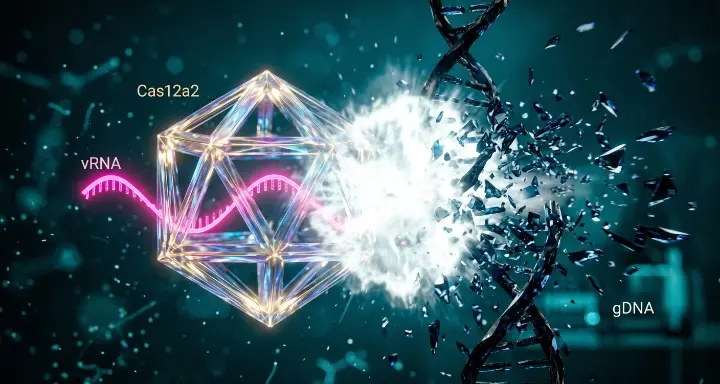
The double helix was shredded into a billion useless pieces. This isn’t the work of a blunt-force chemotherapy drug or a blast of radiation, but a molecular shredder that knows exactly which cell deserves to die. While the world has spent a decade obsessing over CRISPR as a surgical scalpel for gene editing, a team of researchers led by Paul Scholz and Ryan Jackson just unveiled CRISPR’s dark twin: a nuclease that acts as an executioner.
Their findings, recently published in Nature, describe a newly discovered type V CRISPR nuclease called Cas12a2. Unlike the famous Cas9, which makes a precise cut to swap out a gene, Cas12a2 is a biological trap. Once it recognizes a specific RNA password, a transcript that shouldn’t be there, it doesn’t just cut. It unleashes a rampant wave of double-stranded DNA breaks. It effectively forces the cell to tear its own blueprint to ribbons.
The Failure of the Scalpel
We have been trying to use CRISPR to kill bad cells for years, but we’ve mostly been using the wrong tool. When you use a standard nuclease like Cas9 to cut DNA in human cells, the cell doesn’t necessarily die. It just tries to fix the damage using repair pathways like non-homologous end joining. You end up with a slightly different gene, but a cell that is very much alive.
Cas12a2 changes the math because it doesn’t care about repair. Once triggered by a target transcript, its nuclease activity becomes indiscriminate. It attacks any double-stranded DNA it can find in the nucleus. This isn’t a surgical edit. It is an SOS response that leads straight to mitotic catastrophe and programmed cell death. The researchers proved this by watching yeast and human cells essentially vanish after the protein was activated.
Hunting the Virus Within
One of the most immediate implications of this research is the possibility of a biological search-and-destroy mission for viruses. The team targeted cells harboring high-risk variants of Human Papillomavirus. Because viral transcripts are entirely foreign to the human body, they serve as the perfect trigger.
When the researchers delivered the Cas12a2 machinery into a mixed cell population, it ignored the healthy cells entirely. But as soon as it encountered an HPV-infected cell, the shredder turned on. In laboratory tests, they achieved a 94% reduction in HPV-infected cells. They even took this into a live scenario, using a mouse model with implanted human tumors. Intratumoral injections of the molecular shredder significantly stunted tumor growth, proving that a disease can now be targeted based on the transcriptional profile of a single cell.
The Single-Base Execution
Perhaps the most startling capability of Cas12a2 is its single-nucleotide resolution. Most drugs struggle to tell the difference between a healthy protein and a mutated one that drives cancer. The researchers tested Cas12a2 against KRASG12C, a notorious oncogenic mutation responsible for tumor growth in many patients.
By designing a guide RNA sensitive to a single-letter change in the genetic code, they were able to kill cells expressing the mutated KRAS while leaving the healthy versions of the same gene completely untouched. Even when healthy cells were overexpressing the normal gene, the shredder stayed dormant. It is a level of precision that finally puts the so-called undruggable within reach. The researchers also showed this could work alongside existing FDA-approved drugs like sotorasib, producing a synergistic effect that killed over 85% of cancer cells.
The End of the Off-Target Nightmare
The primary fear with any CRISPR technology is that it will go rogue and cut something it shouldn’t. But because Cas12a2 is triggered by RNA, the researchers found that off-target activation is almost nonexistent. It requires a near-perfect match to the RNA trigger before the shredder turns on. In their tests, even a tiny mismatch in the guide RNA was enough to keep the nuclease completely dormant.
This also makes it a powerful cleanup tool for other gene editing therapies. If only 10% of a cell population receives the correct edit, Cas12a2 can be used to eliminate the unedited failures. By counterselecting against those cells, the researchers were able to enrich for prime-edited cells by up to 4.3 times.
The Future of Programmable Death
This discovery isn’t just about another CRISPR tool. It represents a fundamental shift in how medicine could work. We are moving away from chemicals that poison the whole body and toward molecular machines that wait for a specific transcriptional identity before they strike.
Whether clearing out a chronic viral infection, purging cancer cells carrying specific mutations, or ensuring that a gene-editing therapy reaches full success, the shredder offers a level of control medicine has never had before. The researchers are already exploring ways to package these molecular executioners into lipid nanoparticles, the same delivery technology used in mRNA vaccines, to send them directly to where they are needed. The logic is simple: if a cell is expressing a disease, its own transcript will be the very thing that triggers its destruction.