Scientists found a way to borrow immune strength from healthy strangers to stop terminal disease
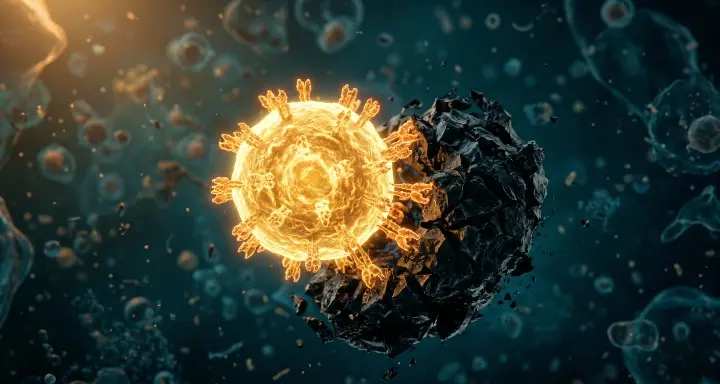
Only 1.2 percent of cancer mutations actually trigger an immune response. It is a startlingly low number that explains why, for many, the promise of “personalized vaccines” remains a distant hope rather than a clinical reality. Your body identifies a tumor, sees the genetic glitches—the “neoantigens”—and often decides to do absolutely nothing. It isn’t just that the cancer is hiding; it’s that your defenders have given up.
A team of researchers led by Hong Kai Teo and Shuting Han at the National University of Singapore recently published findings in Science Advances that suggest we’ve been looking for the cure in the wrong bodies. They didn’t look deeper into the sick. They looked into the healthy. What they found was a biological disconnect that could rewrite how you think about immunotherapy.
The Exhaustion of the Self
When you fight a chronic illness like liver cancer (HCC) or colorectal cancer (CRC), your T cells—the infantry of your immune system—undergo a brutal war of attrition. By the time a doctor tries to “train” these cells with a vaccine, the cells are often functionally dead. They are senescent. They are exhausted. They are essentially staring at the enemy and refusing to pull the trigger.
This isn’t just a theory. The researchers tracked patients through a Phase 2 clinical trial involving dendritic cell vaccines. They found that even after multiple rounds of vaccination, many patients’ T cells remained stubbornly silent. In one case, a patient named B04 received four cycles of a cutting-edge vaccine but showed zero immune reaction to the targets. The cancer returned shortly after. The problem wasn’t the vaccine’s design. The problem was the “fitness” of the patient’s own biological machinery.
Borrowing Fire from Strangers
If your own cells are too tired to fight, why not use someone else’s? This is where the team’s strategy shifts from standard medicine to something resembling high-tech biological scavenging. They took blood from healthy donors and “matched” them to patients using HLA markers—basically the biological zip codes that allow cells to talk to one another.
The results were lopsided. While a patient’s T cells recognized only a tiny sliver of their tumor’s mutations, healthy donor T cells saw a “broader spectrum” of targets. These “fresh” cells from strangers were able to spot mutations that the patients’ own systems had completely ignored.
Think of it like a cold case. The patient’s immune system has been looking at the evidence for years and has become blind to the clues. A healthy donor’s immune system walks into the room with fresh eyes and immediately spots the killer. In the lab, these donor cells didn’t just “see” the cancer; they went on the offensive.
The Elite Hunter Receptors
The “wow-effect” here isn’t just about using donor blood. It’s about the receptors—the TCRs. These are the specialized “hooks” on the surface of T cells that allow them to grab onto a cancer cell and destroy it.
The Singapore team, including Gloryn Chia, found they could harvest these elite receptors from healthy donors and “copy-paste” them into the patient’s exhausted cells. They tested this on “organoids”—miniature, lab-grown versions of a patient’s actual tumor.
In one experiment, they took a receptor from a donor (named HD9) that recognized a specific mutation called DDX19B. When they engineered this donor receptor into the T cells of patient A02, the result was a slaughter. The newly armed cells didn’t just recognize the tumor; they triggered a massive release of Caspase-3/7, a chemical signal for cell death. The tumor cells began to pop and wither in the dish.
Beyond the Vaccine Dead End
This discovery suggests that for many of you, a personalized vaccine might never be enough. If your T cells are intrinsically defective or depleted by previous rounds of chemotherapy, a vaccine is like screaming orders at a soldier who has already collapsed from heatstroke.
By building a library of these high-performance receptors from healthy people, we might move toward “off-the-shelf” treatments. Instead of waiting weeks to manufacture a vaccine that might not work, doctors could eventually select a pre-validated donor receptor that fits your specific tumor mutation and “re-arm” your immune system in days.
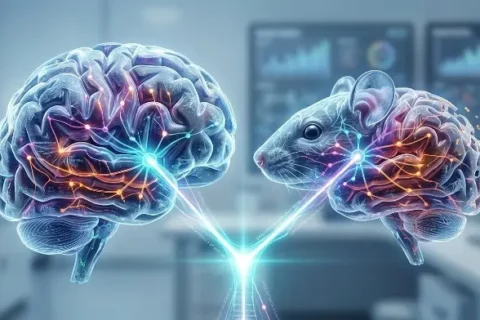
It changes the narrative of “us versus the disease.” It turns out the weapon you need to survive might be circulating in the veins of a complete stranger right now. The researchers even proved this in mice, showing that these donor-derived receptors could shrink established tumors that were otherwise invincible.
The 1.2 Percent Problem
We are currently trapped in a cycle where we only treat what the patient’s body already knows how to fight. But as Teo’s team demonstrated, healthy donors can react to 16 different neoepitopes while patients struggle to find even one.
This isn’t just about a “new era” or a simple “breakthrough.” It is a fundamental shift in how we view the “self” in medicine. Your body has limits. Your immune system has a shelf life. But the human species, as a collective, has a massive library of defenses that we are only just beginning to tap into. For the patients who saw no results from their vaccines, this “borrowed” immunity isn’t just a scientific curiosity. It’s the difference between a recurrence and a clean bill of health.