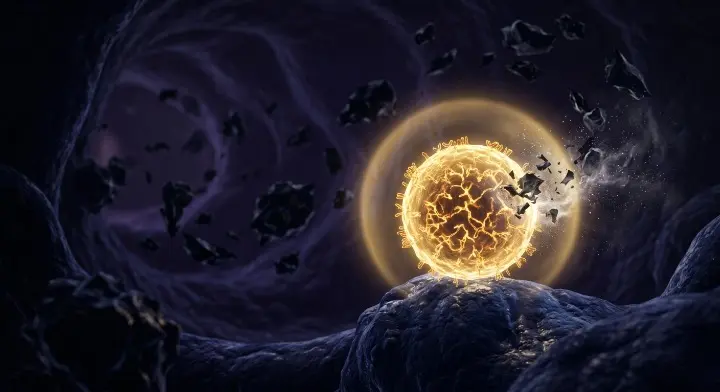
Imagine a surgeon telling you they “got it all.” In the world of pancreatic cancer, that sentence is rarely the end of the story. It is usually just the start of a high-stakes countdown. This is a disease that kills 88% of those it touches, largely because it doesn’t just grow—it hides. You have the surgery, you go home, but the “ghost” of the tumor remains in your bloodstream, a single microscopic cell waiting for its moment to return. Historically, for about 80% of patients, that return happens within just three years.
But what if you could leave a sentry behind? What if you could train a specialized force of cells to spend the next decade patrolling your body, specifically looking for that one runaway cancer cell?
New research published in the journal Nature suggests we’ve finally found a way to do exactly that. A team of scientists, led by Vinod Balachandran at Memorial Sloan Kettering Cancer Center, has been tracking a group of patients who received a highly personalized mRNA vaccine called autogene cevumeran. The results aren’t just promising; they’re bordering on the science-fictional. They found that these vaccines can “prime” the immune system to create T cell clones with an average lifespan of 7.7 years. Some of these cells are projected to live for decades. Some might even outlive their hosts.
The Bespoke Blueprint
Pancreatic ductal adenocarcinoma (PDAC) is an “immunologically cold” killer. It doesn’t have many mutations, which means the immune system usually just walks right past it, unable to recognize the threat. To fix this, the researchers took a biopsy of each patient’s tumor and sequenced its DNA. They looked for “neoantigens”—tiny, misshapen proteins that only exist on the cancer cells.
Using this data, they printed a custom mRNA vaccine for every single person in the trial. This isn’t a one-size-fits-all flu shot. This is a digital blueprint of your specific enemy. When injected, the vaccine teaches your CD8+ T cells—the “special forces” of your immune system—exactly what that enemy looks like.
The study followed 16 patients who had their tumors surgically removed. Eight of them responded to the vaccine, creating a massive wave of these specialized hunters. The other eight did not. The difference in their survival is stark. For the non-responders, the median time before the cancer came back was just 13.4 months. For the responders? They haven’t even reached the median yet. At the 3.2-year mark, most of them are still cancer-free.
The 7.7-Year Sentry
The most staggering revelation in the data is the sheer longevity of these cells. Usually, when the body fights an infection, the “effector” T cells do their job and then die off. But these vaccine-induced hunters are built different.
The researchers used a computational strategy called CloneTrack to watch these cells over time. They found that while the initial “priming” doses created the army, a single boost dose extended their life expectancy by sevenfold. These cells didn’t just linger; they thrived. About 20% of the T cell clones were found to have “latent multi-decade lifespans”.
Even three years after the vaccination, 86% of these clones were still circulating in the blood at high frequencies. They were still ready to kill. When the researchers “challenged” these cells with pieces of the tumor in a lab dish, the T cells immediately produced poison to dismantle them. They hadn’t forgotten their mission.
HOBIT: The DNA of Persistence
Why don’t these cells get “tired” and stop working, as often happens in chronic diseases? The team looked at the genetic signature of over 9,000 individual cells to find out. They discovered that the vaccine pushes the T cells into a very specific state.
They don’t become standard “memory” cells. Instead, they overexpress a core transcription factor called ZNF683, also known as HOBIT. This gene is the hallmark of “tissue-resident memory” cells—tough, long-lived guardians that usually hunker down in specific organs to prevent reinfection.
The vaccine-induced cells seem to have the best of both worlds: the stamina and killing power of a tissue-resident cell, but with the ability to circulate through the blood. They are effectively a “circulating resident” force, patrolling the entire body for any sign of a recurring tumor.
Pruning the Garden
The real-world proof of this strategy came from two patients who actually did have their cancer start to return. When the researchers looked at the new tumors, they found something fascinating: the cancer had “evolved”. The specific clones of cancer that the vaccine had targeted were gone—pruned away by the T cells.
The cancer only managed to return by growing new branches that didn’t have the “red flags” the T cells were trained to see. This suggests the vaccine was working with such lethal efficiency that it forced the cancer to change its entire genetic makeup just to survive.
What does this mean for you? It means we are moving away from the era of “poisoning” the whole body with chemotherapy and toward an era of “programming” it. If a vaccine can create a sentry that lives for nearly a decade in a disease as aggressive as pancreatic cancer, the same logic could apply to almost any tumor. We aren’t just treating the disease anymore. We are installing a permanent security system. The war against cancer has always been a game of hide-and-seek. Now, for the first time, we have hunters that never stop looking.