A new trial found that about 30 percent of the weight people lose on tirzepatide is muscle, and a second drug can cut that in half

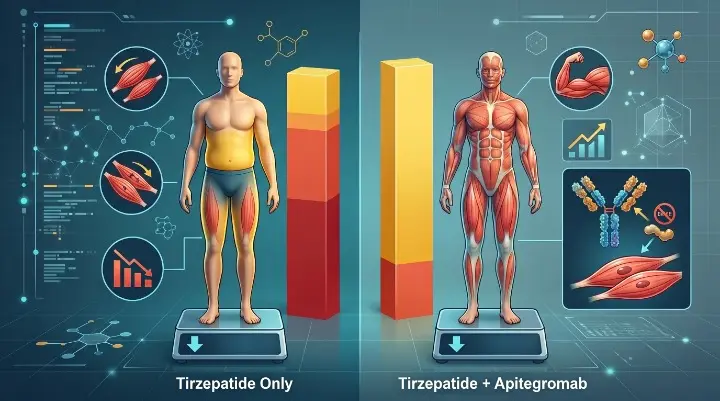
Roughly 30 percent of the weight people lose on tirzepatide, the drug sold as Zepbound and Mounjaro, isn’t fat. It’s lean mass, made up mostly of skeletal muscle. This has been one of the most persistent concerns about GLP-1 class weight loss drugs since they went mainstream: the scale goes down, but a meaningful chunk of what’s disappearing is muscle, not fat, with potential downstream effects on strength, metabolism, and long-term health.
A phase 2 trial published in Nature Medicine tested whether adding a second drug could change that ratio. The trial, called EMBRAZE, randomized 102 adults with overweight or obesity to receive tirzepatide plus either apitegromab or a placebo. After 24 weeks, the apitegromab group lost 1.9 kilograms, about 4.2 pounds, less lean mass than the placebo group, while losing essentially the same amount of total body weight and a comparable amount of fat. That’s a 54.9 percent reduction in the muscle loss normally seen with tirzepatide alone.
What apitegromab actually does
Apitegromab isn’t a new GLP-1 drug. It’s a fully human monoclonal antibody that targets myostatin, a protein whose entire job is to put the brakes on muscle growth. Block myostatin, and the body’s normal limits on building and retaining muscle loosen. The drug was originally developed for spinal muscular atrophy, a neuromuscular disease, by the biotech company Scholar Rock, and is now being tested in a completely different context: as a add-on to make weight loss drugs preserve muscle while still burning fat.
In the trial, participants on tirzepatide plus apitegromab ended up with a weight loss composition of roughly 85 percent fat and 15 percent lean mass. The placebo group, on tirzepatide alone, lost weight in a roughly 70 percent fat, 30 percent lean mass split. Total weight loss was similar between the two groups, around 12 to 13 percent of body weight over six months. The difference wasn’t how much weight came off. It was what kind of weight came off.
Why losing 30 percent muscle matters in the first place
Skeletal muscle isn’t just about strength and appearance. It’s a major site of glucose disposal, meaning it plays a direct role in blood sugar regulation, which matters enormously for the type 2 diabetes and metabolic syndrome patients who make up a large share of GLP-1 drug users. Muscle also helps maintain resting metabolic rate, supports balance and fall prevention in older adults, and is one of the strongest predictors of long-term physical function and independence as people age.
Losing a large proportion of lean mass during rapid weight loss, especially in older adults or people who were already at risk of sarcopenia, can leave someone lighter on the scale but functionally weaker and metabolically worse off than the number alone suggests. This is part of why some clinicians have pushed back on framing GLP-1 weight loss purely in terms of pounds lost, and why resistance training has increasingly been recommended alongside these drugs.
What this doesn’t solve
This was a 24-week, 102-person proof-of-concept trial, not a long-term outcomes study. It establishes that apitegromab can shift the composition of weight loss in the direction clinicians want, but it doesn’t yet tell us whether that translates into measurably better strength, fewer fractures, lower long-term diabetes risk, or any other downstream outcome that would actually matter to a patient’s daily life. Dr. Brendan Gabriel, a muscle metabolism researcher at the University of Aberdeen who reviewed the findings independently, noted that larger and longer trials are still needed, particularly in people with diabetes and cardiovascular disease, before this becomes a real clinical option.
It’s also not a replacement for the advice already given to people on these drugs: resistance exercise and adequate protein intake remain the most accessible, already-available tools for limiting muscle loss during GLP-1 treatment, and the researchers themselves frame apitegromab as something that could help people who, for whatever reason, aren’t able to combine tirzepatide with that kind of exercise and nutrition program, not as a substitute for it.
Where this fits in the bigger picture
This trial is part of a broader wave of research trying to solve the muscle-loss problem with GLP-1 drugs through pharmacology rather than relying entirely on lifestyle changes that many patients struggle to sustain. Myostatin inhibitors like apitegromab were originally built for a completely different disease, and their move into the obesity and metabolic space is a direct response to how widespread tirzepatide and semaglutide use has become, and how consistently the muscle loss issue has shown up across real-world use.
For the tens of millions of people currently on these drugs, or considering starting them, this is still an investigational combination years away from being something a doctor can prescribe. But it’s the first randomized, placebo-controlled evidence that the muscle loss problem isn’t necessarily an unavoidable side effect of GLP-1 weight loss. It may be a separate, targetable mechanism that can be addressed without giving up the fat loss the drugs are designed to produce.
Sources:
Pratley, R.E., Denham, D.S., Trivedi, R. et al.
Apitegromab for lean mass preservation during tirzepatide-induced weight loss: a randomized, double-blind, placebo-controlled phase 2 trial.
Nature Medicine, June 8, 2026.
nature.com/articles/s41591-026-04440-4
medicalxpress.com/news/2026-06-drug-apitegromab-muscle-loss-weight.html
sciencemediacentre.org/expert-reaction-to-study-investigating-a-drug-apitegromab-to-help-to-preserve-lean-body-mass-during-weight-loss-with-tirzepatide