A Google Research study published in Nature found that the front camera measuring your face when you unlock your phone contains enough data to track your heart health continuously

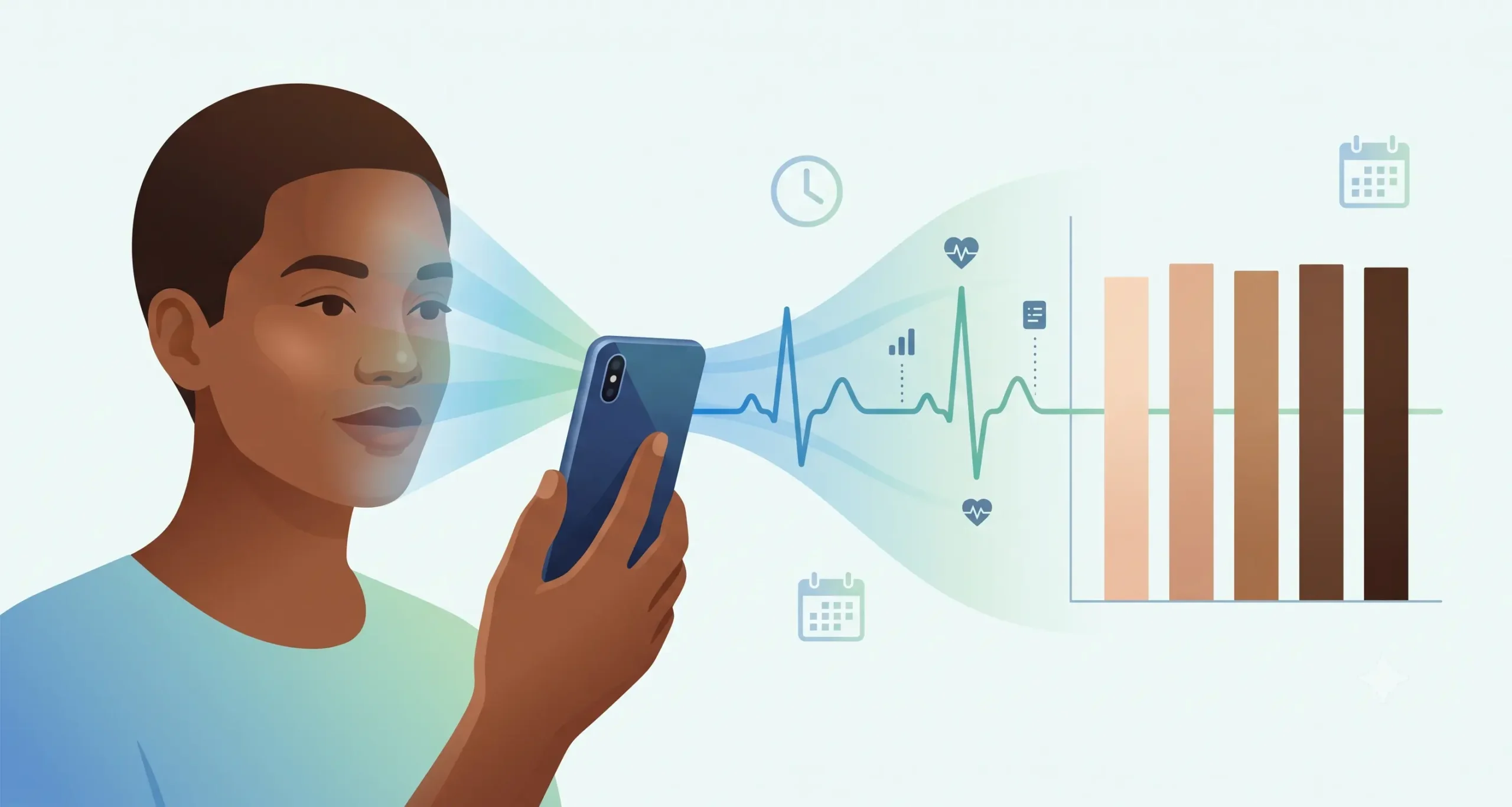
Every time you unlock your phone, your face is being filmed for about eight seconds. You probably knew that, in a vague way, because you set up face recognition yourself. What you almost certainly did not know is that those same eight seconds of footage contain enough information for an AI system to measure your heart rate with clinical accuracy, and that Google Research has now demonstrated this at a scale and reliability level that meets industry standards across all skin tones.
The research, published in Nature on June 1, 2026 by a team at Google Research and the University of Washington, describes a system called Passive Heart Rate Monitoring, or PHRM. It works in the background during normal phone use, requiring no action from the user, no wearable device, and no deliberate measurement. The camera that unlocks your phone is already, with the right software, a medical-grade cardiovascular monitoring tool. The footage has been there the entire time. The question was whether it could be read.
The Physics the Camera Was Always Capturing
The technique underpinning PHRM is called remote photoplethysmography. The principle is straightforward even if the engineering is not. When your heart beats, blood pressure pulses through the capillaries in your face, changing the volume of blood in the skin with each cycle. This change in blood volume alters how the skin absorbs and reflects light at the surface. The change is completely invisible to the naked eye, on the order of subtle color fluctuations occurring across the skin with each pulse. But a camera sensor capturing video of your face in good lighting is recording those fluctuations in every frame.
The system records an eight-second video clip of the user’s face whenever the phone is unlocked, then employs a deep learning system to detect minute changes in light reflected from facial skin caused by blood flow through capillaries. Multiple readings taken throughout the day are then aggregated to estimate daily resting heart rate, a biomarker closely linked to cardiovascular health and mortality risk.
The average person unlocks their smartphone 144 times per day. Each of those unlocks, under the PHRM system, is a brief cardiovascular measurement taken in a natural resting or near-resting state, distributed across the day and averaged into a daily resting heart rate figure that tracks health changes over time. This is precisely the kind of longitudinal, passive monitoring that cardiologists and epidemiologists have wanted for decades but have only been able to achieve by strapping monitoring equipment to people who agreed to participate in a study.
The Validation That Makes This Different
The gap between a promising proof-of-concept and a clinically relevant technology is filled by validation data, and the scale of the validation behind PHRM is what distinguishes it from the many smartphone health monitoring ideas that have not made it out of the laboratory.
More than 192,000 videos from 485 participants were used to train the neural network. The system was validated on 162,546 additional videos from 211 participants in laboratory and real-world conditions, representing the largest validation study of its kind.
Against electrocardiogram ground truth, the system achieved a mean absolute percentage error below 10% across all tested skin tone groups, meeting industry accuracy standards for heart rate measurement. For daily resting heart rate estimation, its performance came within five beats per minute of a Fitbit Charge 6, which is the category of wearable tracker that currently serves as the consumer standard for passive cardiovascular monitoring.
The system used colorimetric methods and the Monk Skin Tone scale to assess performance across a range of skin tones, including light, medium, and dark skin groups, with dark skin representing at least 33% of the datasets. This equity focus matters because photoplethysmography-based technologies have historically performed less reliably on darker skin, and the finding that PHRM achieved equivalent accuracy across all three groups is one of the more clinically significant aspects of the validation.
What Resting Heart Rate Actually Tells You
Resting heart rate is not just a fitness metric. It is one of the most powerful predictors of long-term cardiovascular health available from a non-invasive measurement.
A higher resting heart rate and, critically, an increasing resting heart rate over time are both associated with major adverse cardiovascular events and all-cause mortality. The relationship is independent of other risk factors. Someone whose resting heart rate creeps upward by five beats per minute over six months is carrying a biological signal about their cardiovascular system that is clinically meaningful even if they feel fine, even if their blood pressure is normal, and even if their last checkup showed nothing unusual.
The problem has always been measurement. A resting heart rate taken at a single clinical appointment is a snapshot under conditions that may not represent the person’s true baseline. Anxiety about the appointment, the walk from the parking lot, the time of day, all of these introduce noise that a single measurement cannot filter out. Continuous passive monitoring across 144 daily readings, averaged into a daily resting heart rate figure tracked over weeks and months, produces a signal of entirely different quality. PHRM-derived resting heart rate measurements demonstrated greater day-to-day consistency than traditional clinical methods, suggesting that the passive, frequent nature of the measurements offers advantages beyond mere convenience.
The validation study also confirmed that PHRM-derived resting heart rate associated with known cardiovascular risk factors in the expected directions. Participants with higher resting heart rates as measured by PHRM were more likely to have higher body mass index and lower cardiovascular fitness as measured by VO2 max. The system was not just measuring accurately against a reference device. It was capturing biological reality.
Five Billion People Without a Wearable
The demographic argument for this technology is the one that runs through every paragraph of the Google Research paper even when it is not explicitly stated. Wearable heart rate monitors are owned primarily by people who are already health-conscious, already affluent enough to purchase discretionary health technology, and already engaged enough to charge and wear a device consistently. The populations at highest cardiovascular risk are disproportionately outside that group.
Around 69% of adults globally and 90% in the United States own a smartphone, with an average of 144 interactions with the device each day. Nearly five billion people carry a device that is, under this framework, already a passive cardiovascular monitor. The barrier to access is not hardware. It is software and deployment decisions that have not yet been made.
The PHRM paper is a research publication, not a product announcement. The system is not currently deployed in any consumer device. Google has released the AI model and the dataset publicly for research purposes, framing this as a foundation for further development rather than a finished tool. The company’s own blog post describing the work was careful to note that questions of user consent, data privacy, and the appropriate clinical use of continuous passive biometric monitoring remain to be worked through before any deployment would be responsible.
The Questions the Technology Opens
The cardiovascular monitoring application is the one Google’s research addresses directly, but it is not the only application that resting heart rate data collected this way could serve. Resting heart rate is sensitive to fever and systemic infection, often rising before other symptoms appear. It tracks recovery from illness and overtraining in athletes. It responds to sleep deprivation, chronic stress, alcohol consumption, and the early physiological effects of several medications. A passive daily resting heart rate measurement is, in effect, a broad-spectrum physiological check-in that the person receives without doing anything beyond using their phone in their ordinary way.
The privacy dimension of this is where the research prompts questions it does not fully answer. An eight-second facial video taken every time a person unlocks their phone, processed by an AI system to extract cardiovascular data, is a biometric surveillance capability of considerable power. Google has been explicit that the current research system is designed with privacy in mind and that any future deployment would require explicit user consent and transparent data handling. The gap between what the technology can do and what governance structures currently exist to regulate how it is used is one that the research community, regulators, and platform companies will need to close before passive health monitoring at this scale becomes routine.
What the Nature paper establishes is the technical foundation. The phone you are holding right now contains the hardware to passively monitor one of the most important cardiovascular biomarkers known to medicine. It has contained that hardware since the first smartphone with a front-facing camera shipped. The footage has been generated 144 times a day for years. The question the PHRM research answers is whether the signal was always there. It was.
Sources:
Liao, S., Di Achille, P., Wu, J., et al. Passive heart-rate monitoring during smartphone use in everyday life. Nature, June 1, 2026. DOI: 10.1038/s41586-026-10507-6
research.google/blog/towards-passive-heart-health-monitoring-via-smartphone-camera