A study of 4.2 million people found that exercise prevents dementia, but only the kind you choose to do. Physical activity at work was linked to 20% higher dementia risk.

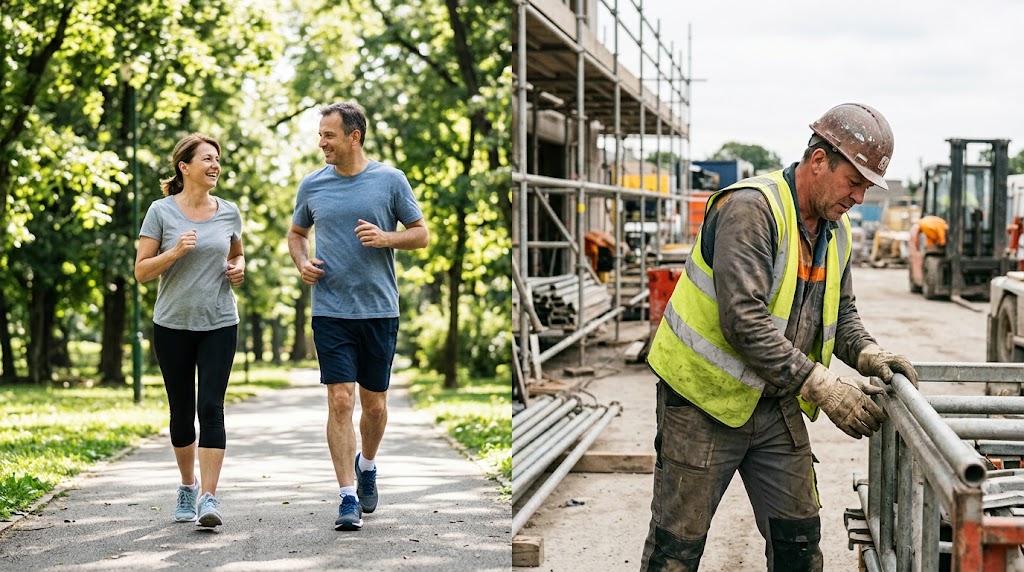
Exercise has become one of public health’s most confident recommendations for brain health. The evidence base is large and consistent: people who are physically active in their leisure time develop dementia at lower rates than sedentary people, and the relationship is dose-dependent, meaning more activity is associated with more protection up to a point. The biological mechanisms are plausible and documented. Exercise increases cerebral blood flow, reduces neuroinflammation, promotes the release of brain-derived neurotrophic factor which supports neuron growth and maintenance, and improves cardiovascular health in ways that directly benefit the brain.
The message that followed has been simple: exercise more, protect your brain.
A meta-analysis published in The Lancet Public Health has examined whether that message captures the full picture, and found that it does not. The study, led by Professor David Raichlen of the USC Dornsife College of Letters, Arts and Sciences and first author Natan Feter, analyzed data from 74 cohort and case-control studies involving more than 4.2 million participants across 30 countries, with a mean follow-up period of 10 years. Rather than treating all physical activity as equivalent, the researchers divided it into four distinct domains: leisure-time activity, occupational activity, household activity, and active commuting.
The results showed that the domain in which physical activity occurs matters as much as the activity itself.
Leisure-time physical activity was associated with a 24% lower risk of all-cause dementia. Household activity was associated with a 15% lower risk, though this finding came from only one study and requires replication. Occupational physical activity was associated with a 20% higher risk of dementia. Active commuting, including walking or cycling to work, was associated with a 10% higher risk, though this was based on only two studies.
The same human body, moving in the same way, produces opposite outcomes depending on whether that movement is chosen or required.
Why the paradox exists
The physical activity paradox, the observation that physically demanding jobs do not confer the same health benefits as leisure-time exercise, was first documented in cardiovascular research more than a decade ago. Workers in manual occupations have higher rates of cardiovascular disease than their physical activity levels would predict if activity were uniformly protective. The Lancet Public Health study is the first to systematically examine whether this paradox extends to dementia, and confirms that it does.
Several mechanisms have been proposed to explain why the context of physical activity changes its effects on the brain.
The nature of the physical demands differs substantially between leisure exercise and occupational labor. Leisure-time activity is typically self-directed, performed at a self-selected intensity, often moderate to vigorous rather than sustained heavy exertion, and accompanied by recovery time between sessions. Occupational physical labor is more likely to involve prolonged heavy exertion, repetitive strain, sustained postures that impair circulation, and limited recovery time. The cardiovascular stress pattern of repetitive heavy labor without adequate recovery may produce different physiological effects from the intermittent stress and recovery cycle of leisure exercise.
Workplace exposures add a layer of risk that leisure exercise does not carry. Physically demanding jobs disproportionately involve exposure to industrial noise, air pollution including fine particulate matter and chemical vapors, neurotoxic compounds in some industrial settings, and shift work with associated circadian disruption. Each of these workplace exposures has independent associations with cognitive decline.
Occupational physical labor is also strongly associated with lower educational attainment and lower socioeconomic status, both of which independently predict dementia risk through pathways that include reduced cognitive reserve, less access to healthcare, poorer nutrition, and higher baseline stress burden. These confounders are partially addressed by statistical adjustment in the studies included in the meta-analysis, but they cannot be fully eliminated in observational research.
Psychological stress may be a third factor. Leisure-time exercise is often a source of stress relief and psychological wellbeing. Physically demanding work is associated with occupational stress, lower autonomy, and reduced psychological recovery. Chronic stress activates the hypothalamic-pituitary-adrenal axis, elevating cortisol over time in ways that are neurotoxic. A construction worker who lifts heavy loads under time pressure and returns home exhausted is experiencing a different physiological reality from a retiree who cycles for an hour each morning.
“Improving access to safe parks, walking trails and recreational facilities, ensuring people have adequate leisure time for exercise, and reducing harmful workplace exposures may ultimately prove as important as promoting physical activity itself,” Raichlen said.
What the numbers mean specifically
The 24% reduction in dementia risk from leisure-time exercise, and the 20% increase from occupational activity, are relative risk estimates derived from a meta-analysis of observational studies. They describe population-level statistical patterns, not individual predictions.
A 24% relative risk reduction does not mean that everyone who exercises recreationally will be 24% less likely to develop dementia. It means that in the pooled data across 74 studies, people in the high leisure-time activity group developed dementia at rates 24% lower than people in the low activity group, after statistical adjustment for other measured factors. The absolute risk difference depends on baseline dementia risk, age, genetic factors, and other variables.
Similarly, the 20% higher risk associated with occupational activity does not predict any individual worker’s dementia outcome. People who do physically demanding jobs do not automatically face higher dementia risk. The association reflects a pattern across millions of people that, on average, shows elevated risk, but individual variation around that average is large.
The more practically significant implication is for public health communication and policy. Advice to “exercise more” as a dementia prevention strategy has different meaning for a lawyer who can schedule recreational exercise versus a factory worker who spends eight hours doing physical labor and returns home too fatigued to exercise additionally.
For the factory worker, the physical activity they are doing at work is not providing the brain protection that the public health messaging implies. They may be moving as much or more than the lawyer who runs three times a week and bikes on weekends. But the type of movement, the conditions in which it occurs, and the recovery they can access afterward produce different biological outcomes.
The domains that mattered and those that didn’t
The study’s division of physical activity into four domains produced findings that add texture to the primary paradox result.
Leisure-time activity consistently showed the strongest protective effect. This was based on the largest number of studies and showed the most consistent signal across subgroups and geographic regions. The association appeared across Alzheimer’s disease specifically, vascular dementia, and all-cause dementia, suggesting a broad rather than mechanism-specific protective effect.
Household activity, including cooking, cleaning, and gardening, was associated with a 15% lower dementia risk, but this estimate came from only one study. The directional signal is encouraging and consistent with other research suggesting that any self-directed purposeful activity engages cognitive and physical systems in beneficial ways, but it cannot be considered established.
Active commuting, including walking or cycling to work, was associated with a 10% higher risk, but this was based on only two studies and the confidence interval spanned protective to harmful effects. The researchers explicitly describe this finding as preliminary and subject to revision as more data become available.
Occupational activity was the most counterintuitive and the most robustly established of the non-leisure findings, based on five studies that showed consistent direction and a meaningful effect size.
Who this affects
The practical implications fall most heavily on the working populations who are least likely to have been the primary audience for exercise-and-brain-health messaging.
Physically demanding occupations are disproportionately held by people with lower educational attainment, lower income, and in many countries higher rates of chronic disease. These groups already face elevated dementia risk through multiple pathways. The Lancet Public Health finding adds another dimension to that inequality: the physical demands of their work may not be protecting them in the way that equivalent movement in a leisure context would, and may be actively increasing their risk through the workplace-specific mechanisms the researchers identify.
The researchers note that this has implications for how dementia prevention is framed at the policy level. Recommending that people be more physically active addresses only part of the equation. Creating conditions in which physical activity is achievable in leisure contexts, reducing harmful exposures in physically demanding workplaces, and improving occupational health standards may matter as much for population-level dementia prevention as encouraging more movement.
Access to leisure exercise is itself inequitably distributed. Safe parks, affordable gym memberships, leisure time that is not consumed by commuting and domestic obligations, and physical capacity that has not been depleted by a demanding job are all more available to higher-income populations. The paradox the study identifies therefore reflects and potentially amplifies existing health inequalities.
What the study does not establish
The meta-analysis is based entirely on observational studies. Randomized controlled trials of occupational physical activity assignment are not feasible: you cannot randomly assign people to physically demanding versus sedentary jobs for a decade. The evidence base for this question will always be observational, which means residual confounding, selection effects, and reverse causation cannot be fully excluded.
Reverse causation is a particular concern in some of the included studies. People who develop early cognitive changes may shift toward less demanding jobs before diagnosis, which could produce an apparent association between sedentary work and lower dementia risk that reflects the disease selecting for the job rather than the job protecting against the disease. The studies included in the meta-analysis used varying methods to address this concern, and many restricted their analyses to cognition-healthy participants at baseline, but the issue cannot be fully resolved observationally.
The five studies on which the occupational activity finding is based are fewer than the leisure activity studies, and the meta-analytic estimate carries more statistical uncertainty. The direction is consistent across those five studies, but the confidence interval, while excluding the null, is wider than for leisure activity.
What the study establishes clearly enough to inform how exercise advice is communicated: the domain in which physical activity occurs changes its relationship with dementia risk. Exercise is not a single intervention. Its effects on the brain depend on why it is happening, under what conditions, at what intensity pattern, with what recovery, and in what broader life context. A blanket recommendation to move more is correct as far as it goes. But it goes less far than the public health message has implied.
The study, “Domain-specific physical activity levels and risk of dementia: a systematic review and meta-analysis with 4 million participants”, was authored by Natan Feter, David A. Raichlen, and colleagues at the University of Southern California and collaborating institutions, and published in The Lancet Public Health in August 2026.
Source: University of Southern California / The Lancet. DOI: 10.1016/s2468-2667(26)00142-8