New research finds that brief financial stress from delayed paychecks significantly increases intimate partner violence. The finding suggests domestic violence has an economic dimension that affects far more households than previously understood.

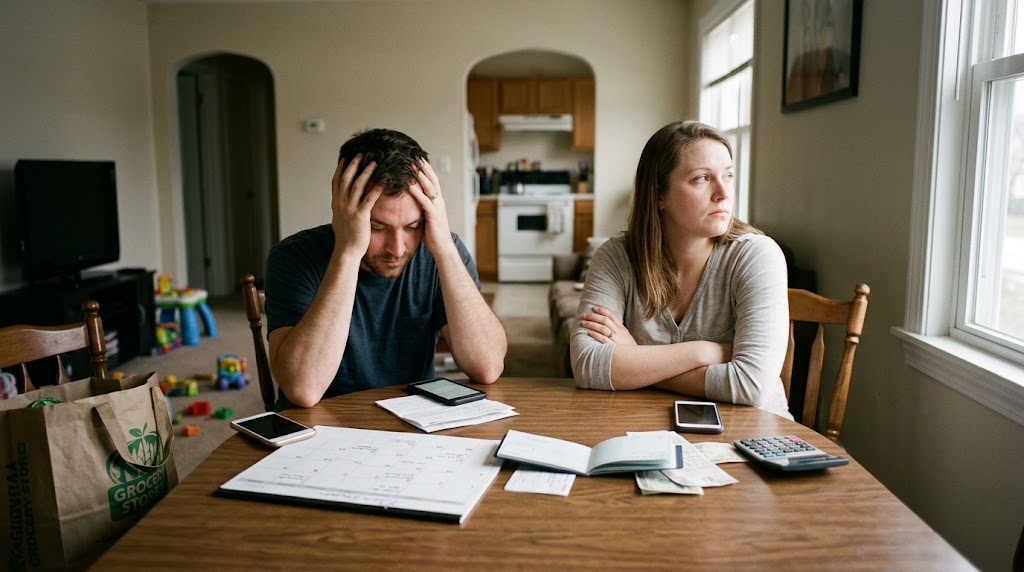
The dominant framework for understanding domestic violence focuses on factors that are deep, persistent, and structural. Abuser psychology, histories of trauma, patterns of control that develop over months or years, substance dependence, and chronic poverty have all been documented as risk factors. This framework has shaped both clinical intervention and public policy: programs focus on identifying at-risk individuals, breaking cycles of violence, and addressing the underlying conditions that sustain abusive relationships over time.
What is harder to explain within this framework is why domestic violence appears to spike and fall in response to conditions that should be too temporary and too mundane to shift something as serious as violence between intimate partners. Why do domestic violence incidents increase around major sporting events? Why do they track patterns in local economic data with a lag that is too short for poverty to be causing psychological damage? The standard risk factor model does not have a good answer.
A study published in the Journal of Health Economics has provided a new piece of that answer, using one of the cleanest natural experiments available in social science research.
Olivia Masi of Aalto University and Bocconi University’s AXA Gender Lab and Chiara Santantonio of the University of Bath noticed something about the intersection of paycheck timing and calendar mechanics. In the United States, many private-sector employees are paid on fixed semi-monthly schedules. When a scheduled payday falls on a weekend or a federal holiday, banks delay the payment to the next business day. This creates months where households must stretch their finances for a few extra days, not because of any change in their underlying economic situation, but purely because of the calendar.
The paycheck is coming. It is just late.
This calendar-driven delay is valuable to researchers precisely because it is exogenous: it is not caused by anything the household did, any decision anyone made, or any underlying characteristic of the people involved. It is driven entirely by the interaction of a fixed pay schedule and a fixed holiday calendar. That makes it possible to treat the delay as a quasi-random assignment and use it to estimate the causal effect of short-term financial stress on household outcomes.
The researchers merged information about when these payment delays occurred with two decades of National Crime Victimization Survey data from 1998 to 2019, a nationally representative longitudinal survey that asks respondents about victimization experiences including domestic violence. They focused on women in households where at least one partner worked in the private sector, making them plausibly subject to the payment schedule disruption.
The results showed that domestic violence incidents were measurably higher in the months when households had to stretch their finances due to paycheck delays.
What the paycheck delay actually does to households
The researchers also used data from two additional sources to understand what happens inside households during stretch months: the Consumer Expenditure Survey, which tracks daily household spending, and the American Time Use Survey, which tracks how household members spend their hours.
During stretch months, daily household expenditure fell. Households spent less, suggesting they were actively managing a cash flow constraint. The spending reduction was not catastrophic or crisis-level. It was the ordinary behavior of a household that knows money is coming but needs to be careful for a few days.
Time use data showed that time spent together at home increased during stretch months. Partners were more likely to be in the same space, with less money to spend on outside activities, more awareness of financial constraints, and a disrupted sense of routine.
These behavioral changes together create the conditions that prior research has identified as proximate triggers for domestic violence incidents: increased time in shared domestic space, financial frustration, and the psychological experience of scarcity even when actual poverty is not present. The paycheck delay does not change anyone’s long-term economic situation. It does not make anyone poorer in a meaningful sense. But it creates a temporary experience of financial stress that affects behavior in measurable ways.
“The findings suggest that the emotional stress of stretching household finances over extra days can negatively impact relationship dynamics,” the researchers wrote.
Why both partners’ paychecks matter
The study’s analysis of subgroups produced a finding that clarifies the mechanism. When only one partner worked in the private sector, the effect of paycheck delays on domestic violence was not statistically significant. When both partners worked in the private sector, meaning both paychecks were potentially delayed simultaneously, the effect was substantially stronger.
This asymmetry is informative. If one partner’s paycheck is delayed but the other’s arrives on schedule, the household can manage the shortfall without experiencing the full psychological impact of a combined cash flow disruption. The couple can coordinate around the delay, and the financial stress is partially buffered.
When both paychecks are delayed, the household faces a more acute version of the same constraint, with less buffering capacity and potentially more conflict about how to manage the shortfall. The result is a stronger effect on domestic violence.
This pattern suggests the mechanism is not primarily about poverty, which would be a persistent state rather than a paired disruption. It is about the experience of simultaneously reduced financial latitude and increased time together in the same domestic space.
The researchers are explicit that their finding should not be read as saying financial difficulty is the primary or sole cause of domestic violence. “Another caveat is that our findings should not be read as saying that financial difficulties cause intimate partner violence per se,” Masi and Santantonio cautioned. “Domestic violence is a complex phenomenon driven by many factors, and our findings point to one additional pathway.”
What the finding means for how domestic violence is understood
The domestic violence field has documented economic factors as risk conditions for decades: poverty, unemployment, and financial hardship all appear in the literature as correlates of elevated violence rates. But most of this research establishes correlations rather than causal effects, making it difficult to separate the effect of economic stress itself from the effects of the underlying conditions that produce both economic stress and violence.
The natural experiment design of this study produces a cleaner estimate. Because the paycheck delay is driven by calendar mechanics rather than by anything about the household, the comparison between stretch months and non-stretch months isolates the effect of the financial stress itself, holding constant the underlying economic situation, the relationship characteristics, and everything else that makes households differ from each other.
The causal estimate shows that even minor, temporary financial disruption, the kind that affects millions of ordinary working households every year, produces measurable increases in domestic violence. The disruption does not have to be severe or sustained. The experience of financial stress, even briefly, is sufficient.
This finding has implications for how domestic violence risk is understood and monitored. Current approaches tend to focus on identifying individuals and relationships with chronic risk factors: substance dependence, documented prior violence, controlling behavior patterns, severe poverty. These factors are important and real. But they do not capture the population of households in which violence is not a chronic problem but responds to short-term stressors.
If paycheck timing can produce measurable spikes in violence, then other short-term financial disruptions, unexpected bills, brief periods of unemployment, gaps in government benefit timing, might produce similar effects. The mechanism the study identifies is not specifically about paycheck delays. It is about the experience of financial stress and constrained resources that those delays produce.
What the study cannot fully establish
The study’s identification strategy relies on households where at least one partner works in the private sector, which is an approximation. The National Crime Victimization Survey does not include information on respondents’ specific payment schedules, so the researchers cannot confirm which households were actually subject to paycheck delays in any given month. They use private-sector employment as a proxy, which means the estimates represent an intent-to-treat effect rather than a precise measure of the impact on households that definitely experienced a delay.
The data cover 1998 to 2019, predating the widespread adoption of digital banking and payment technologies that have reduced some of the friction associated with delayed bank transfers. Whether the effect would be as strong in more recent years, when many households have greater access to credit and digital financial tools that can bridge brief cash flow gaps, is an open question.
The study also cannot directly measure the psychological experience of financial stress. It documents behavioral changes in spending and time use, and documents the downstream effect on violence, but it cannot observe the stress itself or the specific interactions that produce the violence.
What it establishes clearly, across two decades of nationally representative crime victimization data and a causal identification strategy that other research in this area rarely achieves, is that minor, temporary financial disruptions elevate domestic violence risk in affected households. The violence that results from something as mundane as a payday calendar conflict is not the violence of chronic poverty or deep psychological damage. It is the violence of ordinary financial stress, in ordinary households, responding to a disruption that will resolve in a few days.
The study, “Overstretched: Financial distress and intimate partner violence in the U.S.”, was authored by Olivia Masi and Chiara Santantonio, and published in the Journal of Health Economics in May 2026.
Source: Aalto University / University of Bath. DOI: 10.1016/j.jhealeco.2026.103124