A study of 21,797 Swedish twins found that teens who spent 6+ hours a day gaming or online on weekdays had over 3 times the rate of later depression or anxiety. Then researchers compared each teen with their own twin.

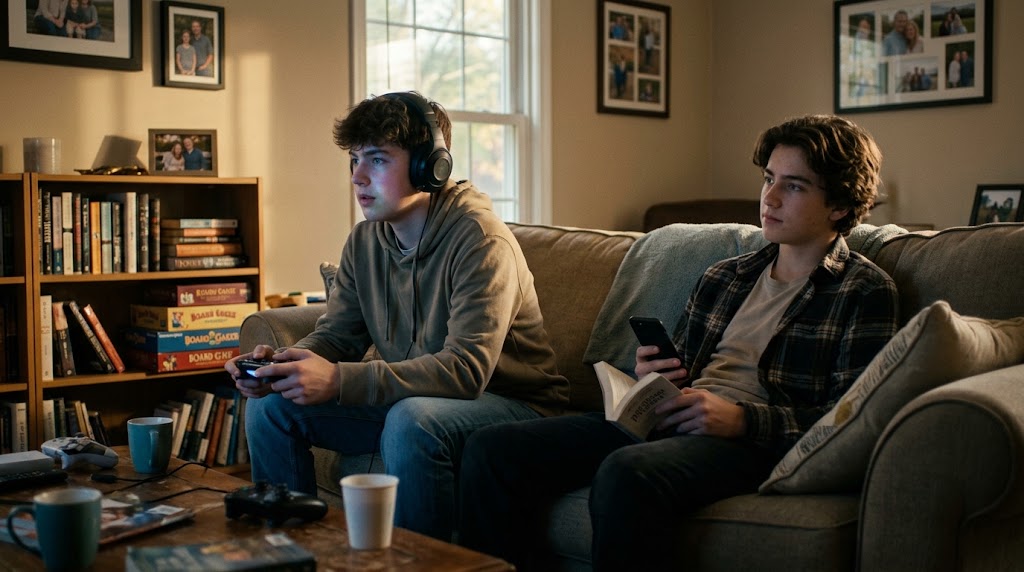
Most parents of teenagers have heard the warning: too many hours on screens, and depression and anxiety follow. Studies keep finding the link, but they all share one weakness. Kids who game or scroll for hours may already differ from other kids in their genes and their homes. Researchers at the Karolinska Institutet found a way around that problem: twins. They followed 21,797 Swedish twins from age 9 into their twenties.
Across the whole group, the warning held up. Teens who spent more than six hours a day gaming, chatting or browsing on weekdays at age 15 had more than three times the rate of being diagnosed with depression or anxiety, or being prescribed an antidepressant, by age 28, compared with teens who used screens for two hours or less.
But when the researchers compared each heavy user with their own twin, who grew up in the same home and shared some or all of the same genes, that link shrank by more than half. It no longer passed the study’s strict statistical test. For screen time and depression, much of the connection seemed to come from the family, not the screen.
That speaks to one of the loudest fights in psychology. In 2019, an analysis of more than 350,000 adolescents in Nature Human Behaviour concluded that the link between digital technology and teen well-being was tiny. A year later, a reply by Jean Twenge, Jonathan Haidt and colleagues argued that this underestimated the harm, especially for heavy users and girls.
Genetic studies have since suggested the two sides may both be partly right. A 2023 study in JAMA Network Open found that shared genetic risk explains part of the link between screen time and psychiatric problems in children. The new twin study pushes that idea further, with clinical diagnoses rather than questionnaires alone.
The twins came from the Child and Adolescent Twin Study in Sweden, which contacts every Swedish twin born since 1992 at age 9 and follows up at 15, 18 and 24. Parents reported screen use at 9, and the teens reported their own hours later on. The surveys were then linked to national records of every psychiatric diagnosis and filled prescription. By age 28, 17.7% of those surveyed at 15 had a depression or anxiety diagnosis or an antidepressant prescription.
The design works like a natural experiment. Identical twins share all their genes and their upbringing. If one plays games for six hours a day and the other for two, and they end up equally anxious, the screens probably were not the cause.
The second finding is the one parents may find most useful: the type of screen use mattered. Watching TV and videos showed no clear link with later diagnoses. The risk sat with interactive use, meaning gaming, chatting and browsing, and it was concentrated in the heaviest users.
In the twin comparison, the link did not vanish completely either. Among identical twins at 18, heavy weekend gaming and browsing was still tied to depression and anxiety scores about 0.26 standard deviations higher. The researchers point out that this is in the same range as bullying, a well-established risk factor.
They also found the arrow pointing the other way, though weakly. Teens with more symptoms at 15 went on to use slightly more screens at 18.
The researchers write that the associations “were largely attenuated in co-twin comparisons, indicating substantial contribution of shared familial factors.” At the same time, they describe heavy recreational screen use as “a growing public health and clinical concern.”
For parents, the study suggests that how many hours a teen spends on screens is only part of the story. A teen who games most of the day and seems withdrawn may need attention for the withdrawal itself, and the family’s wider circumstances may matter as much as the device. Earlier research we covered found that more screen time was even linked to better cognitive processing in teens, while very young children may be more sensitive at specific ages.
There are limits to what this shows. The surveys started in 2004, before smartphones and social media took over teenage life, so the screen habits measured may not match what teens do today. Hours were self-reported in broad bands, which says nothing about what teens were actually doing online.
Fewer twins answered each later survey, and only pairs who differed in screen use could be compared, which leaves the twin analyses with less statistical power. A small direct effect of screens cannot be ruled out. The study was not preregistered.
Source
Gong T, Frans E, Ohlis A, et al. “Recreational screen use and internalizing problems from preadolescence to young adulthood in a longitudinal twin cohort with co-twin comparison.” Nature Human Behaviour, 2026.
DOI: 10.1038/s41562-026-02607-0
Also cited
Orben A, Przybylski AK. “The association between adolescent well-being and digital technology use.” Nature Human Behaviour, 2019.
DOI: 10.1038/s41562-018-0506-1
Twenge JM, Haidt J, Joiner TE, Campbell WK. “Underestimating digital media harm.” Nature Human Behaviour, 2020.
DOI: 10.1038/s41562-020-0839-4
Zhang Y, et al. “Shared genetic risk in the association of screen time with psychiatric problems in children.” JAMA Network Open, 2023.
DOI: 10.1001/jamanetworkopen.2023.41502