Scientists discovered that your abdomen and your brain are connected by a hydraulic pump and it cleans your brain every time you move

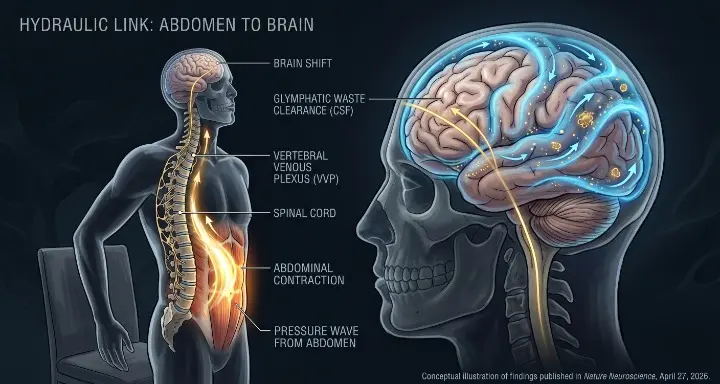
Every time you brace your core to stand up from a chair, your brain moves. Not because something is wrong. Because a hydraulic connection between your abdomen and your skull just did something researchers at Penn State spent years trying to find evidence for, and published in Nature Neuroscience.
The finding reframes something most people do dozens of times a day without a second thought. Tightening your abdominal muscles, to stand, to lift something, to walk, to shift position on the couch, compresses blood vessels connected to the spinal cord, sends a pressure wave upward through a network of veins running along the spine, and causes the brain to shift gently inside the skull. That tiny motion drives cerebrospinal fluid across the brain’s surface. And cerebrospinal fluid, when it moves, carries away the metabolic waste that accumulates in brain tissue every hour of every day.
“Our research explains how just moving around might serve as an important physiological mechanism promoting brain health,” said Patrick Drew, a professor of engineering science and mechanics, neurosurgery, biology, and biomedical engineering at Penn State and senior author of the study.
The Hydraulic System Nobody Knew Existed
The brain floats inside the skull surrounded by cerebrospinal fluid, a colorless liquid that cushions it from physical shocks, delivers nutrients, and removes waste. The glymphatic system, the brain’s dedicated waste-clearance network, uses cerebrospinal fluid as its working medium, circulating it through channels alongside blood vessels to flush out toxic proteins, cellular debris, and metabolic byproducts that accumulate as neurons fire and burn energy throughout the day.
For most of the history of neuroscience, the glymphatic system was understood to operate primarily during sleep. Deep sleep is when cerebrospinal fluid circulation accelerates most dramatically, when the spaces between brain cells widen, and when the clearance of amyloid-beta and tau proteins, the molecules that accumulate in Alzheimer’s disease, reaches its peak. The implication was that waking life was mostly a period of accumulation, and sleep was when the bill got paid.
The Penn State research adds a second chapter to that story. Using microCT scanning and two-photon microscopy, which allows high-resolution imaging of internal structures and entire organs, the researchers found that the brain shifted just before the animals moved, immediately after the abdominal muscles tightened to initiate motion. The timing was precise and consistent. The abdominal contraction came first. The brain motion followed within milliseconds. The cerebrospinal fluid moved in response to that motion.
“In this study, we found that when the abdominal muscles contract, they push blood from the abdomen into the spinal cord, just like in a hydraulic system, applying pressure to the brain and making it move,” Drew said. “Simulations show that this gentle brain movement will drive fluid flow in and around the brain.”
The Vertebral Venous Plexus
The anatomical structure that makes this mechanism possible is called the vertebral venous plexus, a network of veins running through the interior of the vertebrae and around the spine that connects the abdominal cavity directly to the base of the brain. This network has been known to anatomists for decades but its functional role in brain physiology was poorly understood. It was thought of primarily as a venous drainage route, a pathway for blood to return from the lower body.
When abdominal muscles contract, even slightly, they compress blood vessels connected to the spinal cord. That pressure travels upward through the vertebral venous plexus and causes the brain to shift gently within the skull. The veins act as a hydraulic line, transmitting mechanical force from the abdomen to the intracranial space with every contraction. The brain’s motion in response to that force is small, on the order of micrometers, but the researchers’ simulations showed it was sufficient to meaningfully increase cerebrospinal fluid circulation across the brain’s surface.
The researchers compared the process to squeezing a sponge under running water. The brain does not need to move dramatically to generate fluid flow. The gentle, rhythmic compression and release created by ordinary physical activity, walking, standing, shifting, bending, produces enough hydraulic force to keep the cleaning cycle active throughout the waking day.
What Sedentary Life Is Quietly Doing
The flip side of this finding is where its clinical weight sits. If every abdominal contraction contributes to cerebrospinal fluid circulation and glymphatic waste clearance, then long periods of physical stillness, the uninterrupted sitting that defines most modern work and leisure, represent extended gaps in the brain’s waking cleaning cycle.
This is different from the sleep deprivation problem, which disrupts the primary glymphatic clearing period. Prolonged sitting during waking hours may be creating a secondary deficit, reduced fluid circulation during the hours when metabolic waste is actively accumulating and the hydraulic mechanism that moves it is not being activated.
The brain produces waste products continuously as neurons burn energy and communicate with each other. Scientists believe poor waste clearance may contribute to the buildup of amyloid-beta and tau proteins associated with Alzheimer’s disease and other neurodegenerative disorders. Amyloid-beta and tau accumulation are the defining pathological features of Alzheimer’s disease. Both proteins have been shown to clear more efficiently when cerebrospinal fluid circulation is active.
The research does not establish that sitting causes Alzheimer’s through this mechanism. The study was conducted in mice, and the direct translation to human physiology requires further investigation. But the biological logic is coherent and grounded in well-established glymphatic science. Movement activates the hydraulic system. The hydraulic system drives cerebrospinal fluid. Cerebrospinal fluid clears waste. Waste clearance matters for long-term brain health.
The Movement Does Not Need to Be Intense
One of the more immediately reassuring aspects of this finding is what Drew said about the scale of movement required. “This kind of motion is so small. It’s what’s generated when you walk or just contract your abdominal muscles, which you do when you engage in any physical behavior. It could make such a difference for your brain health.”
The hydraulic mechanism does not require exercise in the conventional sense. It does not require elevated heart rate, sustained aerobic effort, or deliberate workout sessions. It requires the kind of muscle engagement that happens automatically with any physical activity at all, standing from a seated position, walking to another room, shifting posture, carrying groceries. The abdominal muscles engage reflexively during all of these movements, generating the pressure wave that drives the mechanism.
Scientists say ordinary daily activities may already stimulate the fluid flow needed to support brain waste clearance. The encouraging part of this research is that the movements do not need to be intense workouts. What matters is the frequency of engagement rather than the intensity, which reframes the question of what counts as brain-protective physical activity in a way that is accessible to almost everyone regardless of fitness level or mobility.
A Connection the Body Was Always Making
What the Penn State study fundamentally changes is the conceptual boundary between the brain and the body. The brain has been treated in neuroscience as a largely self-contained organ, connected to the body through neural pathways and the bloodstream but mechanically separate from the physical forces that act on muscles and joints. The vertebral venous plexus as a hydraulic link between abdominal contraction and intracranial cerebrospinal fluid movement suggests that boundary is softer than the textbooks implied.
The brain is physically coupled to the body in a way that means every ordinary movement contributes something to its maintenance. Walking is not just cardiovascular exercise with neurological benefits mediated by blood flow and growth factors. It is also, at a mechanical level, a cleaning cycle activated by the hydraulic pressure generated in the abdomen with every step. The brain was always receiving that contribution. Researchers just did not have the imaging resolution or the conceptual framework to see it until now.
Source:
Garborg, C.S., Ghitti, B., Zhang, Q., et al. Brain motion is driven by mechanical coupling with the abdomen. Nature Neuroscience, April 27, 2026. DOI: 10.1038/s41593-026-02279-z
https://neurosciencenews.com/abdominal-pump-brain-waste-removal-30618/