
People who got less than 42 minutes of bright daylight a day had a higher risk of dementia, and it predicted risk better than six well-known risk factors

Most adults spend their days indoors, where light levels are a small fraction of what they get outside, even on a cloudy afternoon. Researchers in China, Hong Kong and Sweden wanted to know whether that matters for the brain. They followed 87,577 adults who wore wrist devices that measured light exposure as well as movement, then tracked who developed dementia over a median of about eight years. They compared daytime light with light at night.
Brighter days were linked to lower risk. People whose average daytime light exposure was above 1,000 lux, roughly the brightness of an overcast day outdoors, had a 16% lower risk of developing dementia. Spending longer in even brighter light, at least 5,000 lux, was linked to further reductions.
At the other end, people who got less than 42 minutes of bright daylight a day stood out. That shortfall was a stronger predictor of dementia than six established dementia risk factors.
Light at night, by contrast, showed no statistically significant link with dementia risk in this study.
“Daytime light exposure may serve as a novel indicator of dementia risk,” said corresponding author Hongliang Feng of Guangzhou Medical University.
Over the follow-up period, 741 participants developed dementia. Because light was measured by the devices rather than reported by participants, the estimates do not depend on people’s memories of how much time they spent outside.
Light is the main signal that keeps the body clock in time, and a disrupted body clock has been tied to poor sleep and to dementia in other research. Sleep and daily rhythms keep turning up in dementia research, as with frequent napping in older adults and the health of night owls.
The second finding is how much light counts. Ordinary indoor lighting usually sits far below 1,000 lux, so in practice the threshold mostly means time spent outdoors or next to a bright window. An hour outside, even on a grey day, can deliver more light than a full day under office lights.
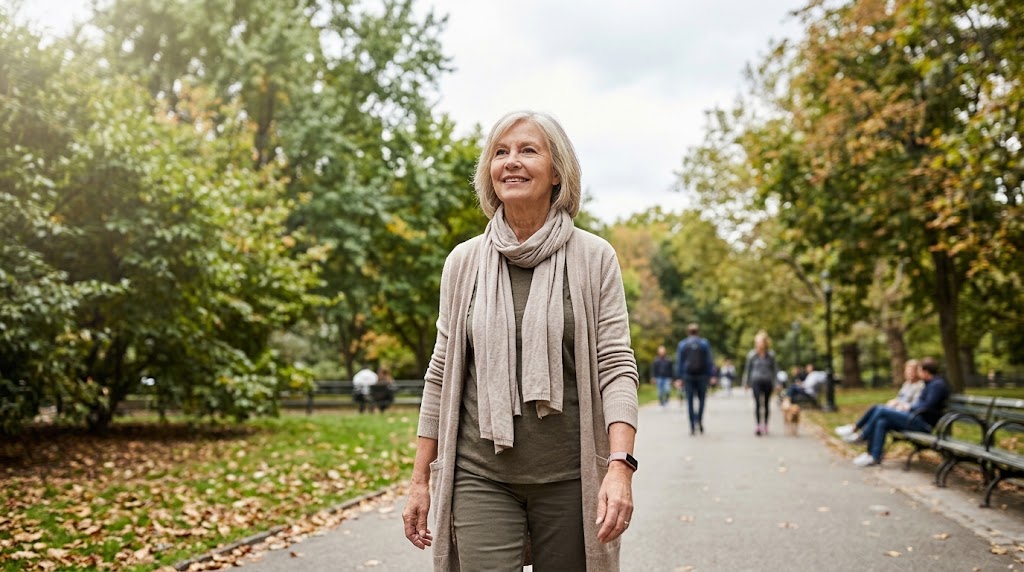
For older adults and their families, getting outside during the day is a simple, low-risk habit that also brings exercise and social contact. The study cannot say whether more daylight prevents dementia, but there is little downside to a daily walk in the morning or at lunchtime.
There are limits to what this shows. The study is observational, and the link may run both ways: people in the early stages of dementia, years before diagnosis, may already be going outside less. Light was measured at the start of the study, over a limited period, and people who spend more time outdoors also tend to be more active and social, which the analysis may not fully capture. The press materials do not describe the population in detail, so the results may not apply everywhere.
Source
Zheng N, Wang W, Li B, et al. “Associations between wearable-device-measured daytime and nighttime light exposures and dementia risk: A prospective cohort study.” General Psychiatry, 2026.
DOI: 10.1002/gps3.70039