A study that followed 1,266 adults for 35 years found that cannabis users had more broken, restless sleep on wrist monitors. Yet the same people rated their sleep no worse than non-users did.

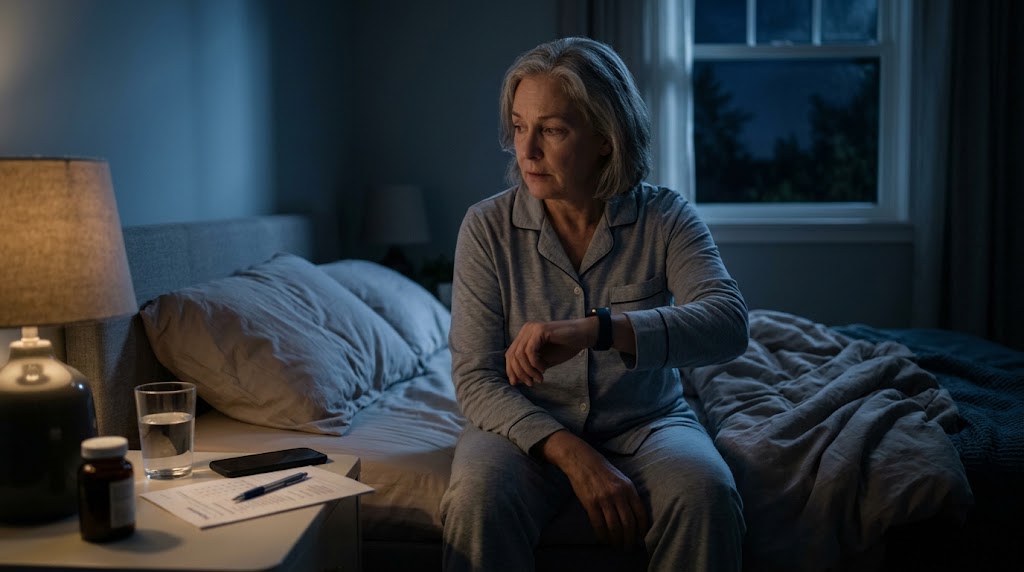
Millions of people reach for cannabis at night because it seems to help them drift off. Researchers at Northwestern University had an unusual way to test that belief: a group of American adults whose cannabis use had been tracked since they were young adults in the mid-1980s. Now around 60, the participants wore a sleep monitor on the wrist for a week and filled out a sleep questionnaire. The two measurements did not tell the same story.
On the wrist monitors, cannabis users slept worse. The more years of use people had built up, the more likely they were to spend less than 85% of their time in bed actually asleep, to sleep restlessly, and to lie awake for 30 minutes or more after first dropping off.
On the questionnaire, though, cannabis users rated their sleep no worse than anyone else. When it came to cannabis and sleep, the device and the sleepers disagreed.
The researchers counted use in cannabis-years, with one cannabis-year equal to 365 days of use. Each extra cannabis-year was linked to about 10% higher odds of a night with too little time asleep, and about 21% higher odds of a long stretch awake in the night.
People who had used cannabis in the past month showed the clearest pattern. Compared with people who had never used it, they had about three times the odds of lying awake for 30 minutes or more after falling asleep.
“This study challenges the common belief that cannabis helps people sleep better,” corresponding author Thanh-Huyen Vu said in a statement.
The belief has never had much evidence behind it. In March, the largest review of cannabis medicines for mental health, a meta-analysis of 54 randomized trials in The Lancet Psychiatry, found no evidence that they work for anxiety, depression or PTSD, as we reported at the time. That review did find hints of a benefit for insomnia, but the researchers rated the trials behind it as low quality.
What happens to sleep after decades of everyday use is a different question, and that is the gap the new study addresses.
The data come from CARDIA, a long-running US study that began in 1985 and 1986 with Black and white adults aged 18 to 30. Participants were asked about cannabis at check-ups spread over 35 years. At the most recent check-up, between 2020 and 2022, 891 of them wore an actigraph, a wristwatch-like device that tracks movement around the clock, for seven days and nights.
Separately, 1,128 participants filled out the Pittsburgh Sleep Quality Index, a standard questionnaire about how well people think they sleep. The analysis took into account age, sex, race, smoking, alcohol, physical activity, depression, chronic illness and other drug use.
The second finding is the one most likely to surprise regular users. People who had used cannabis in the past month had more than four times the odds of sleeping over eight hours a night compared with never-users. They slept longer, yet their sleep was more broken.
“This was one of the most interesting findings,” Vu said of the gap between the device and the questionnaire. “The wearable device detected more nighttime disruption among participants with long-term cannabis exposure, but the participants themselves generally did not report worse sleep.”
The researchers write that the results show why sleep should be measured both by asking people and by tracking it objectively.
“Our data do not support the belief that cannabis is helpful as a sleep aid,” senior author Mercedes Carnethon said.
If you use cannabis to sleep and still feel tired during the day, how you rate your nights may not be the whole picture. Co-author Kristen Knutson, a sleep researcher at Northwestern, points to the usual basics: a regular bedtime, a cool, dark and quiet bedroom, no screens right before bed, and a talk with a doctor if problems persist or if you snore loudly. Prescription sleep aids come with their own trade-offs, as a study of first sleeping pill prescriptions showed last week.
There are limits to what this shows. The study is observational, so it cannot prove that cannabis causes poor sleep. People who already sleep badly may be more likely to use cannabis to cope, which would produce the same pattern.
The researchers did not know how people used cannabis, whether smoked, vaped or eaten, or how strong it was, and habits surely changed over 35 years. Actigraphs estimate sleep from movement rather than brain activity, so they can mistake lying still for sleeping.
The group of recent users appears to have been small, which makes those estimates uncertain: the true increase in long night-time waking could be anywhere from about 1.4 to 7 times the odds. The study included only Black and white adults in late middle age, and it looked at recreational use, not cannabis prescribed by a doctor.
The study was funded by the National Heart, Lung, and Blood Institute and the Kaiser Foundation Research Institute.
Source
Vu THT, Knutson KL, Auer R, et al. “Recent and Cumulative Cannabis Use and Sleep in Middle-Aged Adults.” JAMA Network Open, 2026.
DOI: 10.1001/jamanetworkopen.2026.38303
Also cited
Wilson J, Dobson O, Langcake A, et al. “The efficacy and safety of cannabinoids for the treatment of mental disorders and substance use disorders: a systematic review and meta-analysis.” The Lancet Psychiatry, 2026.
DOI: 10.1016/S2215-0366(26)00015-5