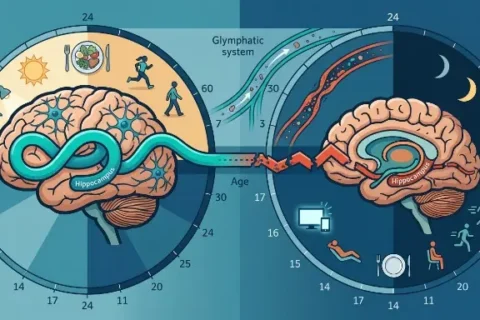
A Nature study found that sleeping more than 8 hours ages your organs as fast as sleeping fewer than 6. Half a million people, 17 organs, 23 aging clocks all showed the same U-shaped curve.

The recommendation to sleep seven to nine hours a night has become one of public health’s most repeated messages. Organizations from the American Academy of Sleep Medicine to the CDC have endorsed it. Smartwatches track it. Parents enforce it for children. The reasoning has always been directional: sleep deprivation is harmful, more sleep is protective, and the goal is to get as close to the upper end of the recommended range as possible.
A study just published in Nature has examined that reasoning against biological aging data from half a million people and found it is incomplete in a specific and important way.
The research, conducted by the MULTI Consortium, an international collaborative team working with UK Biobank data, is the first study to map the relationship between sleep duration and biological aging simultaneously across multiple organ systems using three independent biological measurement technologies. The scale and methodological ambition of the work are without precedent in sleep research.
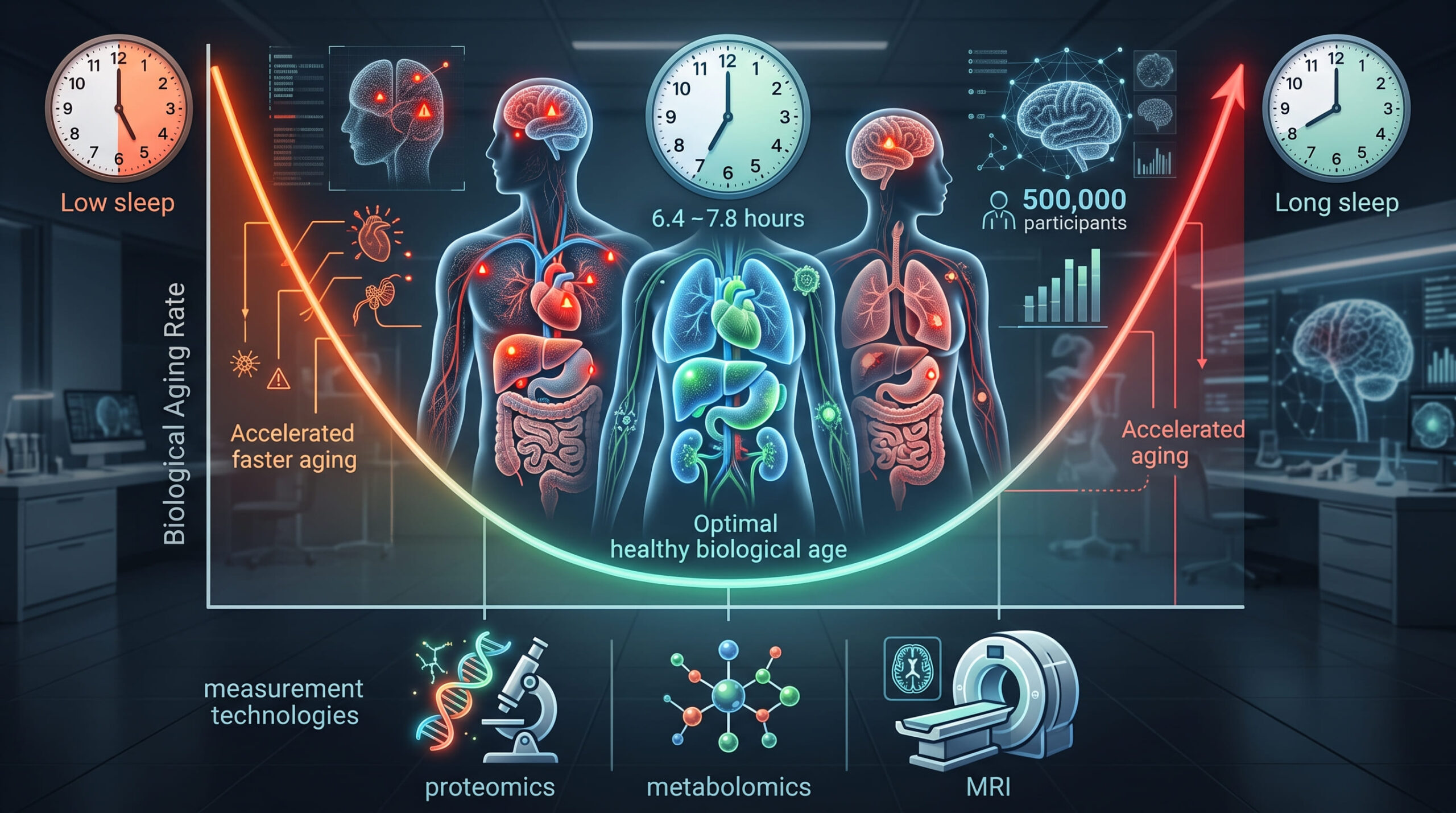
The team built 23 distinct biological aging clocks, each designed to measure how fast a specific organ system was aging relative to a person’s chronological age. Eleven clocks were derived from plasma proteomics, measuring the protein signatures that organs shed into the bloodstream. Five were derived from plasma metabolomics, measuring the circulating metabolic markers associated with organ-specific aging. Seven were derived from in vivo MRI imaging of the brain and body, providing a structural window into how organs were changing over time. Together, the 23 clocks covered 17 organ systems including the brain, heart, liver, kidneys, pancreas, immune system, and musculoskeletal system.
The researchers then asked a single question: how does the amount of sleep a person reports getting each night relate to how fast those 23 clocks were ticking?
The answer was not what the seven-to-nine-hours message implies.
The U-shaped curve across 17 organs
In 9 of the 23 clocks, covering organs spanning the brain, metabolic system, and immune system, the relationship between sleep duration and biological aging followed a non-linear, U-shaped curve. The clocks did not show a simple pattern of more sleep equals slower aging. They showed a pattern where both extremes of sleep duration, too little and too much, were associated with faster biological aging, with a narrow band in the middle where aging was slowest.
The bottom of the curve, the point of minimum biological aging across the organ clocks, fell between 6.4 and 7.8 hours of sleep per night. This range varied slightly depending on which organ system was being measured and whether the participant was male or female, with women generally showing an optimal point slightly higher than men on several clocks.
Below 6 hours, aging accelerated. Above 8 hours, it accelerated again. The symmetry of the damage on both sides of the optimal window is the finding that most directly challenges the public health assumption that more sleep is always better.
“A systemic, U-shaped pattern emerges between sleep duration and biological age gaps across nine brain and body systems and three omics technologies,” the researchers wrote. “The sample-specific lowest biological age gaps are achieved between 6.4 and 7.8 hours of sleep duration, varying by organ and sex.”
What the aging clocks actually measured
Biological aging clocks have become one of the most powerful tools in aging research over the past decade. Unlike chronological age, which simply counts years since birth, biological aging clocks measure the accumulated molecular wear that predicts health outcomes and mortality risk more accurately than birth year alone.
Epigenetic clocks, the earliest and most widely studied type, measure chemical modifications to DNA that shift in predictable ways as cells age. Proteomic clocks measure the proteins that organs release into the bloodstream, which change as organ function shifts with age. Metabolomic clocks measure the small molecules produced by metabolic processes, which also shift with age in organ-specific patterns. MRI-based clocks measure the structural and volume changes that organs undergo as they age.
The fact that the U-shaped sleep-aging relationship appeared independently across all three of these measurement types, proteomics, metabolomics, and MRI, is what gives the finding its unusual credibility. Each technology is measuring a different aspect of biological aging from a different angle. Finding the same curve in all three directions means the result is unlikely to be an artifact of any one measurement approach.
“The consistent U-shaped associations observed in both structural imaging and circulating molecular markers suggest that maintaining sleep within the 6-8 hour window may be relevant to healthier organ aging profiles,” the researchers concluded.
What short and long sleep do differently
One of the study’s most nuanced findings concerns the specific diseases and organ systems affected differently by too little sleep versus too much sleep.
Short sleep, defined as fewer than 6 hours, showed the broadest pattern of associated risk. The genetic variants linked to short sleep overlapped with disease endpoints spanning cardiovascular, metabolic, musculoskeletal, pulmonary, digestive, neurological, and psychiatric conditions. Short sleep appears to accelerate aging across the widest range of body systems, consistent with the established literature showing that sleep deprivation disrupts nearly every physiological maintenance process that occurs during rest.
Long sleep, defined as more than 8 hours, showed a different and more focused pattern. Its genetic architecture and disease associations were concentrated in neuropsychiatric and brain-related conditions rather than the broad metabolic and cardiovascular risks associated with short sleep. This difference is important for interpreting why long sleep is associated with faster aging.
The most likely explanation is that long sleep is, in many cases, a symptom rather than a cause. People who sleep more than 8 hours consistently are often doing so because their health is already compromised. Depression, chronic pain, cardiovascular disease, and early neurodegenerative changes all increase sleep duration, and all accelerate biological aging. In this interpretation, long sleep and faster aging appear together not because one causes the other but because a third factor, underlying poor health, drives both.
Short sleep may be more directly causative. Restricting sleep below 6 hours impairs the clearance of metabolic waste from the brain, disrupts hormonal regulation, suppresses immune function, and prevents the cellular repair processes that normally occur during slow-wave sleep. These are mechanisms through which insufficient sleep could directly accelerate biological aging rather than simply reflecting it.
The study cannot definitively distinguish between these interpretations. What it establishes is that the two extremes of sleep duration are associated with faster aging through different biological pathways, which has implications for how each should be addressed clinically.
The sex differences in the optimal window
The study found that the optimal sleep window for minimizing biological aging was not identical for men and women. Across several of the aging clocks, women showed a slightly higher optimal sleep duration than men, meaning that women achieved the lowest biological aging at a sleep duration somewhat longer than the point that minimized aging in men.
The most pronounced sex difference appeared in the brain’s proteomic aging clock, where the optimal duration was approximately 7.82 hours for women and somewhat lower for men. This finding is consistent with prior research showing that women’s brains are metabolically more active during sleep and may require more time for the restorative processes that sleep enables.
The sex difference also adds complexity to the standard recommendation of seven to nine hours for all adults. If the optimal window for minimizing biological aging varies by both organ system and sex, population-level guidelines may be too broad to capture individual variation at the level where it matters most.
What 500,000 participants allows that smaller studies cannot
The UK Biobank’s approximately 500,000 participants are what make this level of analysis possible. Detecting a non-linear U-shaped relationship between sleep duration and biological aging requires a sample large enough to populate the entire range of the curve, including the extremes of very short and very long sleep that account for relatively small proportions of the population.
In smaller studies, these extremes are underrepresented, and the relationship between sleep and aging appears approximately linear because the uptick at the long end of the curve is statistically invisible. Only at the scale of half a million participants does the full curve become detectable with the statistical confidence to describe its shape precisely.
The researchers used generalized additive models specifically designed to detect non-linear relationships without assuming a particular shape in advance, allowing the data to determine the shape of the curve rather than testing a predetermined hypothesis.
The large sample also allowed the researchers to link sleep duration to 726 specific disease endpoints defined by ICD-10 diagnostic codes. Both short sleep (fewer than 6 hours) and long sleep (more than 8 hours) were associated with significantly increased risk across dozens of conditions, providing a direct line from the abstract biological aging clocks to clinically meaningful health outcomes.
What the finding means practically
The practical message from this study is more specific than the current sleep guidelines suggest.
For people who consistently sleep fewer than 6 hours, the finding reinforces existing guidance: the damage to biological aging is real, measurable across 17 organ systems, and likely causally related to sleep deprivation’s known effects on cellular repair and metabolic regulation. Getting more sleep is protective.
For people who consistently sleep more than 8 hours, the finding raises a different question. If long sleep is frequently a symptom of underlying health problems rather than a cause of faster aging, the appropriate response is not necessarily to sleep less. It is to investigate why they are sleeping so long. Persistent long sleep that represents a change from a person’s normal pattern may be an early signal of health changes worth discussing with a physician, independent of any concern about biological aging per se.
For people sleeping between 6.4 and 7.8 hours, the data suggest their sleep duration is within the range associated with the slowest biological aging across the most organ systems. The specific number within that range matters less than staying within the window.
What the study cannot establish
The primary limitation is the reliance on self-reported sleep duration. Participants were asked how many hours they typically slept per 24 hours including naps, a single question answered once. Self-reported sleep is subject to both inaccuracy and change over time, and it does not distinguish between time in bed and actual sleep time, between consolidated and fragmented sleep, or between sleep of different quality levels.
The study is also cross-sectional in its primary analysis, capturing sleep habits and biological age at one point in time. Whether changing sleep habits changes the biological aging clock trajectories requires longitudinal data that this design cannot provide.
The optimal window identified, 6.4 to 7.8 hours, is a population average across a specific demographic, UK Biobank participants aged 37 to 84, and may not generalize precisely to younger adults, people with chronic conditions, or populations outside the UK. The window is an empirical description of where the curve bottoms out in this dataset, not a prescription for every individual.
What the study establishes at unprecedented scale and with unprecedented methodological breadth is the shape of the relationship itself. It is not a slope. It is a curve. And the far side of that curve begins before 8 hours.
The study, “Sleep chart of biological ageing clocks across organs and omics”, was authored by the MULTI Consortium and collaborating institutions, and published in Nature in 2026.
Source: MULTI Consortium / UK Biobank. DOI: 10.1038/s41586-026-10524-5