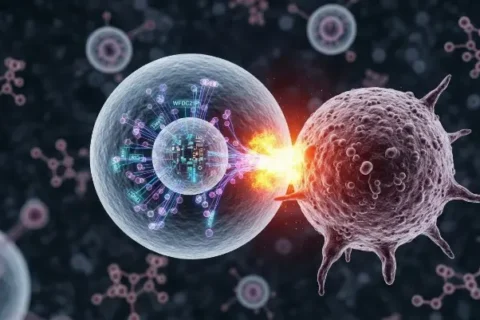
Every person who had COVID or got vaccinated carries an immune memory of the virus. A new vaccine platform has found a way to use that memory to make tumors visible to the immune system.

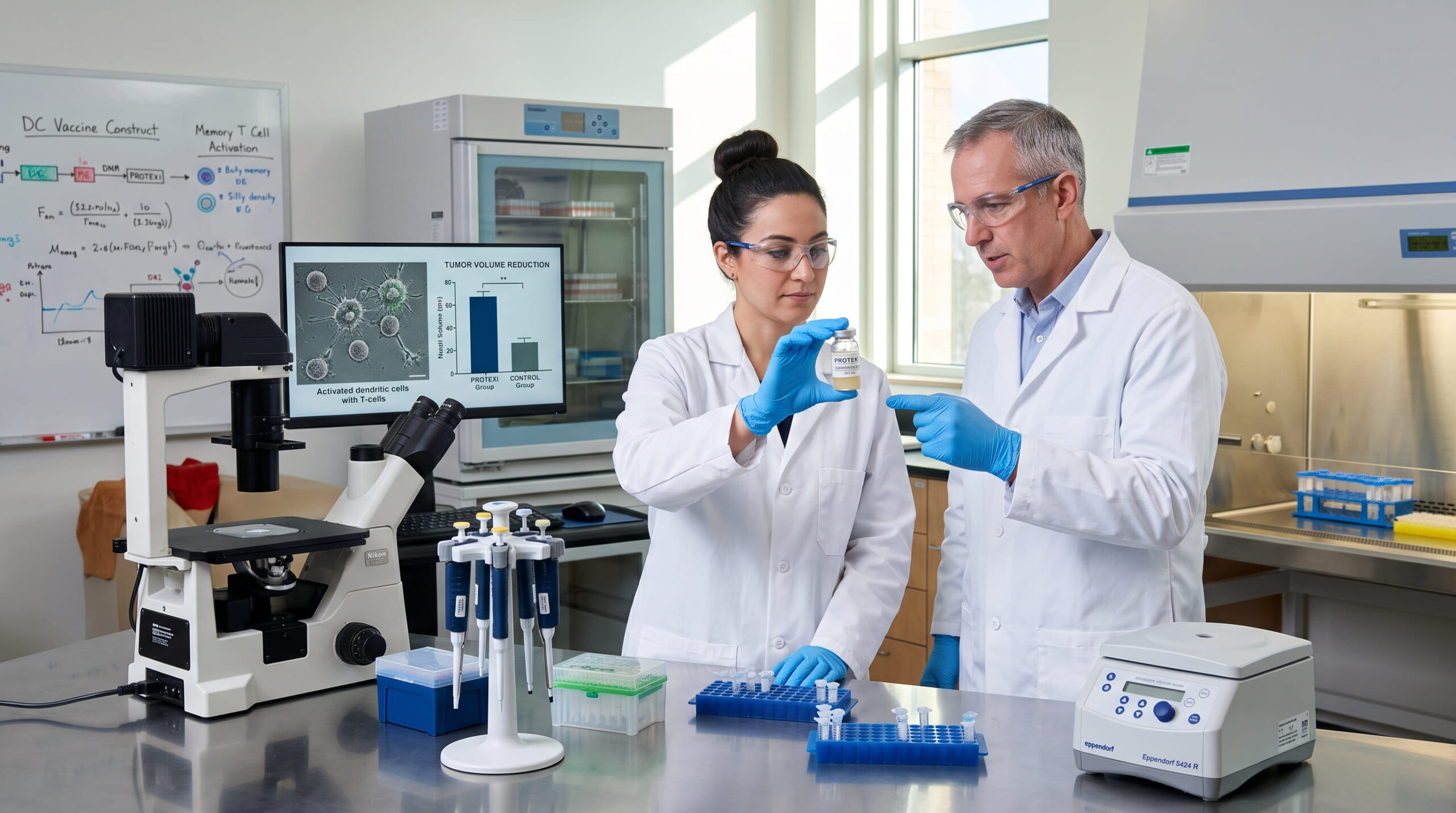
Somewhere inside your body right now, a population of T cells is waiting. They were trained during your COVID infection or vaccination to recognize a specific set of molecular signatures from the SARS-CoV-2 spike protein. They mobilized when you needed them, helped clear the threat, and then settled into a long-term memory state. For the vast majority of people, those cells will never be activated again. The virus they were trained to fight is no longer a serious threat. The immune memory they represent has no remaining purpose.
That is what researchers at Case Western Reserve University, University Hospitals, and the biotech company Celloram set out to change.
Their platform, called PROTEXI, was published on July 27, 2026 in Nature Communications. It represents a fundamentally different approach to one of oncology’s oldest problems: how to make the immune system see and attack cancer when cancer has evolved specifically to avoid being seen.
The central insight behind PROTEXI is simple enough to state in a single sentence. If the immune system already has a powerful, battle-tested response to COVID, and if that response can be linked to a cancer target, then the immune system might be tricked into attacking the tumor with the same force it once directed at the virus.
In mouse models of breast cancer and melanoma, that is precisely what happened.
The problem PROTEXI was designed to solve
Cancer immunotherapy has transformed oncology over the past two decades. Checkpoint inhibitors, CAR-T cells, and tumor-infiltrating lymphocyte therapies have produced remarkable outcomes in some patients with some cancers. But they share a fundamental limitation: they depend on the immune system being able to recognize tumor cells as foreign in the first place.
Many cancers, described in the field as immune-cold tumors, have evolved to make that recognition nearly impossible. They suppress the signals that would normally flag them as abnormal. They create a local environment around the tumor that inhibits immune activity. They look, to a surveying immune cell, almost indistinguishable from healthy tissue.
Getting an immune response started against a cold tumor requires what immunologists call helper T cell activation. CD4 helper T cells are the coordinators of the immune system. When they are engaged, they amplify the activity of CD8 killer T cells, sustain the immune attack over time, and help establish lasting immune memory against the target. Without helper T cell involvement, a killer T cell response against a tumor tends to be weak, short-lived, and insufficient.
Finding the right signals to activate helper T cells against cancer has been one of the field’s most persistent bottlenecks. The signals need to be specific enough to target tumor cells without triggering autoimmune damage to healthy tissue. Identifying them for each patient’s individual tumor is time-consuming, technically demanding, and expensive. Personalized cancer vaccines based on this approach exist, but their complexity limits how widely they can be deployed.
PROTEXI sidesteps the problem entirely by asking a different question. Rather than finding new signals to activate helper T cells from scratch, what if you used signals those cells already know?
How the platform works
The mechanism is more elegant than complex. PROTEXI constructs a vaccine by linking two components together. The first is a tumor-specific antigen, a molecular signature found on the surface of the patient’s cancer cells that distinguishes them from healthy tissue. The second is a short fragment of the SARS-CoV-2 spike protein, specifically the regions that existing COVID-trained helper T cells already recognize.
When this combined construct is delivered via dendritic cells, the immune system’s primary antigen-presenting machinery, something specific happens. The COVID fragment activates the existing memory T cells that were trained during infection or vaccination. Those activated helper T cells then see the tumor antigen sitting alongside the COVID fragment. Because the helper response is already running at full power, the killer T cell response against the tumor antigen gets amplified dramatically.
The tumor, which had been invisible, suddenly has the full force of a primed immune response directed at it.
“Instead of asking how to build increasingly complex cancer vaccines from scratch, we asked a different question,” said Tej Pareek, chief executive officer of Celloram. “Can we harness the immune memories that billions of people already possess and redirect them against cancer?”
In multiple mouse models of melanoma and breast cancer, PROTEXI slowed tumor growth significantly compared to control groups. Survival rates improved. Perhaps most importantly for long-term cancer treatment, the immune system generated a new memory against the tumor itself, one that persisted after the initial vaccine response had run its course. When tumor cells were reintroduced in rechallenge experiments, the immune system recognized and responded to them, suggesting a durable protective effect rather than a one-time intervention.
The scale of the shared resource
What makes PROTEXI conceptually different from other cancer immunotherapy approaches is not just its mechanism but the resource it draws on.
Every cancer vaccine developed before it has had to build immune recognition from the ground up, tailored to each patient, each tumor, each individual immune landscape. PROTEXI starts from a foundation that billions of people already share.
As of 2026, an estimated five billion people worldwide have been vaccinated against COVID-19, and billions more have been infected. Each of them carries memory T cells trained against the SARS-CoV-2 spike protein. The specific fragments of the spike protein that PROTEXI uses as helper signals are among the most immunogenic regions of the virus, meaning they reliably activated strong T cell responses across diverse human immune systems during the pandemic.
This creates something that has never existed before in medicine: a population-level shared immune resource that can be tapped by a therapeutic platform designed around it. A cancer vaccine that works for one person who had COVID can, in principle, work for anyone who had COVID or received the vaccine, regardless of their individual tumor type, because the helper signal is universal while the tumor antigen component is swapped out for each cancer indication.
“PROTEXI offers a compelling solution by redirecting robust antiviral immune memory toward tumor eradication,” said John Letterio, a pediatric oncologist at University Hospitals Rainbow Babies and Children’s Hospital and a co-author of the study. “These findings have provided the scientific rationale to advance this platform into first-in-human studies for patients with sarcoma, a disease where innovative immunotherapeutic approaches are urgently needed.”
What the mouse data showed and what it cannot establish
The results published in Nature Communications are preclinical. Every experiment was conducted in mouse models, and the paper’s own title makes this explicit. No human being has yet received PROTEXI. The planned first-in-human trial in sarcoma patients has not begun.
This distinction matters for interpreting the findings. Mouse immune systems differ from human immune systems in ways that regularly cause promising preclinical results to fail in clinical translation. The history of cancer immunotherapy includes many therapies that were effective in mice and ineffective in humans. The mouse models used for melanoma and breast cancer are useful approximations but not perfect representations of the complexity of human tumors, human immune landscapes, or the microenvironmental dynamics of cancer in people.
The planned human trial will evaluate safety and immunogenicity first. Whether the platform produces antitumor immune responses in humans at the level seen in mice, and whether those responses translate into clinical benefit measured by tumor response rates and survival, requires years of clinical study to establish.
There is one additional consideration the study cannot address. The SARS-CoV-2 memory T cell response wanes over time, as all immune memory does. The strength of the helper signal PROTEXI borrows depends on how robust each patient’s COVID immune memory remains at the time of treatment. Patients who were vaccinated many years ago, or who mounted weaker immune responses to begin with due to age or immune compromise, may carry less potent helper T cell memory than the preclinical models assumed. Whether this limits the platform’s effectiveness in practice is unknown.
What makes this moment specific to now
The biological opportunity PROTEXI exploits is, in a sense, time-limited. The COVID pandemic produced a synchronized, population-wide immune event that has no precedent in recorded history. Five billion people received the same vaccine antigens within a few years of each other. The resulting shared immune memory is at its strongest now, in the years immediately following mass vaccination, and will gradually diminish over subsequent decades as memory T cells age and wane.
Developing a cancer vaccine platform designed around this shared resource makes particular biological sense right now, in a way it would not have before 2020 and may not in 2040. Whether PROTEXI or platforms like it can be tested, validated, and deployed before that window closes is a question that will be answered in clinical trials.
What the preclinical data establishes is the proof of concept: dormant antiviral immune memory can be redirected against tumors. The immune system does not forget. And for the first time, researchers have a way to put that memory back to work.
The study “The Dendritic Cell-based Vaccine PROTEXI leverages Antiviral CD4 T cell Memory to boost anti-tumor immune responses in mice” was authored by Jong Min Kang, Eun Hye Han, Joo Kyung Choi, Sehyun Youm, Tej Pareek, Levi Levi, Seok-Jin Kim, John Letterio, and Soyoung Lim at Celloram Inc., University Hospitals, and Case Western Reserve University, and published July 27, 2026 in Nature Communications.
Source: Celloram Inc. / University Hospitals /Case Western Reserve University. DOI: 10.1038/s41467-026-74891-3