Childhood trauma may reprogram DNA in ways that raise disease risk later in life

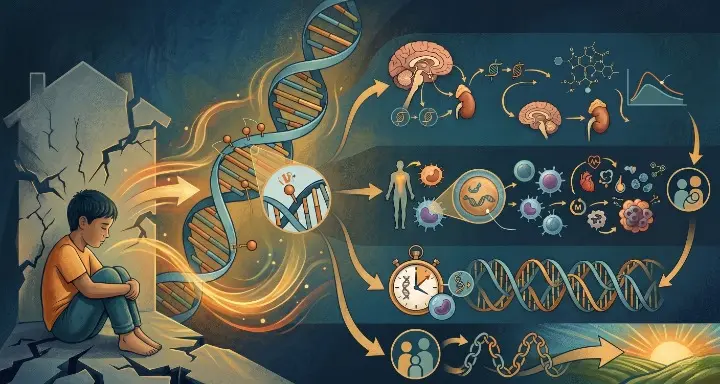
Something happened to you when you were seven years old. You don’t think about it much anymore. But your DNA remembers it perfectly.
This is not a metaphor. A growing body of epigenetic research is now able to locate the precise chemical marks that adverse childhood experiences leave on the genome, identify which genes they silence or amplify, and trace how those alterations reshape the body’s stress response, immune function, and disease risk across an entire lifetime. The precision of what science can now see in this space is genuinely new, and what it is revealing is uncomfortable.
Childhood adversity doesn’t just hurt at the time. It rewrites the instruction manual for your biology, and in many cases, that rewrite is permanent.
What DNA Methylation Actually Is
Before getting into what childhood stress does to the genome, it helps to understand the mechanism. DNA methylation is one of the primary tools the body uses to regulate which genes get expressed and which ones stay silent. The process involves attaching a small chemical group called a methyl group to specific sites on the DNA strand, usually at locations called CpG sites. Think of it as a dimmer switch on a gene. Methylation typically turns the expression down or off entirely. Demethylation turns it back up.
Under normal circumstances, this system is responsive and adaptive. The body adjusts gene expression in response to the environment, and those adjustments are sensible. The problem arises when extreme stress during a critical developmental window sets the dimmer switches to positions they were never meant to hold permanently, positions that made sense for surviving a chaotic or threatening childhood but that become liabilities in adulthood.
The Stress Axis Gets Reprogrammed
The most well-documented target of childhood adversity in the epigenome involves the hypothalamic-pituitary-adrenal axis, the system that governs the body’s cortisol response to stress. Several specific genes sit at the center of this story.
NR3C1, which encodes the glucocorticoid receptor that cortisol binds to, shows altered methylation patterns in people who experienced childhood maltreatment. A hypermethylated NR3C1 gene means fewer functional glucocorticoid receptors, which means the stress response has less ability to shut itself off once activated. The system gets stuck in a state of chronic low-grade alarm.
FKBP5, another stress-regulation gene, tells a similar story. Maltreated children show significantly altered methylation profiles at this gene compared to non-maltreated peers. FKBP5 is involved in moderating how strongly cortisol affects the body. When its regulation is disrupted through methylation changes, the downstream consequences include increased vulnerability to depression, PTSD, and anxiety disorders that can persist for decades.
A landmark genome-wide study published in Nature Communications found that methylation at a locus in the KITLG gene, involved in haematopoiesis and cortisol signaling, strongly mediated the relationship between childhood trauma and cortisol stress reactivity in adulthood, accounting for 32% of that relationship. This is not a correlation. It is a mechanistic pathway, mapped at the molecular level, connecting something that happened in childhood to a measurable biological response in the adult body.
The Immune System Pays the Bill
The reprogramming doesn’t stay confined to the stress axis. Individuals who experienced childhood adversity show differential methylation of genes involved in the immune system at the whole-genome level, with evidence pointing toward a state of chronic low-grade inflammation that begins at the cellular level and compounds over time.
This matters clinically because chronic inflammation is not a neutral background condition. It is a driver of cardiovascular disease, metabolic disorders, accelerated cellular aging, and cancer risk. When the immune system is kept in a state of perpetual readiness by an epigenetically altered threat-detection system, the cumulative physiological cost is enormous.
Research has also identified methylation changes in the BDNF gene, which encodes a protein critical for neuronal survival and plasticity, in maltreated children. BDNF is one of the primary molecular mechanisms through which the brain maintains its capacity for learning, adaptation, and recovery. Its suppression through methylation creates a brain that is physically less equipped to process new experience and regulate emotional responses, independent of any conscious psychological pattern.
The Clock Starts Running Early
A 2026 systematic review and meta-analysis published in Clinical Epigenetics examined 27 observational studies covering the relationship between cumulative adverse childhood experience exposure and epigenetic age acceleration in adults. The findings confirmed what individual studies had been suggesting: adverse childhood experiences are associated with measurable acceleration of biological aging as read by DNA methylation-based epigenetic clocks.
These clocks, including GrimAge, PhenoAge, and DunedinPoAm, estimate biological age by scanning the methylation state of hundreds of specific sites across the genome. When these clocks run ahead of chronological age, they predict increased risk of morbidity and earlier mortality. The data from this meta-analysis showed that people with high ACE exposure are biologically older than their birth certificates suggest, and that this gap appears to widen over time.
A separate analysis of 3,586 older American adults from the Health and Retirement Study found that specific patterns of adverse childhood experiences, including physical abuse, household substance use, and socioeconomic adversity, were associated with accelerated GrimAge and faster pace-of-aging scores, with effects that differed by race and sex. This level of granularity is new. We are no longer just asking whether childhood adversity ages people. We are beginning to map which specific combinations of adversity affect which biological aging signatures in which populations.
When the Damage Travels Across Generations
Perhaps the most arresting dimension of this research is what happens when it crosses generational lines. Studies on the intergenerational transmission of trauma have found DNA methylation changes in the children of Holocaust survivors and in the sperm of combat veterans with PTSD. Stress on mothers during pregnancy, particularly in women who themselves experienced childhood trauma, produces measurable hormonal and immune alterations that affect fetal development.
What this means in practice is that the epigenetic consequences of adverse childhood experiences are not necessarily contained within a single lifetime. A mother’s unprocessed childhood trauma can alter the methylation patterns of her child’s genome before that child has experienced anything at all. The ACE literature, in other words, is not just a story about individual suffering. It is a story about how biological damage propagates through time.
What This Changes About Prevention
The traditional public health framing of adverse childhood experiences treats them primarily as a psychological and social problem, one addressed through therapy, social work, and community support. Those interventions remain essential. But the epigenetic data adds a dimension that changes the urgency of the conversation.
If a childhood characterized by abuse, neglect, household dysfunction, or chronic socioeconomic stress is leaving permanent chemical annotations on the genome that alter cortisol regulation, immune function, neuroplasticity, and biological aging speed, then preventing those experiences is not just a matter of child welfare. It is a matter of long-term population health on a scale that includes cancer rates, cardiovascular disease burden, mental health prevalence, and dementia incidence decades from now.
The marks are being written right now, in households where children are living under sustained threat. And the biology has made its position very clear: the earlier the intervention, the less of the genome gets rewritten.
Sources:
Russell, H., Angus, G., Singleton, S. et al. The impact of adverse childhood experiences on DNA methylation age: a systematic review and meta-analysis. Clinical Epigenetics, 2026; 18: 33. DOI: 10.1186/s13148-025-02047-z https://link.springer.com/article/10.1186/s13148-025-02047-z
Houtepen, L.C., et al. Genome-wide DNA methylation levels and altered cortisol stress reactivity following childhood trauma in humans. Nature Communications, 2016; 7: 10967. DOI: 10.1038/ncomms10967 https://www.nature.com/articles/ncomms10967
Adverse childhood experiences patterns and biological aging in a representative sample of older Americans. Psychoneuroendocrinology, 2025. DOI: 10.1016/j.psyneuen.2025.007 https://www.sciencedirect.com/science/article/abs/pii/S0306453025004056
Epigenetic Modifications in Stress Response Genes Associated With Childhood Trauma. Frontiers in Psychiatry, 2019; 10: 583. DOI: 10.3389/fpsyt.2019.00583 https://www.ncbi.nlm.nih.gov/pmc/articles/PMC6857662/
Epigenomic embedding of childhood adversity links to disease risk and chronic inflammation. medRxiv, 2025. DOI: 10.64898/2025.12.04.25341605 https://www.medrxiv.org/content/10.64898/2025.12.04.25341605.full.pdf
Saied, A. et al. A Systematic Review of Adverse Childhood Experiences and Epigenetic Age Acceleration in Later Adult Life Measured With Second and Third-Generation Epigenetic Clocks. American Journal of Medical Genetics Part B, 2025. DOI: 10.1002/ajmg.b.33058 https://onlinelibrary.wiley.com/doi/full/10.1002/ajmg.b.33058