A major study from the Potsdam Institute, published in Nature, warns that nearly two-thirds of the Amazon rainforest could shift into a degraded, savannah-like ecosystem if global warming reaches 1.5°C to 1.9°C

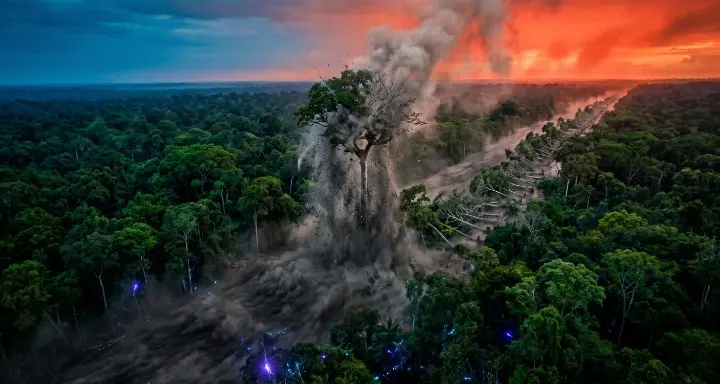
The Amazon will collapse at 1.5 degrees Celsius. For years, the scientific consensus suggested we had a comfortable cushion, a threshold of 2 to 6 degrees of global warming before the world’s largest rainforest hit a point of no return. But a massive new study published in Nature just shredded that safety net. Nico Wunderling and an international team of researchers found that when you combine rising temperatures with the current rate of deforestation, the forest doesn’t just fade away. It triggers a self-propelling collapse.
This isn’t just about losing some trees. It is about the failure of a biological machine that keeps half of South America from turning into a desert. If we hit 1.5 to 1.9 degrees of warming while allowing deforestation to reach 22 to 28 percent, the system enters a near system-wide transition. We are talking about 62 to 77 percent of the entire Amazon basin flipping from a lush carbon sink into a degraded, dry ecosystem within our lifetime.
The Invisible Water Pump
To understand why the forest is failing, you have to understand how it breathes. The Amazon isn’t just a passive recipient of rain. It creates its own weather. Each tree acts as a biological pump, pulling water from the soil and releasing it back into the sky through transpiration. This isn’t a small amount of moisture. Locally, up to 50 percent of the rain falling in the basin was generated by the forest itself.
The real surprise lies in the canopy. High-flying emergent trees contribute about 71 percent of this transpired water. When these giants are cut down or die from drought, the sky literally goes dry. As moisture recycling breaks down, the dry season stretches longer and the wet season arrives late, or not at all. This creates a feedback loop where the forest effectively starves itself of the very water it needs to survive.
The Thousand-Mile Domino
The most alarming part of Wunderling’s data is the network effect. The Amazon is a sprawling, interconnected web of moisture transport. When a patch of forest dies in the east, the wind carries less moisture to the west. This triggers a spatial knock-on effect that can travel thousands of kilometers.
The researchers found that 99 percent of the transitions in a high-deforestation scenario are caused by these cascading effects. It is a continental-scale house of cards. A local fire in one region isn’t just a local problem. It is a drought-delivery system for a forest a thousand miles downwind. These cascades are self-amplifying, meaning once the first few dominos fall, the forest starts to consume itself regardless of what happens with emissions elsewhere.
The 1.5 Degree Death Trap
Why did the safe threshold drop so drastically? Previous models often looked at global warming in isolation. They ignored the fact that humans are actively tearing at the forest’s edges while the planet heats up. When you factor in land use, the Amazon’s resilience essentially disappears.
The data shows that southern and southeastern parts of the forest are currently at the limit of their physiological capacity to handle water stress. Trees have adapted to survive dry spells with deeper roots and stored trunk moisture, but these survival strategies are being outpaced by the intensity of modern droughts. By the time global warming hits 3.7 to 4.0 degrees, even a perfectly protected Amazon loses stability across a third of its area. With current levels of deforestation, we hit that same danger zone at just 1.5 degrees.
The Cost of Silence
You might think this is a problem for remote indigenous communities or wildlife, but the fallout will hit your plate and your wallet. The moisture the Amazon generates doesn’t stay in the basin. It is exported to downwind regions including southern Brazil, Bolivia, Paraguay, and Argentina, some of the most intensive agricultural zones on the planet.
If the Amazon transitions to a degraded state, it threatens regional water security and crop yields for millions of people. The forest is also shifting from a carbon sink, something that cleans our atmosphere, into a carbon source. We are losing our best natural defense against climate change at the exact moment we need it most.
The Arc of Restoration
The researchers are blunt: we have reached the last chance for meaningful action. But the data also offers something. Just as deforestation creates a downward spiral, restoring degraded forests can act as a shield against further collapse.
Brazil’s plans for an Arc of Restoration, reclaiming 12 million hectares of forest, isn’t just an environmental gesture. It is a survival calculation. We have the tools to limit warming and halt the chainsaws. But if we keep waiting for a clearer signal, we may find that the moisture recycling network has already come apart, leaving behind a dry, silent landscape that no amount of rain can bring back.