New research shows your toddler is judging your loyalty rather than your personality

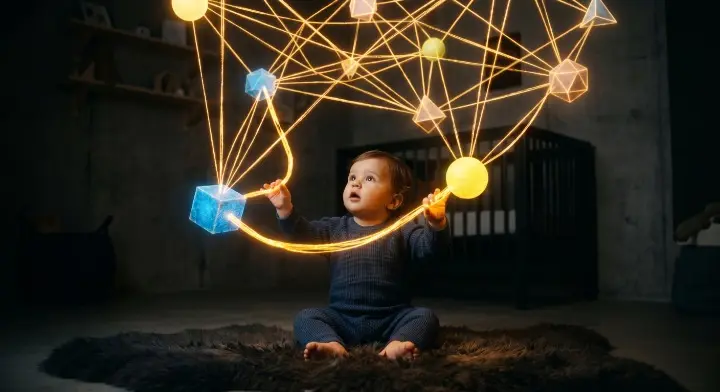
Imagine your 14-month-old watching you help a friend move a heavy box. You probably think they are absorbing a simple lesson: “helping is good”. You might imagine they are looking at you and seeing a “nice” person with a “good” heart. But you would be wrong.
New research published in PNAS suggests that your baby isn’t interested in your general moral character. They aren’t building a list of “nice” and “mean” people to play with later. Instead, they are doing something far more sophisticated: they are mapping the invisible web of your social life. They are watching who you help to figure out who you actually care about.
For decades, we’ve assumed that infants have a “moral core” that helps them distinguish between prosocial and antisocial behavior. We thought they preferred the “helper” because they inferred the helper was a morally good individual. Bill Pepe and his team at UC San Diego just flipped that script. They’ve shown that to a baby, an act of kindness isn’t a sign of a good soul—it’s a data point about a relationship.
The Lavender Cone Test
To prove this, the researchers ran a series of “violation-of-expectation” experiments with 14- and 15-month-olds. First, the babies watched a yellow, spherical character try to push a boulder up a hill. A blue character helped; a red character hindered.
If babies think the blue character is just a “nice guy,” they should expect that blue character to help anyone who needs it. But when the scene shifted and a brand-new lavender, cone-shaped character needed help, the babies didn’t care who stepped in. They didn’t expect the “helper” to be a universal samaritan.
However, when the original yellow target needed help again in a completely different scenario, the babies had very clear expectations. They looked significantly longer—indicating surprise—when the former “hinderer” suddenly decided to be helpful to that same target. The “helper” was expected to stay helpful, and the “hinderer” was expected to stay mean, but only toward that specific person.
This suggests that babies don’t see a “nice” person. They see a relationship. They think: “Blue likes Yellow,” not “Blue is good”.
The Hierarchy of the Nursery
It gets even deeper. We often think of infants as simple creatures, but Experiment 4 of this study reveals they are capable of transitive inference—the kind of “A > B and B > C, therefore A > C” logic that many adults struggle with.
The researchers showed infants a helper who had to choose between three different recipients: A, B, and C. The helper consistently prioritized B over A, and then prioritized C over B. When the helper was finally faced with a choice between A and C—a pairing the baby had never seen before—the infants knew exactly what should happen.
They looked longer when the helper chose A. Why? Because they had already mapped a “hierarchy of care”. They understood that if the helper cares about C more than B, and B more than A, then C must be the top priority. Your baby is essentially calculating your “best friend” rankings based on how much effort you’re willing to put in for different people.
Why This Changes Everything
This isn’t just an academic quirk. It changes how we understand the very foundation of human social reasoning. It suggests that our ability to represent the existence and strength of relationships is a primary tool we use to survive from the moment we can crawl.
If infants don’t attribute general “moral traits” to people, it means their early social world is much more pragmatic than we realized. They aren’t looking for saints; they are looking for reliable allies. They value loyalty and reliability within a specific partnership over a general disposition to be kind to everyone.
For you as a parent, this means your child is a much more active observer of your social dynamics than you think. They aren’t just learning “right from wrong”. They are learning who is “us” and who is “them”. They are watching how you prioritize your time and resources to understand the structure of their tribe.
The Evolutionary Cheat Code
Why would evolution give a 14-month-old the ability to map social hierarchies? Because knowing who cares for whom is a survival cheat code. If a baby knows that “Person A” cares deeply for “Person B,” they can predict an entire range of future behaviors—from who will share food to who will offer protection during a threat.
This “care” representation acts as a foundation for everything that comes later. It allows the developing mind to organize a chaotic world of social interactions into a neat, predictable map of affiliations. It turns out that before your child can even tell you they love you, they are already experts at measuring exactly how much you love everyone else.
Next time you’re at a playdate, watch your child watch the other parents. They aren’t just staring blankly. They are running a sophisticated social simulation, building a database of who matters most, and waiting to see who steps up when the boulder starts rolling back down the hill.