Researchers told 41 people to breathe differently while making risky decisions. A slow exhale physically changed which risks they were willing to take

There is a standard assumption in neuroscience about where decisions come from. The brain evaluates the options, weighs the potential gains against the losses, and arrives at a choice. The body is largely a bystander. It reacts to the decision, maybe, but it does not make it.
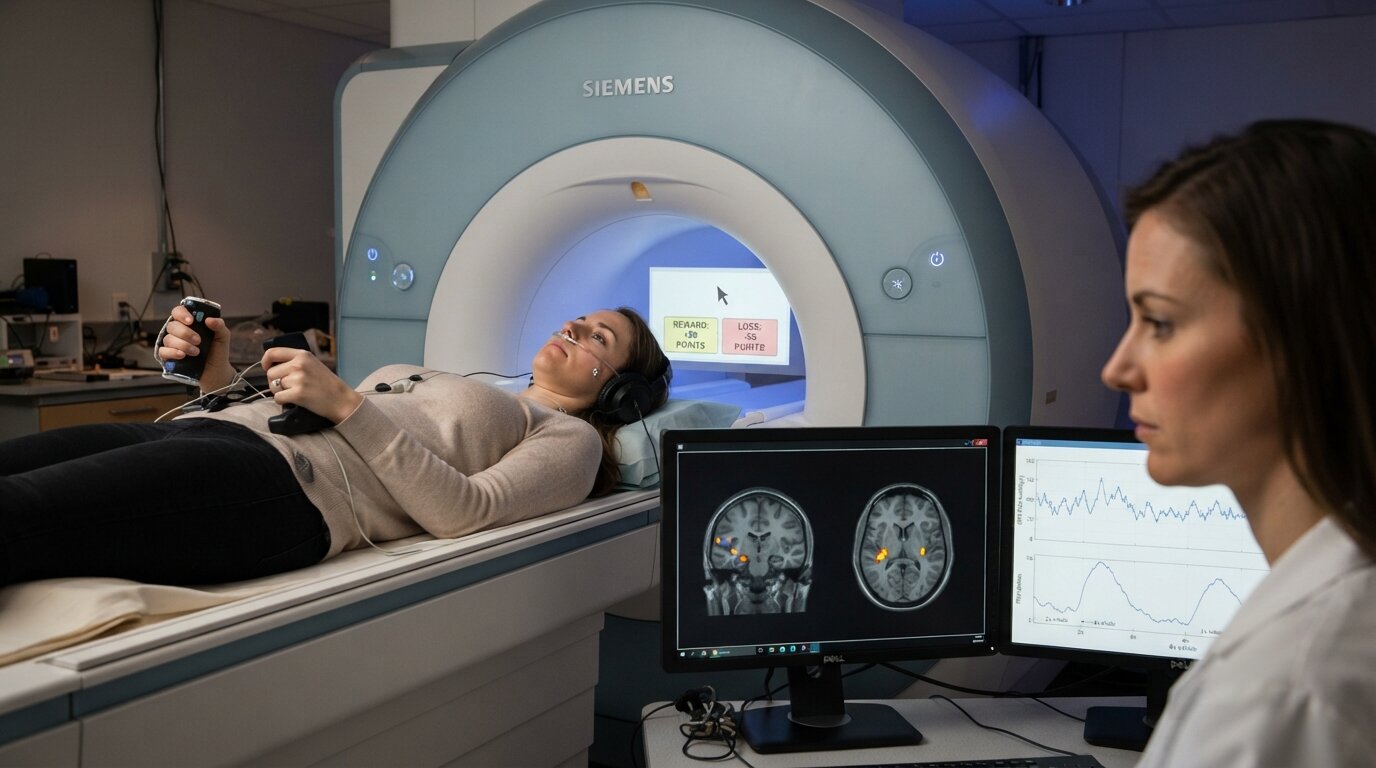
A new study published in Neuron, one of the most selective journals in brain science, has run a controlled experiment that challenges that assumption in a surprisingly direct way. Researchers recruited 41 healthy adults and put them in a brain scanner. While inside, participants were asked to make a series of financial gambles, classic risk-taking decisions. The twist was what they were told to do with their breathing.
Half of the participants breathed at their natural pace. The other half followed a specific pattern: two seconds to inhale, eight seconds to exhale. That’s it. A longer breath out. No meditation training, no relaxation techniques, no prior experience required.
The group breathing slowly took more risks. Their brains showed measurably stronger responses in the regions that evaluate reward. And the effect was not uniform. The participants whose cardiovascular systems responded most strongly to the slow breathing showed the biggest shift in how their brains processed potential gains.
The study was led by Professor Soyoung Q. Park at the German Institute of Human Nutrition Potsdam-Rehbruecke in collaboration with Charité Universitätsmedizin Berlin and published in Neuron in May 2026.
What changed in the body, and why it mattered
The researchers were not guessing about the mechanism. They were measuring it in real time. Participants in the scanner wore physiological monitoring equipment alongside the fMRI, so the team could track heart rate, heart rate variability, and brain activity simultaneously.
When people breathed with the extended exhale, their cardiac parasympathetic activity increased. This is the branch of the autonomic nervous system associated with rest and recovery, the counterpart to the fight-or-flight response. A reliable marker of this shift is heart rate variability, the variation in the intervals between heartbeats. Higher variability generally indicates the parasympathetic system is more active.
That physiological shift corresponded directly to what happened in two specific brain regions: the ventromedial prefrontal cortex and the precuneus. Both are well-established nodes in the brain’s reward evaluation network. In the slow-breathing group, these areas showed stronger activation when participants encountered potential gains in the gambling task.
The result was a measurable bias toward accepting gambles they might otherwise have declined. Importantly, the researchers found this was not recklessness. Participants did not stop registering potential losses. They became more sensitive to reward, not less sensitive to risk.
The link between body state and decision-making
The finding fits into a larger framework that has been building in neuroscience over the past decade. The brain does not operate in isolation from the body. It constantly receives signals from the heart, the gut, and the lungs, and it integrates those signals into its processing, including the processing that underlies choices.
What makes this study unusual is the causal direction. Most research on body-brain interactions is observational: people who are calm tend to make different decisions than people who are stressed, but it is difficult to isolate what is driving what. Here, the researchers assigned the breathing protocol randomly. They imposed the physiological state deliberately, then watched the brain and behavior follow.
“Our decisions are rarely determined solely by external information,” said Park, who heads the Department of Decision Neuroscience and Nutrition at the institute. “Rather, our judgment emerges from the interplay between cognitive processes and our current bodily state.”
The practical implication is striking. A breathing pattern that takes no equipment, no training, and roughly ten seconds to initiate appears to be enough to shift the brain into a state where it evaluates potential rewards more generously.
What it doesn’t tell us yet
The study has real limitations worth naming. Forty-one participants is a small sample. The task was a controlled gambling scenario, not a real-world decision under genuine stakes. Whether the same breathing pattern shifts risk tolerance when someone is negotiating a salary, deciding whether to quit a job, or making a medical choice is not something this study can answer.
The duration of the effect is also unknown. The protocol was applied during the task itself. The question of how long the effect persists after a person stops following the breathing cue was not measured.
And the study was conducted on healthy adults in a controlled lab setting. People with anxiety disorders, cardiovascular conditions, or prior trauma may respond differently to deliberate breathing manipulation.
What the study does establish clearly is the mechanism: breath into autonomic nervous system into brain reward circuitry into choice behavior. That pathway, demonstrated causally in a controlled human experiment and published in a Tier 1 journal, is itself a significant finding. It gives researchers a specific target to build on, and it gives future studies a clear question to answer: how large, how durable, and how generalizable is this effect in the real world?
The study, “Slow breathing impacts inter-organ dynamics modulating brain function and risk behavior” was authored by Wenhao Huang, Mine Schmidt, Ignacio Rebollo, Felix Molter, and colleagues, and published in Neuron.
Source: German Institute of Human Nutrition Potsdam-Rehbruecke / Charité Universitätsmedizin Berlin. DOI: 10.1016/j.neuron.2026.04.044