Scientists Warn Small Increases in Heat Can Cause Large-Scale Chaos
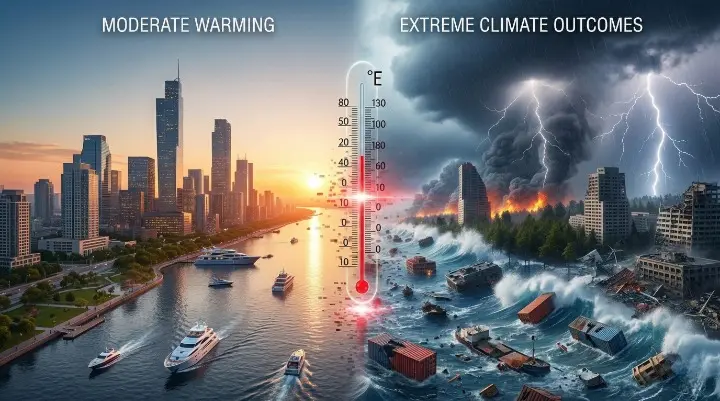
For years, the global conversation around climate change has focused on a specific set of numbers: 1.5°C and 2°C. We are told that if we stay below these “moderate” levels of warming, we might avoid the worst-case scenarios. However, a sobering new study published in Nature reveals a terrifying catch. Even if we succeed in keeping global temperatures within these moderate limits, the “math of extremes” means we could still face devastating climate outcomes that look like a Hollywood disaster movie.
The research highlights a critical flaw in how we think about the future: we focus too much on the average and not enough on the outliers.
The “Bowl of Soup” Effect
To understand this, imagine a bowl of soup. If you heat it up “moderately,” the average temperature of the liquid is warm but safe to touch. However, due to the way heat moves (convection), tiny pockets of that soup can suddenly bubble up and become scalding hot.
The Earth’s climate works in a similar, but much more complex, way. While the global average might only rise by 1.5 degrees, the internal “gears” of the planet—like ocean currents, polar ice sheets, and jet streams—don’t react in a straight line. The study shows that “moderate” warming can push these systems past invisible tipping points. Once a tipping point is crossed, it can trigger extreme weather events, massive sea-level rises, or total ecosystem collapses that are far more severe than the “moderate” average temperature would suggest.
This isn’t just a warning for scientists; it changes how every one of us needs to prepare for the coming decades.
-
Redefining “Safe”: We can no longer assume that hitting our climate targets means we are “safe.” City planners, insurance companies, and governments need to build infrastructure not just for a “warmer world,” but for a “wilder world” where extreme floods or droughts can happen even when the thermometer looks stable.
-
The Risk of Tipping Points: The study emphasizes that some parts of our planet—like the Amazon rainforest or the West Antarctic Ice Sheet—are fragile. Even a small nudge can cause them to collapse. If the Amazon turns into a dry savanna, it releases massive amounts of carbon, creating a “feedback loop” that could accelerate warming beyond our control.
-
Investing in Resilience: Since “moderate” warming doesn’t rule out “extreme” outcomes, we need to focus as much on adaptation as we do on prevention. This means building sea walls, developing drought-resistant crops, and creating emergency systems that can handle “once-in-a-thousand-year” storms that might now happen every decade.
The takeaway from this research is clear: there is no “safe” amount of global warming. The 1.5°C goal is a vital shield, but it isn’t a magic wand. The climate is a chaotic system, and the more energy (heat) we pump into it, the more unpredictable it becomes.
However, there is a silver lining. By understanding that extreme outcomes are possible even at moderate levels, we can stop being surprised by “unprecedented” disasters and start building a world that is truly resilient. We aren’t just fighting to keep a number on a thermometer down; we are fighting to keep the complex, delicate balance of our planet from tipping into chaos.