Scientists Uncover the Microscopic Switch That Feels the Cold
We’ve all felt it—that sharp, stinging bite of a winter wind or the shock of jumping into an icy lake. But for decades, the actual “hardware” inside our bodies that detects these temperatures was a blurry mystery. We knew we had sensors, but we didn’t know how they actually moved or changed shape to send a “COLD!” signal to the brain.
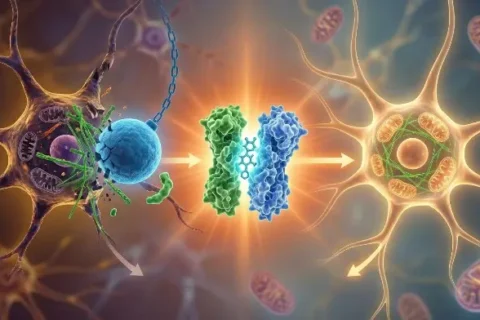
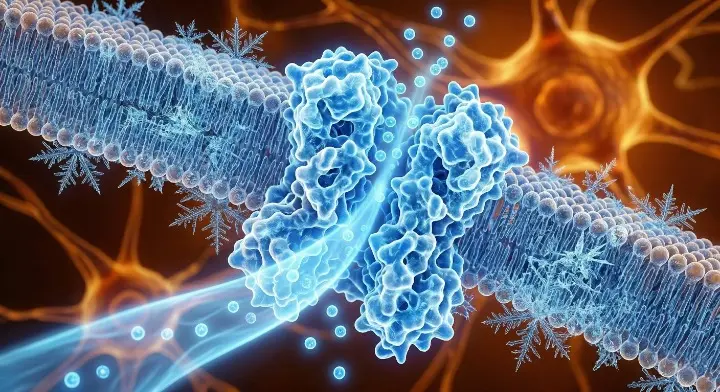
This new study has used ultra-powerful microscopes to look at a protein called TRPM8. Think of TRPM8 as a microscopic gatekeeper living on the surface of your nerve cells. When it’s warm, the gate is locked shut. But as the temperature drops, the protein physically twists and shifts its energy state, swinging the gate open and allowing a flood of signals to rush to your brain.
The “Cold Energy” Breakthrough What makes this research so special isn’t just seeing the protein, but understanding the energetics—the hidden forces that push the gate open. The team discovered that TRPM8 is incredibly sensitive; it doesn’t just react to “cold,” it calculates the exact level of thermal energy in its environment. It’s a biological computer made of atoms, fine-tuned over millions of years of evolution to keep us alive.
How This Changes People’s Lives This isn’t just about understanding why we reach for a coat. Mapping the structure of our cold sensors has massive implications for human health:
-
Revolutionary Pain Management: Many people suffer from “cold allodynia”—a condition where even a light, cool breeze feels like a burning, agonizing pain (often seen in cancer patients undergoing chemotherapy or people with nerve damage). Now that we have the “blueprint” of the sensor, scientists can design high-precision drugs to “tweak” the gate, muffling the pain without numbing the rest of the body.
-
Targeting Chronic Inflammation: Our temperature sensors are closely linked to how our bodies handle inflammation. By understanding how to control these gates, we could potentially develop new treatments for inflammatory diseases that don’t rely on traditional, heavy-duty steroids.
-
New Frontiers in Longevity: Temperature regulation is a core part of how our metabolism works. Understanding the energetics of these sensors might lead to ways to “trick” the body’s metabolism into burning more energy or protecting vital organs during extreme stress.
For the first time, we aren’t just feeling the cold—we are seeing it. By mastering the structural energetics of our internal thermometers, we are moving toward a future where “the cold” is no longer something we just endure, but something we can medically manage and understand at the deepest level of our biology.