Scientists found your gut remembers past illness and uses those memories to fuel future cancer
Imagine you’ve just recovered from a brutal, weeks-long bout of food poisoning or a flare-up of ulcerative colitis. The cramps have vanished. Your appetite is back. To any doctor—and to your own bathroom mirror—you look entirely healed. But deep inside the lining of your colon, a silent ledger is being kept. Your cells aren’t just recovering; they are taking notes. And those notes might eventually become a death warrant.
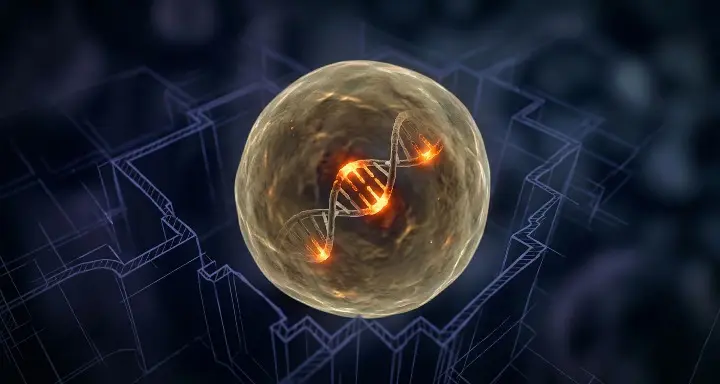
New research published in Nature has uncovered a phenomenon known as “epigenetic memory.” It turns out that when your gut is under siege from inflammation, your intestinal stem cells don’t just react to the fire; they physically remodel their architecture to remember it. Even after the inflammation is gone, these cells remain “open” in all the wrong places, like a door left slightly ajar for an intruder. That intruder is cancer.
The study, led by scientists at the Broad Institute of MIT and Harvard, used a sophisticated new tracking tool called SHARE-TRACE to watch this process in real-time. They found that chronic inflammation leaves behind molecular “scars.” These aren’t mutations in the traditional sense—your DNA sequence remains the same—but the access to that DNA changes. Specifically, a group of proteins called AP-1 transcription factors become hyperactive. They park themselves on the DNA and refuse to leave, keeping the cell in a permanent state of “emergency repair.”
Think of your stem cells as the master architects of your gut. Every few days, they give birth to a fresh lining for your intestines. If the architect is traumatized by a past disaster, every new building they design will be slightly skewed. The researchers discovered that these traumatized stem cells pass their “inflammatory memory” down to every daughter cell they produce for months—perhaps even years—after the original illness has passed.
Why does this matter to you? Because of the “one-two punch.”
On its own, this cellular memory doesn’t cause cancer. You can walk around with these molecular scars and feel perfectly fine. However, the study showed that if a random, cancer-promoting mutation occurs later in life, these “primed” cells explode into action. In mice that had recovered from colitis, tumors grew significantly faster and larger than in mice with “clean” memories. The old inflammation didn’t cause the first spark, but it provided a massive pile of dry kindling just waiting for a match.
“We have known for some time that colitis can accelerate tumor growth,” says Jason Buenrostro, one of the study’s lead authors. “But here we show that the effect of chronic inflammation remains well after animals have recuperated.”
This discovery shifts how we think about “pre-cancer.” Usually, we look for polyps or visible growths. But this research suggests that the danger begins at a level we currently don’t test for. The risk is hidden in the very way your cells package their DNA.
The good news? This isn’t necessarily a life sentence. When the researchers blocked the activity of those AP-1 proteins, the pro-cancer effect of the old inflammation vanished. The “memory” was essentially wiped clean.
This opens a door to a future where we don’t just treat the symptoms of gut inflammation, but we actively “defrag” the cellular memory it leaves behind. It suggests that if you have a history of digestive issues, your future checkups might involve more than just a colonoscopy. One day, a simple biopsy might look for these AP-1 scars, allowing doctors to identify—and perhaps erase—your cancer risk before a single tumor ever has the chance to form.
For now, the takeaway is clear: healing isn’t just about the absence of pain. Your body is a biological archive, and the best way to prevent a dark future is to pay very close attention to the fires of the past.