Scientists Discover a Radiation-Free Cavity Between Earth and the Moon
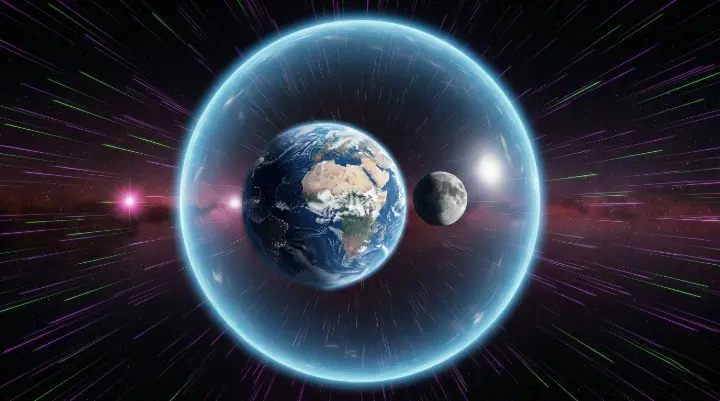
For decades, we’ve looked at the space between the Earth and the Moon as a dangerous, empty void filled with “Galactic Cosmic Rays”—invisible, high-energy particles from exploding stars that can shred DNA and fry electronics. But new research published in Science Advances has revealed something startling: we aren’t just sitting ducks. It turns out that Earth and the Moon reside inside a massive, naturally occurring “cavity” that acts as a protective shield against the full fury of deep space.
The “Eye of the Storm” in Space
Imagine standing in a heavy rainstorm while holding a large umbrella. While the rain is falling everywhere, there is a dry “cavity” directly beneath the umbrella. According to the study, the complex interaction between the Sun’s solar wind and the magnetic fields of our planet creates a similar effect.
This isn’t a solid wall, but rather a “galactic cosmic ray cavity”—a region where the concentration of dangerous radiation is significantly lower than in the rest of the galaxy. It’s as if Earth and the Moon are tucked away in a cosmic basement, sheltered from the radioactive wind blowing through the Milky Way.
This isn’t just a cool fact for astronomers; it has life-or-death implications for our future as a space-faring species.
-
Safer Moon Bases: As NASA and private companies prepare to build permanent bases on the Moon (the Artemis missions), radiation is the #1 hurdle. Knowing exactly where this “cavity” is—and how it fluctuates—allows us to place habitats in the safest possible zones, potentially reducing the heavy (and expensive) shielding currently required.
-
The Bridge to Mars: To get to Mars, we have to leave this protective bubble. By studying this cavity, scientists can better predict when “radiation weather” is at its calmest, helping us time long-distance launches to minimize the health risks to astronauts.
-
Protecting Our Tech: Every satellite and GPS system we rely on is vulnerable to cosmic rays. Understanding this cavity helps engineers design satellites that last longer because they aren’t being bombarded as heavily as we previously assumed.
This discovery adds a new layer to why Earth is so perfectly suited for life. Not only do we have an atmosphere and a magnetic field, but our very position in the Earth-Moon system provides an extra layer of “galactic insulation.”
As we look toward the stars, we are finding that the “void” of space is far more complex than we thought. We aren’t just floating in a vacuum; we are nestled inside a protective pocket of physics that has likely been guarding life on Earth for billions of years.