New Study Reveals How Your Gut Wirelessly Rewires Your Behavior
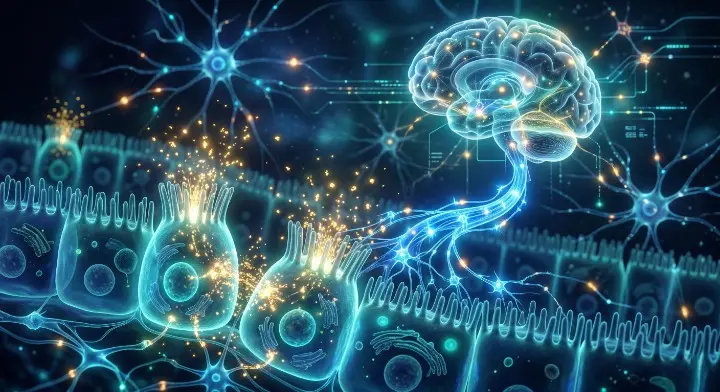
Have you ever wondered why, the moment you catch a stomach bug or a parasite, the very thought of food becomes repulsing? For decades, doctors assumed this “sickness behavior”—the loss of appetite, the nausea, and the lethargy—was just a general side effect of your body being tired from fighting an intruder. But a groundbreaking new study published in Nature has revealed a much more sophisticated “molecular logic.”
It turns out your gut isn’t just a digestive tube; it’s a highly intelligent sensory organ that “talks” directly to your brain using a complex relay system.
The Two Secret Messengers
The research, led by teams at UC San Francisco and Adelaide University, focused on two rare types of cells in our intestinal lining: Tuft cells and Enterochromaffin (EC) cells.
Think of Tuft cells as the “scouts.” They have tiny, brush-like structures that “taste” the environment of your gut. When a parasite enters, these scouts detect specific chemicals the worms leave behind. But Tuft cells don’t have a direct line to the brain. To get the message across, they have to talk to their neighbors, the EC cells.
EC cells are the gut’s “broadcasters.” They hold 90% of your body’s serotonin—the same chemical often associated with mood in the brain, but which acts as a powerful signaling tool in the gut.
The “Two-Phase” Alarm System
The study discovered that this communication happens in two distinct stages, which explains why you might feel fine at first but then suddenly “crash” a few days into an infection:
-
Phase One (The Warning): When parasites first arrive, Tuft cells release short bursts of a chemical called acetylcholine. It’s like a quick “heads up.” At this stage, you might not feel any symptoms yet.
-
Phase Two (The Lockdown): As the infection grows, your immune system creates more Tuft cells. This army of cells begins a sustained, “leaky” release of acetylcholine. This constant signal hits the EC cells hard, causing them to dump massive amounts of serotonin.
This flood of serotonin isn’t for “happiness”—it’s a distress signal. It activates the Vagus nerve, the high-speed data cable connecting your gut to your brainstem. Once that signal hits the brain, it flips a switch: Appetite: OFF. Nausea: ON.
This discovery is much bigger than just understanding parasites. It provides a blueprint for how our gut controls our brain in ways we never realized.
-
Treating Eating Disorders & Obesity: By understanding the “off switch” for hunger, scientists might develop new ways to help people struggling with overeating or, conversely, help cancer and AIDS patients regain the appetite they’ve lost due to chronic inflammation.
-
Solving IBS and Food Intolerances: Many people suffer from “functional” gut issues where they feel nauseous or bloated despite no visible infection. This study suggests that the Tuft-EC cell “cross-talk” might be stuck in the “on” position, sending false danger signals to the brain.
-
A New Way to Fight Nausea: Instead of general anti-nausea meds that affect the whole body, we could create targeted treatments that stop this specific “conversation” in the gut before the signal ever reaches the brain.
Why would our body want us to stop eating? Scientists believe this is an ancient survival tactic. By shutting down your appetite, your body denies the parasites the nutrients they need to multiply. It forces you to rest and diverts all your energy away from digestion and toward your immune system.
Your gut isn’t just digesting your lunch; it is actively monitoring your internal world and whispering instructions to your brain to keep you safe. We are finally learning how to listen in on that conversation.