New Study Explains Why Your Brain Can Recognize a Familiar Face in a Sea of Strangers
Have you ever wondered how you can walk through a crowded airport and instantly spot a friend’s face among thousands of strangers? For a long time, we thought the brain processed these images step-by-step, like a computer slowly loading a large file. But new research has revealed that the brain has a much more spectacular trick: it can “switch” its entire internal code almost instantly.
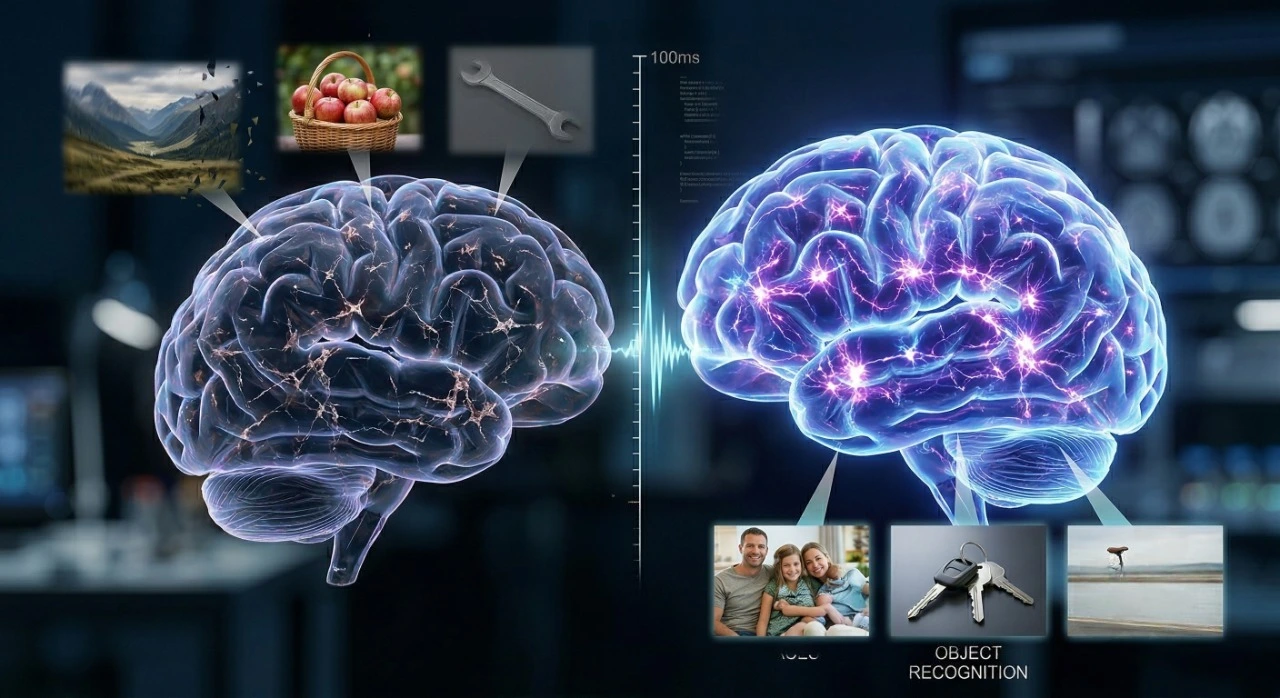
The study focused on a region called the inferotemporal (IT) cortex, which is essentially the brain’s “Object Recognition Headquarters.” Researchers found that the neurons in this area don’t just react to what you are looking at; they work together in a “concerted switch.”
The Neural “Light Switch”
Imagine your brain is a giant theater. Until now, we thought that to change the scene on stage, we had to move every piece of furniture one by one. This study shows that the brain actually uses a “master switch.” In less than 100 milliseconds, the entire neural population can flip from one state to another.
One moment, your brain is coded to recognize “landscapes,” and the next millisecond—without any lag—it has completely reconfigured its internal electrical patterns to recognize “faces” or “tools.” It is a rapid, collective transition that allows us to navigate a fast-moving, complex world without getting overwhelmed.
This isn’t just about understanding the biology of sight; it has massive implications for technology and health:
-
Revolutionary AI and Vision: Current Artificial Intelligence (like self-driving cars) can be slow or easily confused by “noise” in the environment. By mimicking this “rapid switching” method, we could build AI that recognizes hazards instantly, making autonomous travel much safer.
-
Treating Vision Disorders: For people with “face blindness” (prosopagnosia) or other visual processing disorders, we now know exactly where and how fast the breakdown is happening. This opens the door to brain-stimulation therapies that could help “flip the switch” for those whose brains are stuck in one mode.
-
Human-Computer Interfaces: This discovery could lead to faster “mind-controlled” devices. If a computer can detect this rapid switch in your neural code, it could react to your intent before you even realize you’ve made a decision.
Ultimately, this research proves that the human brain is the most efficient processor on the planet. While we often feel “scatterbrained” or overwhelmed, our neurons are actually performing a high-speed ballet, coordinating thousands of signals at once to ensure we never miss a beat. Understanding this “master switch” brings us one step closer to unlocking the full potential of human perception—and perhaps even enhancing it.