New Study Explains the Mysterious Link Between Tumors and Psychosis
Imagine your immune system is an elite security team. For your entire life, some members of this team have been carrying around a “wanted” poster for a specific target—a protein called the NMDA receptor. Usually, this protein lives safely inside your brain, protected behind a high-security wall called the blood-brain barrier. Because the security team can’t see the brain, they stay quiet. They are “germline-encoded,” meaning you were born with the potential to create them, but they remain dormant.
However, a new study has revealed what happens when a “traitor” appears outside the wall. In certain aggressive cancers, like triple-negative breast cancer, the tumor cells start producing these brain proteins (NMDA receptors) on their surface.
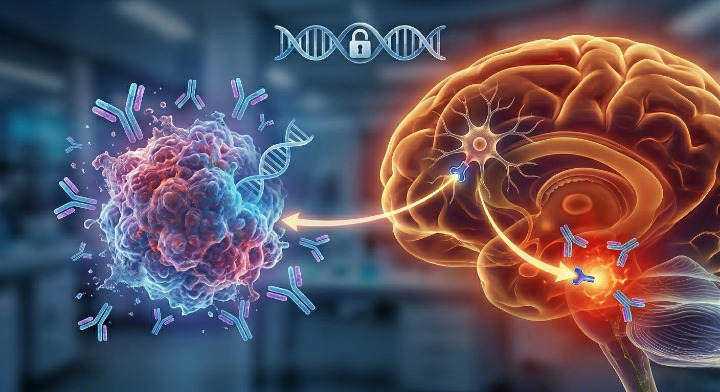
When the immune system spots these proteins on a tumor, it sounds the alarm. It takes those dormant “wanted” posters and starts mass-producing elite, high-powered antibodies to destroy the cancer. This is actually good news for the cancer fight—the study found that patients whose immune systems launched this attack often had better survival rates. Their bodies were effectively “winning” the war against the tumor.
The “Brain on Fire” Connection
The tragedy occurs when these newly “trained” elite antibodies realize that the same protein they just destroyed on the tumor also exists inside the brain. They manage to cross the barrier and begin attacking the patient’s own neurons.
This leads to a terrifying condition called Anti-NMDA Receptor Encephalitis, often referred to as “Brain on Fire.” Patients who were otherwise recovering from cancer may suddenly experience severe psychosis, seizures, memory loss, and insomnia. For decades, doctors treated this as a mysterious, separate autoimmune disease. Now we know: it’s often “friendly fire” from a successful cancer defense.
How This Changes People’s Lives
This discovery is bittersweet but incredibly hopeful for the future of medicine:
-
Earlier Cancer Detection: If a patient suddenly develops “Brain on Fire” symptoms or high levels of these specific antibodies, doctors can now look for a hidden, tiny tumor that hasn’t been found yet. The autoimmune disease becomes a “warning light” for cancer.
-
Safer Immunotherapies: Modern cancer treatments often “unleash” the immune system. This research warns doctors that in some patients, revving up the immune system might accidentally trigger a brain attack. We can now screen patients to see who is at risk before the treatment starts.
-
New Precision Drugs: By using advanced technology like cryo-electron microscopy, the researchers saw exactly how these antibodies “grab” the brain receptors. They found that some antibodies activate the receptor while others shut it down. This means we could potentially design “shield” drugs that protect the brain while still letting the immune system kill the cancer.
Ultimately, this research proves that our bodies are more connected than we ever imagined. The battle for the breast or the lungs isn’t isolated—it’s a conversation happening across the entire body. By understanding this “mechanistic trade-off,” scientists are moving closer to a world where we can defeat cancer without the mind becoming a casualty of war.