A Breakthrough in Reversing the Damage of Alzheimer’s
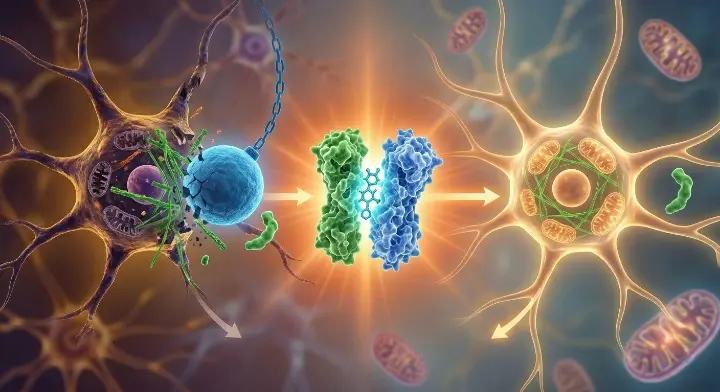
Imagine the neurons in your brain are like high-tech factories. To run, these factories need power, which is provided by tiny internal engines called mitochondria. In a healthy brain, these engines hum along perfectly. But in diseases like Alzheimer’s, something goes wrong. A “rogue” enzyme called calpain-2 starts acting like a wrecking ball, breaking down the factory’s structure and destroying the power-generating mitochondria.
For years, scientists have tried to stop this “wrecking ball.” But there was a problem: calpain-2 is also needed for healthy brain functions. If you block it entirely, you cause other side effects. Now, researchers have found a much smarter solution—a “molecular stabilizer.”
The Natural Bodyguard Our bodies already have a natural “bodyguard” for these enzymes, a protein called calpastatin. Its job is to hold the wrecking ball (calpain-2) in place so it doesn’t cause damage. However, in diseased brains, this bodyguard becomes weak and lets go.
The researchers discovered a “small molecule”—essentially a tiny piece of chemical glue—that slides between the bodyguard and the wrecking ball. This molecule reinforces their bond, locking the enzyme in a safe, stable position.
Saving the Engines By stabilizing this complex, the researchers saw something incredible happen in their models: the mitochondria (the cell’s engines) stopped breaking down. When the engines stayed healthy, the brain cells didn’t just survive—they started functioning better. This approach doesn’t just clear away “trash” (like the plaques often discussed in Alzheimer’s research); it actually repairs the cell’s ability to produce energy and stay alive.
How This Changes People’s Lives This discovery marks a shift from “symptom management” to “structural repair”:
-
A Multi-Disease Solution: Because mitochondrial decay and calpain-2 overactivity are common in Alzheimer’s, Parkinson’s, and even traumatic brain injuries, this one “molecular glue” could potentially treat several different types of brain damage.
-
Fewer Side Effects: Unlike older drugs that tried to “kill” enzymes, this stabilizer only works where the bodyguard is already failing. This means it is much less likely to interfere with the healthy parts of the brain.
-
Restoring Memory and Function: By keeping the “power plants” of the brain running, this treatment aims to keep neurons communicating. For patients, this could mean not just slowing down memory loss, but preserving their personality and independence for much longer.
The future of brain health may not lie in massive, heavy-duty drugs, but in these tiny, precision “glues” that help our cells’ own natural defenses hold everything together. We are moving from a world where we watch the brain’s factories crumble to a world where we can reinforce them from the inside out.