A New Study Proves Brain Network Decline is Universal Across Species

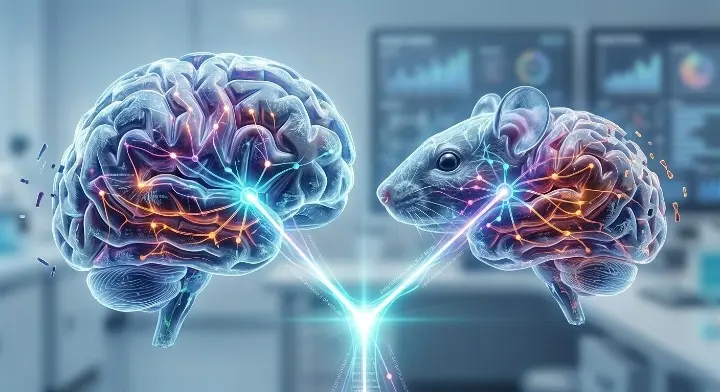
For decades, skeptics have asked: “How much can a tiny mouse really tell us about the complex human brain?” It’s a fair question. Humans write symphonies and solve equations; mice look for cheese. However, a groundbreaking study has just proven that at the deepest levels of brain architecture, we are aging in almost identical ways.
By using advanced functional MRI (fMRI) technology to look at “large-scale functional networks”—the long-distance communication lines that link different parts of the brain—researchers found that the “static” or “noise” that develops as we get older follows a remarkably consistent pattern across species.
The “Highways” of the Brain
Think of the brain not as a collection of parts, but as a busy transportation network. In a young brain, the highways are clear, and signals move swiftly from the front to the back. As we age, these “highways” start to deteriorate. Information gets lost, and regions that used to work together perfectly begin to drift apart.
The study found that in both mice and humans, the most significant decline happens in the Default Mode Network (DMN)—the part of the brain active when we are daydreaming or reflecting—and the Sensorimotor networks. The fact that these specific networks break down in the same order and at the same relative pace in a mouse as they do in a human suggests that brain aging isn’t just “wear and tear.” It is a hard-wired biological program.
This discovery is a massive win for the future of medicine and longevity:
-
Accelerated Drug Testing: Because we now know that mouse brain networks decline just like human ones, we can test anti-aging “senolytic” drugs or memory enhancers on mice with much higher confidence. If a drug “clears the highway” in a mouse’s brain network, there is now a scientifically proven reason to believe it will do the same for a human.
-
Early Warning Systems: By identifying the “first highway to fail” in the mouse-human map, doctors can develop better screening tests. We might be able to detect the very first signs of network decline in a person’s 40s or 50s, decades before symptoms like forgetfulness actually appear.
-
Personalized Aging Strategies: Understanding that certain networks are more “vulnerable” to time allows us to focus on specific interventions—like targeted cognitive exercises or non-invasive brain stimulation—to reinforce those specific highways before they break down.
This research tells us that aging is not a “human problem”—it is a biological process we share with the rest of the mammal kingdom. By studying the mouse, we aren’t just looking at a simple animal; we are looking into a “fast-forward” mirror of our own future. This shared map gives scientists a clearer path than ever before to find the “off-switch” for cognitive decline, promising a future where our brains stay as sharp as our memories, regardless of our age.