Scientists Discover Where Supernova Energy Actually Goes

Imagine a city so crowded and energetic that the heat from its residents literally blows the roof off the buildings. In the universe, “starburst” galaxies are that city. These are galaxies where stars are being born at a frantic pace—hundreds of times faster than in our own Milky Way. But where there is a lot of birth, there is also a lot of death. Massive stars in these regions live fast and die young, ending their lives in spectacular explosions called supernovae.
For decades, astronomers have watched “galactic winds”—colossal plumes of gas—shouting out of these galaxies and into the void of space. They knew these winds were fast and powerful, but they couldn’t agree on what was pushing them. Was it cosmic rays? Magnetic fields? Or just the raw heat of the explosions?
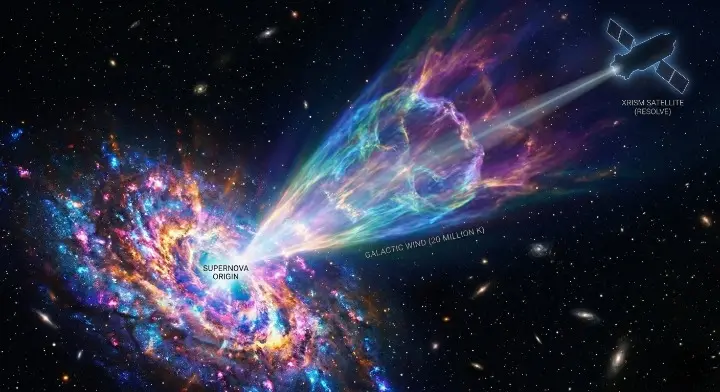
Thanks to the new XRISM (X-ray Imaging and Spectroscopy Mission) satellite, we finally have the answer: It is the heat.
The 20-Million-Degree Mystery Using the ultra-sensitive “Resolve” instrument, scientists looked deep into the heart of the galaxy M82. They found that the gas there isn’t just hot—it’s screaming. The temperature of this “hot wind” is a staggering 20 million degrees Kelvin.
Even more importantly, they measured the energy of this wind and realized it matches up perfectly with the energy released by the supernovae happening nearby. Specifically, about 60% of all the energy from those massive star explosions is instantly converted into heat that inflates the galaxy like a hot air balloon until it “pops,” sending a super-heated wind flying out at nearly 600 kilometers per second.
How This Changes Our Understanding of the Universe This discovery is like finding the “missing receipt” for a galaxy’s energy budget. It changes how we see the evolution of everything:
-
Regulating Star Birth: These winds are so powerful that they blow away the very gas and dust needed to make new stars. It’s a self-regulating system: the more stars a galaxy makes, the more it “exhales,” eventually stopping itself from growing too fast. This explains why galaxies don’t just keep growing forever.
-
Seeding the Deep Space: These winds don’t just carry heat; they carry the “heavy elements” (like iron, oxygen, and carbon) forged inside stars. By blowing these elements out into the intergalactic void, starburst winds act as a cosmic delivery service, spreading the building blocks of planets and life across the universe.
-
Simpler Space Models: Scientists used to think they needed complex theories involving “cosmic rays” to explain these winds. Now we know that simple thermal pressure—the same force that makes a tea kettle whistle—is enough to power a galaxy-scale storm.
The Practical Use for Humanity While we won’t be “using” galactic winds to power our homes anytime soon, this research is a triumph for technology. The XRISM satellite uses sensors cooled to almost absolute zero to detect the hottest things in the universe. This same technology—high-precision X-ray sensing—has spin-off applications in medical imaging, materials science, and security.
Most importantly, it helps us understand our own origin story. Every atom of oxygen you breathe and every bit of iron in your blood was likely once part of a “starburst wind” that traveled millions of light-years before settling into the cloud of dust that became our Earth. We are, quite literally, the cooled-down remnants of a galactic exhale.